

What is TEFCA (Trusted Exchange Framework and Common Agreement)?
The Trusted Exchange Framework and Common Agreement (TEFCA) is a federal initiative designed to establish a single, nationwide framework for health information exchange in the United States. TEFCA sets common rules, technical expectations, and governance structures to enable secure and standardized data exchange across healthcare networks.
TEFCA was developed to address fragmentation in health information exchange, where data sharing often occurs through disconnected regional or vendor-specific networks. Rather than replacing existing exchanges, TEFCA provides a common “rules of the road” that allows these networks to connect with one another under shared trust principles.
Importantly, TEFCA is not a payment program and not a technology platform. It is a policy and governance framework overseen by ONC that defines how organizations participate in large-scale, trusted data exchange across the healthcare ecosystem.
Key Components of TEFCA
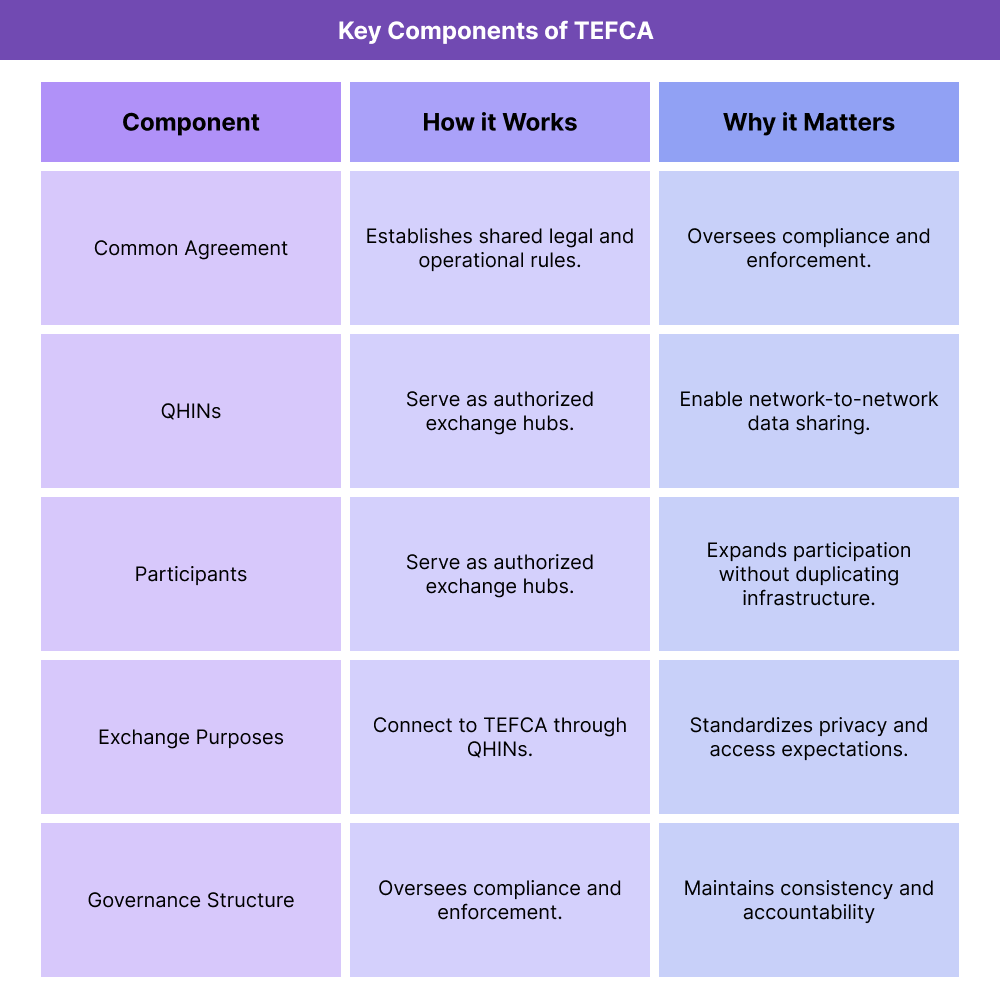
TEFCA is structured around defined roles, agreements, and exchange purposes that together enable nationwide interoperability.
The Common Agreement
At the center of TEFCA is the Common Agreement, a legal and operational framework that participating entities must sign. The Common Agreement establishes standardized terms for data exchange, privacy, security, and accountability.
This agreement allows organizations to exchange data with confidence that all participants are operating under the same expectations.
Qualified Health Information Networks (QHINs)
TEFCA introduces the concept of Qualified Health Information Networks (QHINs). QHINs are organizations that meet specific technical and governance requirements and are authorized to facilitate exchange under TEFCA.
QHINs act as the backbone of the TEFCA ecosystem, connecting participants and enabling data exchange across networks rather than within isolated silos.
Participants and Subparticipants
Organizations do not all connect directly as QHINs. Instead, TEFCA allows for Participants and Subparticipants, which connect through a QHIN.
This structure enables a wide range of entities—providers, health systems, payers, public health organizations, and vendors—to participate without each needing to meet QHIN-level requirements.
Standardized Exchange Purposes
TEFCA defines approved exchange purposes, such as treatment, payment, healthcare operations, public health, and individual access services. These purposes determine when and how data may be shared.
Standardizing exchange purposes helps reduce ambiguity and supports consistent application of privacy and access rules across organizations.
Governance and Oversight
TEFCA includes centralized governance and oversight mechanisms to ensure compliance with the Common Agreement. This governance structure supports dispute resolution, enforcement, and ongoing updates as exchange needs evolve.
How TEFCA Works in Practice
In practice, TEFCA functions as a network-of-networks model for health information exchange. Rather than forcing organizations to abandon existing exchange relationships, TEFCA creates a common trust and governance layer that allows those networks to interoperate at a national scale.
Most providers and vendors will not “use TEFCA” directly in daily workflows, but they will experience its impact through how data becomes accessible across systems.
Step 1: QHINs Establish TEFCA-Compliant Exchange Networks
Organizations designated as Qualified Health Information Networks (QHINs) implement the technical, legal, and governance requirements of the Common Agreement. These QHINs serve as exchange hubs that can connect to one another.
This step enables cross-network connectivity that previously required custom agreements or point-to-point connections.
Step 2: Participants Connect Through a QHIN
Providers, health systems, payers, public health agencies, and vendors participate in TEFCA by connecting through a QHIN as Participants or Subparticipants.
Operationally, this allows organizations to access data from outside their traditional exchange networks without negotiating separate agreements for each connection.
Step 3: Data Is Requested and Shared for Approved Purposes
When data is exchanged under TEFCA, it must align with approved exchange purposes, such as treatment, payment, healthcare operations, public health reporting, or individual access.
Requests and responses follow standardized expectations, reducing ambiguity about when data can be shared and under what conditions.
Step 4: Privacy, Security, and Consent Rules Are Applied
TEFCA enforces consistent privacy and security expectations across participating networks. Organizations must apply appropriate access controls, authentication, and consent logic as defined by the Common Agreement.
This consistency is designed to reduce variation that previously limited trust between networks.
Step 5: Governance, Monitoring, and Dispute Resolution
TEFCA includes centralized governance processes to address compliance issues, disputes, and operational challenges. This oversight helps ensure that participants adhere to the Common Agreement and that exchange remains reliable over time.
TEFCA in Billing, Reimbursement, and System Limitations
Although TEFCA is not a payment program, it has indirect but meaningful implications for billing, reimbursement, and operational efficiency.
How TEFCA Supports Billing and Administrative Workflows
By improving access to patient records across organizations, TEFCA can reduce gaps in documentation that affect billing and claims support. More complete data supports:
- Verification of prior services and diagnoses
- Reduced duplication of tests or procedures
- Better context for coding and medical necessity
These improvements can help reduce denials and rework, especially in complex or transitional care scenarios.
TEFCA and Operational Constraints
Despite its promise, TEFCA does not eliminate all exchange challenges. Limitations include:
- Dependence on QHIN readiness and participation
- Variability in data quality across source systems
- Organizational readiness to consume exchanged data
- Ongoing governance and compliance requirements
TEFCA improves connectivity, but operational workflows still require thoughtful design.
How TEFCA Influences Quality, Access, and Equity in Healthcare
TEFCA’s broader goal is to support system-wide improvements in care delivery and data access.
TEFCA and Quality of Care
More complete and timely access to patient information supports better clinical decision-making and care coordination. This is particularly valuable for patients who receive care across multiple organizations or regions.
TEFCA and Access to Care
By reducing information silos, TEFCA can improve access during referrals, transitions of care, and emergency situations. Providers are less reliant on manual record requests that delay care.
Equity Considerations Under TEFCA
TEFCA has the potential to reduce disparities by improving data access for patients who move between care settings. However, uneven participation or technical readiness can limit these benefits.
Equity-aware implementation focuses on ensuring that smaller and resource-limited organizations can participate meaningfully in exchange networks.
Frequently Asked Questions about TEFCA
1. What is TEFCA in healthcare?
TEFCA (Trusted Exchange Framework and Common Agreement) is a federal framework designed to enable nationwide health information exchange by establishing common rules, governance, and trust across exchange networks.
2. Is TEFCA a technology platform or a payer program?
No. TEFCA is a policy and governance framework, not a software platform or reimbursement program.
3. Are APIs required by healthcare regulations?
Many federal interoperability initiatives assume or require API-based data access, particularly for patient access and data exchange.
3. What is a QHIN under TEFCA?
A Qualified Health Information Network (QHIN) is an organization authorized to facilitate data exchange under TEFCA by meeting specific technical and governance requirements.
4. Do providers have to participate in TEFCA?
Participation is not universally mandatory, but TEFCA is expected to influence interoperability expectations across healthcare over time.
5. How does TEFCA relate to ONC?
Traditional HIEs often operate regionally or within vendor networks. TEFCA enables connectivity across these networks under a single national framework.
