

What is HIE (Health Information Exchange)?
Health Information Exchange (HIE) refers to the electronic sharing of patient health information between healthcare providers, hospitals, payers, and other authorized organizations. Its purpose is to ensure that critical patient data — such as medical history, lab results, medications, and care plans — can be securely exchanged and accessed in real time.
By improving data interoperability, HIE supports better care coordination, reduces duplicate testing, enhances patient safety, and helps providers make more informed decisions. HIE systems are typically governed by strict privacy and security standards to ensure compliance with regulations like HIPAA.
Key Components of HIE
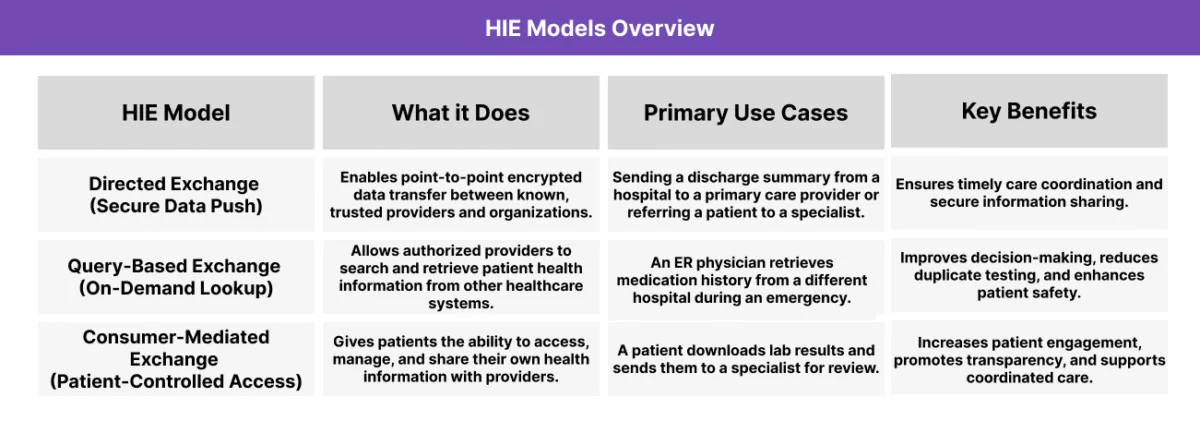
Health Information Exchange (HIE) systems allow healthcare providers, hospitals, payers, and patients to share clinical data securely across different platforms and organizations. There are three main HIE models, each supporting different workflows and levels of interoperability.
1. Directed Exchange (Secure Data Push)
Directed Exchange allows healthcare providers to send secure, encrypted patient information directly to another provider or organization.
- Use Case: Sending discharge summaries from a hospital to a primary care provider.
- Goal: Ensures timely, point-to-point communication between care teams.
- Benefit: Reduces delays and supports faster follow-up care.
2. Query-Based Exchange (On-Demand Lookup)
Query-based HIE allows authorized providers to search and retrieve patient records from other healthcare organizations when needed.
- Use Case: An emergency room doctor retrieves a patient’s medication history from another hospital.
- Goal: Supports better decision-making at the point of care.
- Benefit: Reduces duplicate testing and improves patient safety.
3. Consumer-Mediated Exchange (Patient-Controlled Access)
Consumer-mediated exchange empowers patients to access, manage, and share their health records with providers and other organizations.
- Use Case: A patient downloads their lab results and securely shares them with a specialist.
- Goal: Increases patient engagement and ownership of health data.
- Benefit: Enhances transparency and encourages coordinated care.
How HIE Works in Practice
Health Information Exchange (HIE) enables providers, patients, and healthcare organizations to share and access patient data securely across different systems. The process relies on standardized formats, privacy rules, and secure networks to ensure accurate, real-time information sharing that supports better care coordination.
Step 1 — Data Collection
Healthcare providers, labs, pharmacies, and patients generate health data, such as medical histories, lab results, imaging, prescriptions, and care plans. This information is stored within electronic health records (EHRs/EMRs) and other systems.
Step 2 — Data Request or Transfer
When a provider, hospital, payer, or patient needs information:
- In Directed Exchange, data is securely pushed to a known recipient.
- In Query-Based Exchange, a provider searches a network to find and retrieve a patient’s records.
- In Consumer-Mediated Exchange, patients initiate sharing by granting access or forwarding their own information.
Step 3 — Secure Transmission
HIE networks follow strict privacy and security standards, such as HIPAA-compliant encryption and identity verification, to ensure that only authorized users access sensitive health information.
Step 4 — Data Integration & Use
Once data is received, it’s integrated into the provider’s system or accessed in a standardized format. Providers use this information to:
- Make more informed clinical decisions
- Avoid duplicate testing
- Improve care coordination across multiple facilities
- Enhance patient safety and outcomes
HIE and Its Impact on Billing & Reimbursement
While Health Information Exchange (HIE) itself does not directly change reimbursement rates, it plays an important role in supporting accurate billing, value-based care programs, and compliance with reporting requirements. By enabling secure, timely sharing of patient information, HIE helps healthcare organizations avoid costly errors, streamline claims, and meet quality reporting standards.
How HIE Impacts Reimbursement
- Supports Value-Based Care Models
HIE improves coordination between providers, which is essential for achieving quality benchmarks in programs like MIPS and Alternative Payment Models (APMs). - Reduces Billing Errors
With more complete access to patient records, HIE decreases the likelihood of duplicate tests, missed documentation, and coding mistakes — all of which can impact payment accuracy. - Enhances Reporting for Incentive Programs
Many federal and state initiatives, including the Promoting Interoperability Program, require secure data exchange. HIE participation can help providers demonstrate compliance. - Speeds Up Claims Processing
When accurate, standardized patient data is available at the point of care, it reduces delays caused by missing or incomplete information, leading to faster reimbursements.
Why HIE Matters in Billing
Although HIE isn’t tied to a single reimbursement formula, its role in data quality, interoperability, and care coordination means it increasingly influences financial performance under modern value-based care models.
Frequently Asked Questions about HIE
1. What is Health Information Exchange (HIE)?
Health Information Exchange (HIE) is the secure electronic sharing of patient health information between providers, hospitals, payers, and other authorized organizations. Its goal is to improve care coordination, reduce duplicate testing, and give clinicians access to accurate, real-time data when making decisions.
2. What are the main types of HIE?
There are three primary models of HIE:
- Directed Exchange: Securely sends patient information from one provider to another, often for referrals or transitions of care.
- Query-Based Exchange: Allows providers to search for and retrieve patient records from other organizations when needed.
- Consumer-Mediated Exchange: Gives patients control to access, manage, and share their own health data with providers.
3. How does HIE improve patient care?
HIE gives clinicians faster, more complete access to a patient’s health history, medications, test results, and care plans. This leads to:
- Fewer duplicate tests
- Better-informed treatment decisions
- Improved care coordination between providers
- Enhanced patient safety and outcomes
4. Is HIE secure and HIPAA-compliant?
Yes. HIE systems are designed with strict privacy and security standards to protect sensitive health information. They use encryption, user authentication, and access controls to ensure data is only shared with authorized parties, in compliance with HIPAA regulations.
5. How does HIE relate to interoperability?
HIE is one of the tools that enables interoperability in healthcare. While interoperability refers to the ability of systems to exchange and use data, HIE provides the frameworks and networks that make this secure exchange possible. Together, they support better patient care and more efficient clinical workflows.
6. Does participating in HIE affect Medicare reimbursements?
Not directly. However, HIE participation supports compliance with programs like MIPS and Promoting Interoperability, where sharing accurate data is critical. Improved data exchange can reduce billing errors, streamline claims, and indirectly protect incentive-based payments.
