

What is ONC (Office of the National Coordinator for Health Information Technology)?
The Office of the National Coordinator for Health Information Technology (ONC) is the federal office responsible for coordinating nationwide efforts to advance the use of health information technology and promote interoperability across the U.S. healthcare system. ONC plays a central role in defining how electronic health information is structured, shared, and protected.
In practice, ONC does not administer Medicare or pay claims. Instead, it establishes the technical and policy foundation that allows EHR systems, providers, and other healthcare entities to exchange health data securely and consistently. Many of the interoperability and data-sharing expectations that affect Medicare programs originate from ONC policy frameworks.
ONC operates within the U.S. Department of Health and Human Services and works closely with CMS, but the two entities have distinct roles. CMS focuses on payment and program administration, while ONC focuses on health IT standards, certification, and interoperability policy.
Key Components of an ONC
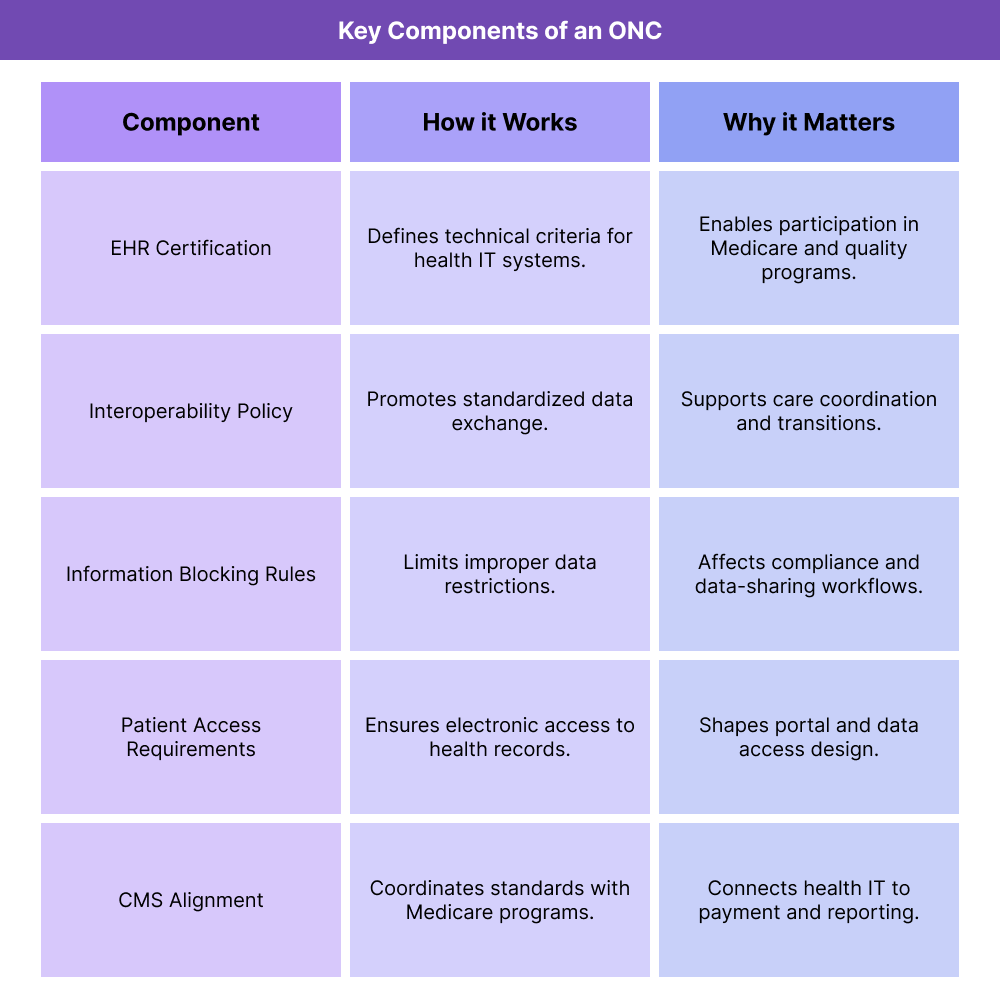
ONC influences healthcare operations by setting expectations for how health information technology should function across systems and organizations.
EHR Certification and Health IT Standards
ONC establishes certification criteria for health IT systems, particularly EHRs. Certification ensures that systems meet defined technical standards for data capture, security, and exchange.
Certified EHR technology is often assumed or required in Medicare programs, quality reporting, and interoperability initiatives.
Interoperability and Data Exchange Policy
A core ONC responsibility is promoting interoperability—the ability of different health IT systems to exchange and use health information.
ONC policies focus on reducing data silos, enabling patient access to records, and supporting information flow across care settings, including post-acute, ambulatory, and specialty care.
Information Blocking Rules
ONC defines and enforces policies related to information blocking, which occurs when access to electronic health information is improperly restricted.
These rules affect providers, health IT developers, and other actors involved in health information exchange, shaping how data-sharing decisions are made operationally.
Patient Access and Data Transparency
ONC policies emphasize patient access to electronic health information. This includes ensuring patients can view, download, and transmit their health records electronically.
Patient access requirements influence EHR configuration, portal functionality, and organizational workflows.
Coordination With CMS and Other Federal Programs
While ONC sets health IT policy, CMS incorporates ONC standards into Medicare programs, payment models, and reporting requirements. This coordination ensures that technical standards align with reimbursement and quality expectations.
How ONC Works in Practice
ONC’s impact is felt through the design, configuration, and use of health IT systems rather than through direct payment or claims processing.
Step 1: Health IT Developers Build to ONC Standards
EHR and health IT vendors design systems to meet ONC certification requirements. These standards dictate how data is structured, exchanged, and secured.
Providers inherit these design decisions through the systems they use.
Step 2: Providers Implement Certified Health IT
Healthcare organizations implement certified EHR technology to support documentation, reporting, and data exchange. ONC standards influence how workflows are configured and how data moves between systems.
Step 3: Data Sharing and Interoperability in Daily Operations
ONC policies shape how organizations share data with other providers, payers, and patients. This includes supporting referrals, transitions of care, and external reporting.
Operational friction often arises when systems technically support interoperability but workflows are not optimized.
Step 4: Information Blocking Compliance
Organizations must ensure that policies, system settings, and practices do not improperly restrict access to electronic health information.
This affects legal, compliance, IT, and operational teams—not just clinicians.
Step 5: Ongoing Policy Updates and Adaptation
ONC policies evolve over time, requiring system updates, workflow changes, and staff education to remain compliant.
ONC in Billing, Reimbursement, and System Limitations
ONC does not set reimbursement rates, but its policies indirectly affect billing and payment by shaping the health IT infrastructure that supports them.
How ONC Influences Billing and Reimbursement
Structured, interoperable data improves documentation quality, coding accuracy, and reporting. Many Medicare billing and quality workflows assume ONC-aligned health IT capabilities.
When systems lack interoperability, billing and reporting often rely on manual processes that increase error risk.
System Limitations and Operational Challenges
Common challenges related to ONC-driven requirements include:
- Complexity of certification standards
- EHR upgrades required to maintain compliance
- Workflow disruption during system changes
- Variability in interoperability maturity across vendors
Organizations often need governance structures to manage these changes effectively.
How ONC Influences Quality, Access, and Equity in Healthcare
ONC policies are designed to support system-wide improvements beyond individual transactions.
ONC and Quality Improvement
Interoperable data enables better quality measurement, care coordination, and performance monitoring. When data flows freely, providers have better visibility into patient history and outcomes.
ONC and Access to Care
ONC’s emphasis on data sharing and patient access supports smoother referrals, faster transitions, and improved patient engagement.
Poorly implemented interoperability, however, can slow workflows rather than improve them.
Equity Considerations in ONC Policy
ONC initiatives aim to reduce disparities by improving data access and transparency. At the same time, uneven health IT adoption and resource constraints can widen gaps between organizations.
Equity-aware implementation focuses on usability, patient access, and support for smaller or resource-limited providers.
Frequently Asked Questions about ONC
1. What is ONC in healthcare?
ONC is the federal office responsible for coordinating health information technology policy, including EHR certification, interoperability standards, and information blocking rules.
2. How is ONC different from CMS?
ONC sets health IT standards and policies, while CMS administers Medicare programs and reimbursement. CMS often incorporates ONC standards into Medicare requirements.
3. Does ONC regulate EHR systems?
ONC establishes certification criteria that EHR systems must meet to be considered certified health IT.
4. What is information blocking?
Information blocking refers to practices that improperly limit access, exchange, or use of electronic health information, as defined by ONC policy.
5. Why is ONC important for interoperability?
ONC sets the technical and policy framework that enables health information to be shared across systems and organizations.
6. Does ONC affect Medicare billing directly?
ONC does not set billing rules, but its standards influence the systems used for documentation, reporting, and billing.
7. Are providers required to follow ONC rules?
Providers are affected by ONC rules when they use certified health IT and participate in programs that assume ONC-aligned systems.
