

What is an TTE (Transthoracic Echocardiogram) in Healthcare?
TTE (Transthoracic Echocardiogram) is a noninvasive cardiac imaging study used to evaluate cardiac structure and function through ultrasound imaging obtained via the chest wall. In healthcare documentation and provider workflows, TTE is treated as a foundational cardiac diagnostic study, not a diagnosis itself.
From an operational standpoint, TTE is one of the most frequently referenced cardiac imaging tools in adult and Medicare populations. It commonly appears in:
- cardiology consult notes
- diagnostic summaries
- discharge documentation
- longitudinal care records
Providers document TTE findings to support diagnoses and care planning related to EF, CHF, HFpEF, HFrEF, CAD, ASCVD, MI, and valvular disease. Even when performed once, TTE results often remain clinically relevant for extended periods.
Unlike acute diagnostic tests, TTE frequently serves a longitudinal reference role. Documentation focuses on what the study demonstrated and how it informs risk stratification, monitoring decisions, and coordination of care across a patient’s LOS (Length of Stay) and care transitions.
Operationally, TTE functions as a structural and functional baseline, anchoring cardiac assessment in both acute and chronic care contexts.
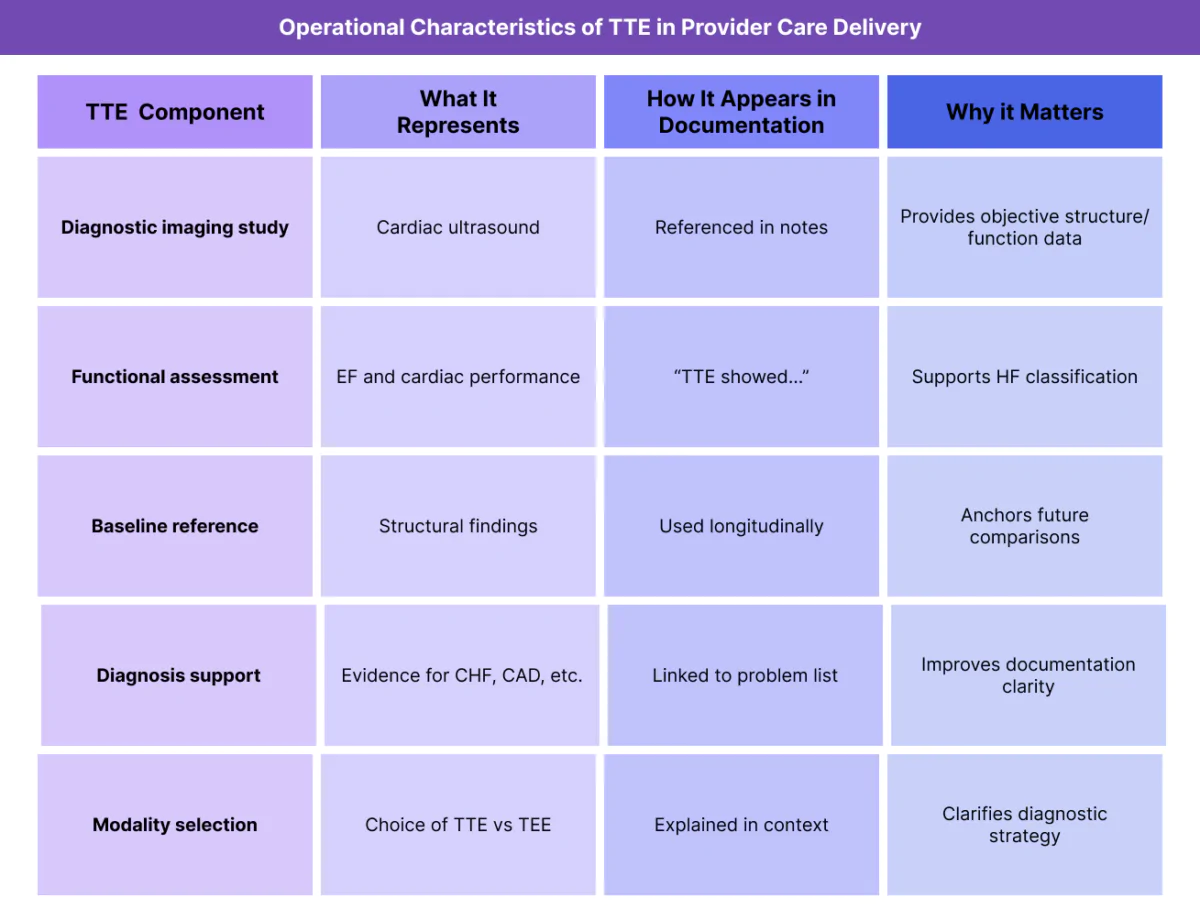
Key Clinical and Operational Components of TTE in Healthcare
TTE’s importance lies in how it is documented, referenced, and contextualized within the medical record rather than in the technical performance of the study.
TTE as a Cardiac Imaging Reference
TTE is documented to provide objective information about cardiac structure and function. Providers reference TTE findings to support or clarify diagnoses without restating full imaging reports.
This reference role makes TTE central to cardiology documentation.
TTE and Evaluation of Cardiac Function
TTE is commonly referenced to document cardiac function, including measurements such as EF (Ejection Fraction). Providers use TTE findings to contextualize heart failure classification and severity.
Clear documentation helps maintain consistency across encounters.
TTE in Diagnosis and Problem List Context
TTE findings themselves do not appear on the problem list, but they frequently support problem list diagnoses. Providers reference TTE results to justify adding, updating, or refining cardiac diagnoses.
This supporting role strengthens documentation defensibility.
TTE and Longitudinal Risk Assessment
Historical TTE findings help providers assess changes over time or establish stability. Prior TTE references are commonly used to explain monitoring cadence or the need for repeat imaging.
This longitudinal context is especially important in chronic care.
TTE vs TEE in Documentation Context
While this page focuses on TTE, providers may contrast it with TEE (Transesophageal Echocardiogram) in documentation. TEE is typically referenced when more detailed imaging is required or when TTE findings are insufficient.
Documenting why TTE was used—or why TEE was pursued instead—adds clarity to the diagnostic narrative.
How TTE Is Documented and Used in Practice
TTE documentation varies based on timing, clinical context, and care setting.
TTE During Initial Cardiac Evaluation
During initial evaluation, TTE is documented to establish baseline cardiac structure and function. Providers reference findings to support diagnoses and guide early care planning.
Documentation focuses on relevance, not imaging detail.
TTE in Longitudinal and Chronic Care Records
In longitudinal care, prior TTE findings are frequently referenced to provide historical context. Providers may note stability or change relative to earlier studies to support monitoring decisions.
Historical references support continuity of care.
TTE and Interdisciplinary Communication
Clear TTE documentation helps the IDT maintain a shared understanding of cardiac status. Referencing key findings rather than full reports supports efficient communication across disciplines.
TTE in Transitions of Care
TTE findings are often summarized during transitions of care to provide receiving providers with structural and functional cardiac context. Accurate documentation reduces duplication and confusion.
TTE in Billing, Reimbursement, and System Limitations
How TTE Supports Medical Necessity Documentation
TTE (Transthoracic Echocardiogram) is a billable diagnostic study, but its broader value in reimbursement review lies in how it supports medical necessity narratives. In Medicare and other payer environments, TTE documentation provides objective evidence of cardiac structure and function that explains why diagnostic evaluation, monitoring, or treatment decisions were appropriate.
Accurate documentation shows that TTE was ordered and reviewed based on clinical risk, symptoms, or known cardiovascular disease—not as a routine or duplicative test.
TTE and Diagnostic Justification in Cardiology Care
From a reimbursement standpoint, TTE supports justification for:
- evaluation of suspected or known CHF, HFpEF, or HFrEF
- assessment of EF changes over time
- investigation of new or worsening cardiac findings
- confirmation of structural or functional abnormalities
Documenting the clinical rationale for TTE strengthens the link between the test and the care delivered.
TTE as Objective Evidence in Longitudinal Care
TTE findings often continue to support medical necessity long after the study is performed. Providers reference prior TTE results to justify ongoing monitoring, medication adjustments, or follow-up decisions.
In reimbursement review, historical TTE context helps explain why care remains appropriate even when patients are clinically stable.
Reimbursement Risk When TTE Is Poorly Documented
TTE documentation can create reimbursement risk when:
- clinical rationale for the study is unclear
- findings are referenced without context
- repeat TTEs are ordered without explanation
- TTE results are disconnected from care planning
Clear documentation of indication, timing, and relevance improves defensibility and reduces audit exposure.
How TTE Influences Quality, Access, and Equity in Healthcare
TTE and Quality-Aligned Documentation
From a quality perspective, TTE documentation supports clarity and continuity, not interpretation. Accurate TTE documentation ensures providers share a consistent understanding of cardiac structure and function and incorporate this information appropriately into care planning.
Quality-aligned documentation reflects that TTE findings inform decisions rather than stand alone.
TTE and Care Coordination Across Settings
TTE findings frequently follow patients across inpatient, outpatient, post-acute, and longitudinal care settings. Consistent documentation helps receiving providers understand prior cardiac evaluation without repeating imaging unnecessarily.
Clear TTE summaries support safer, more efficient transitions of care.
TTE and Access to Diagnostic Imaging
TTE documentation can influence access to further diagnostic evaluation by clarifying whether cardiac imaging has already been performed and what it demonstrated. Accurate documentation supports appropriate escalation—or avoidance of duplication—of testing.
This balance is especially important in Medicare populations.
Equity Considerations in TTE Documentation
Access to cardiac imaging is not uniform across populations. Equity-aware TTE documentation may note delays in testing, limitations in access, or barriers to follow-up that affect interpretation of cardiac status.
Documenting these factors helps ensure quality assessment reflects patient reality rather than system availability alone.
Avoiding Bias in TTE Interpretation Context
Providers should avoid assumptions about disease severity or stability based solely on a single TTE or outdated imaging. TTE findings should be contextualized within the broader clinical picture and updated when clinically appropriate.
Thoughtful documentation supports individualized, equitable care decisions.
Frequently Asked Questions about TTE
1. What is TTE in healthcare?
TTE (Transthoracic Echocardiogram) is a noninvasive cardiac imaging study that uses ultrasound to evaluate cardiac structure and function. In healthcare documentation, TTE provides objective evidence to support cardiac diagnoses and care planning.
2. Is TTE considered a diagnostic or monitoring tool?
TTE functions as both. It may be used to establish an initial cardiac assessment or referenced longitudinally to monitor known conditions and assess changes over time.
3. Does TTE affect billing or reimbursement directly?
Yes. TTE is a billable diagnostic study, and its documentation also supports reimbursement by demonstrating medical necessity and diagnostic relevance.
4. How does TTE differ from TEE in documentation?
TTE is noninvasive and commonly used as a first-line imaging study, while TEE is referenced when more detailed imaging is required. Documentation often explains why TTE findings were sufficient or why TEE was pursued.
5. How often should TTE be repeated?
There is no fixed interval. Repeat TTEs should be clinically justified and documented based on changes in symptoms, status, or care needs rather than routine scheduling.
6. What are common TTE documentation issues?
Common issues include unclear indication, lack of linkage to diagnoses, and failure to explain repeat imaging.
7. Why do reviewers pay attention to TTE documentation?
Reviewers assess whether imaging was clinically justified and appropriately integrated into care decisions. Clear TTE documentation strengthens the diagnostic narrative during review.
