

What is RBRVS (Resource-Based Relative Value Scale) in Healthcare?
The Resource-Based Relative Value Scale (RBRVS) is the reimbursement methodology used by Medicare and many commercial payers to determine how much providers are paid for medical services. Established by the Centers for Medicare & Medicaid Services (CMS), RBRVS assigns a standardized value to each CPT or HCPCS code based on the resources required to perform that service.
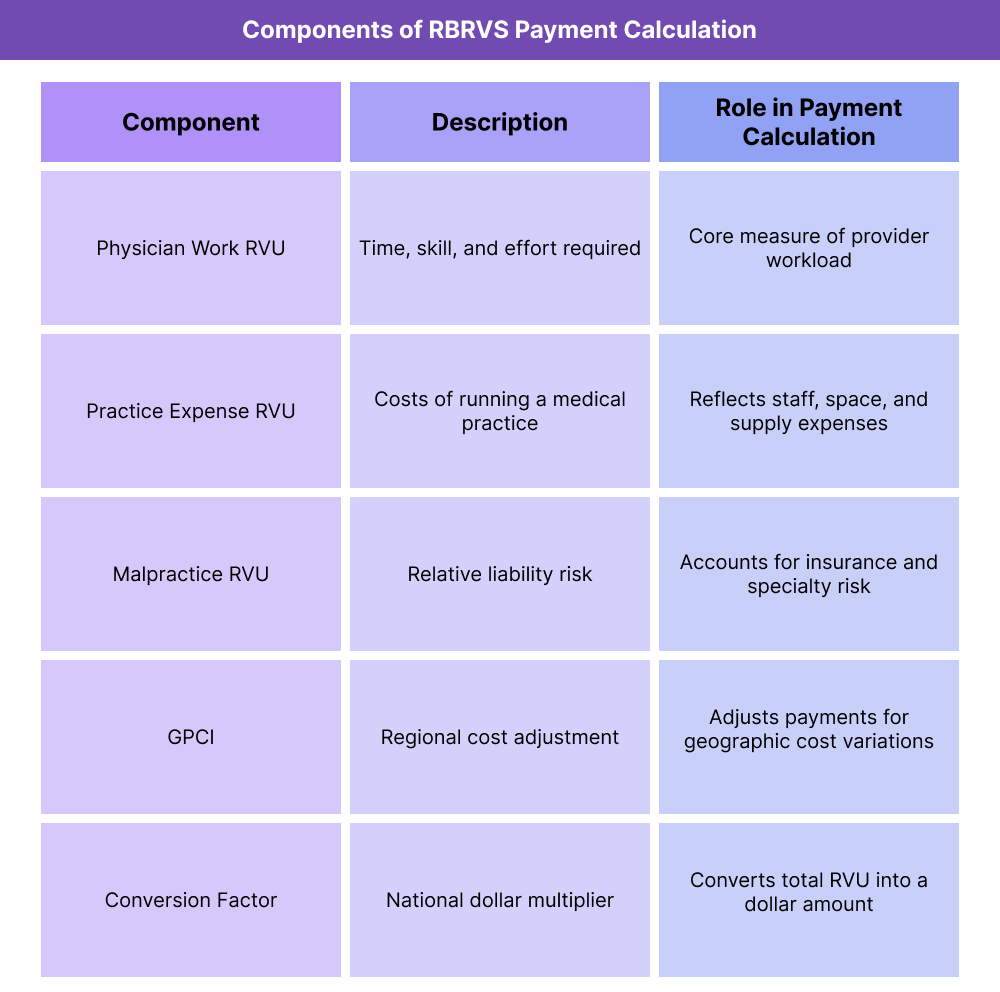
Each service is given a Relative Value Unit (RVU), which reflects three key components:
- Physician Work RVU – the time, skill, and effort required.
- Practice Expense RVU – the cost of maintaining a practice (staff, supplies, equipment).
- Malpractice RVU – the relative risk and cost of malpractice insurance.
These values are then adjusted by a Geographic Practice Cost Index (GPCI) to account for regional cost differences and multiplied by a Medicare Conversion Factor (CF) to calculate the final reimbursement amount.
RBRVS provides a transparent, resource-based framework for valuing physician services and remains the foundation for Medicare’s Physician Fee Schedule (MPFS) and many value-based care payment models.
(Anchor opportunities: RVU, GPCI, Conversion Factor, Fee Schedule, CMS, CPT Codes, Physician Services)
Key Components of RBRVS
The RBRVS framework determines how medical services are valued and reimbursed by assigning a Relative Value Unit (RVU) to each CPT or HCPCS code. These RVUs reflect the relative cost and effort required to deliver a service, adjusted for geography and converted into a dollar amount.
The formula for calculating RBRVS reimbursement is:
Payment = [(Work RVU × GPCI) + (Practice Expense RVU × GPCI) + (Malpractice RVU × GPCI)] × Conversion Factor (CF)
Each component plays a distinct role in establishing fair and consistent payment rates for providers across the U.S.
1. Physician Work RVU (wRVU)
Represents the time, technical skill, mental effort, and judgment required to perform the service, as well as the stress associated with patient risk.
- Typically the largest portion of the total RVU.
- Used in compensation models for productivity-based physician pay.
2. Practice Expense RVU (peRVU)
Accounts for the overhead costs associated with running a practice — including clinical staff, office rent, medical equipment, and supplies.
- Varies between facility and non-facility settings.
- Encourages more accurate representation of resource use across care environments.
3. Malpractice RVU (mpRVU)
Reflects the cost of professional liability insurance for a given service.
- Higher-risk procedures carry greater malpractice RVUs.
- Ensures risk-adjusted payment equity between specialties.
4. Geographic Practice Cost Index (GPCI)
Adjusts each RVU component to reflect regional cost variations.
- Different GPCIs exist for work, practice expense, and malpractice.
- Maintains fairness between high-cost urban areas and rural regions.
5. Conversion Factor (CF)
A national dollar amount set annually by CMS that converts the total RVU into a payment amount.
- Updated each year through the Medicare Physician Fee Schedule (MPFS).
- Represents the monetary value of one RVU.
How RBRVS Is Used in Healthcare Reimbursement Workflows
The Resource-Based Relative Value Scale (RBRVS) is the foundation for how most physician services are valued and reimbursed in the U.S. healthcare system. It drives both Medicare payments and many commercial payer contracts, shaping how providers report services and how claims are processed.
Step 1: CPT or HCPCS Code Selection
- The provider documents and codes each service performed using standardized CPT or HCPCS codes.
- Each code is linked to a specific set of RVUs defined by CMS under the Medicare Physician Fee Schedule (MPFS).
Step 2: RVU Assignment
- CMS assigns work, practice expense, and malpractice RVUs to each code.
- These RVUs represent the resource intensity required to deliver that service relative to others.
Step 3: GPCI Adjustment
- Each RVU component is multiplied by the Geographic Practice Cost Index (GPCI) for the provider’s location.
- This ensures payments reflect local cost variations — for example, wages or rent differences between states.
Step 4: Conversion Factor Application
- The total adjusted RVUs are multiplied by the annual Medicare Conversion Factor (CF), producing the dollar payment amount.
- CMS updates the conversion factor annually based on legislation and the Medicare Economic Index.
Step 5: Claim Submission and Payment
- Providers submit claims to Medicare or commercial payers, who adjudicate payments using RBRVS-based fee schedules.
- Many health systems also use RVUs internally for physician productivity and compensation models.
Step 6: Audit and Compliance Review
- Accurate coding and documentation are critical.
- CMS and payers audit RBRVS-based claims to ensure the reported service level matches the documentation and medical necessity.
RBRVS in Billing, Reimbursement, and Payment Policy
The Resource-Based Relative Value Scale (RBRVS) is central to how providers are reimbursed for medical services in the U.S. It has created a standardized, transparent framework for valuing physician work and resource use, but it also introduces ongoing challenges around payment equity, administrative complexity, and specialty valuation.
Direct Role in Reimbursement
- RBRVS determines nearly all Medicare Part B professional service payments, and many commercial payers adopt the same model for their fee schedules.
- Each CPT or HCPCS code’s RVU combination — adjusted by GPCI and multiplied by the Medicare Conversion Factor (CF) — defines the actual payment a provider receives.
- Many provider compensation plans also use work RVUs (wRVUs) as the basis for productivity-based pay and incentive structures.
Benefits of RBRVS
- Transparency: Creates a measurable, standardized method for comparing resource use across services.
- Fairness: Aligns payment with the relative intensity and cost of care delivery.
- Adaptability: Updated annually by CMS to reflect changes in clinical practice, cost structures, and new procedures.
Limitations and Challenges
- Cognitive vs. Procedural Imbalance: RBRVS has historically favored procedural specialties (e.g., surgery, radiology) over cognitive services like primary care, because it measures effort in time and complexity, not patient outcomes.
- Administrative Complexity: Frequent CMS updates to RVUs and conversion factors require continuous payer and provider recalibration.
- Geographic Disparities: GPCI adjustments attempt to normalize payments, but rural and low-cost regions often still experience lower reimbursement despite comparable workloads.
- Legislative Influence: The Medicare Conversion Factor is subject to congressional budget decisions, creating uncertainty for provider revenue each year.
RBRVS and Its Impact on Quality, Access, and Equity in Healthcare
While the Resource-Based Relative Value Scale (RBRVS) standardized reimbursement across the U.S. healthcare system, it has also influenced how care is delivered, how physicians are paid, and how equitable access to services is maintained. Its effects go far beyond billing — shaping quality, access, and policy decisions.
Improving Transparency and Accountability
- RBRVS created a consistent, data-driven basis for determining physician reimbursement.
- The RVU system makes it easier for payers, policymakers, and providers to compare services objectively, encouraging fairness and cost control.
- Its integration with CMS reporting requirements supports auditability and compliance across all provider types.
Quality and Value Implications
- RBRVS is foundational to Value-Based Care (VBC) models because it provides the baseline cost structure used to measure efficiency and outcomes.
- Accurate RVU documentation ensures performance measures and quality incentives are based on valid, standardized data.
- However, fee-for-service systems built on RBRVS still reward volume over outcomes, requiring supplemental models (like MIPS or APMs) to balance incentives.
Equity and Access Considerations
- Cognitive and primary care services — which rely on time and complexity rather than procedures — often receive lower RVU values, contributing to income disparities across specialties.
- Geographic payment adjustments (GPCI) attempt to level regional differences, but rural areas still face lower reimbursements and workforce shortages.
- Policy reforms are increasingly exploring RBRVS rebalancing, with higher valuations for evaluation and management (E/M) services to promote equity in primary care.
Challenges to Long-Term Equity
- The conversion factor’s dependence on federal budget constraints can disproportionately affect smaller and rural practices.
- Underpayment of preventive and cognitive services may discourage participation in primary care and population health programs.
- To achieve true equity, RBRVS needs to evolve in parallel with outcome-based reimbursement and care coordination models.
Frequently Asked Questions about RBRVS
1. What is RBRVS in medical billing?
RBRVS (Resource-Based Relative Value Scale) is the system used by Medicare and many commercial payers to determine reimbursement rates for physician services. It assigns Relative Value Units (RVUs) to each CPT or HCPCS code based on the time, skill, and resources required to perform the service.
2. How is RBRVS calculated?
RBRVS payments are calculated using this formula:
Payment = [(Work RVU × GPCI) + (Practice Expense RVU × GPCI) + (Malpractice RVU × GPCI)] × Conversion Factor (CF).
The conversion factor, updated annually by CMS, converts total RVUs into a dollar amount.
3. What are the main components of RBRVS?
- Work RVU – Time, technical skill, and effort required.
- Practice Expense RVU – Costs of staff, supplies, and equipment.
- Malpractice RVU – Relative cost of professional liability insurance.
Each is adjusted by a Geographic Practice Cost Index (GPCI) and multiplied by the Conversion Factor.
4. What is the difference between RVU and RBRVS?
- RVU (Relative Value Unit): The numerical value assigned to a service that represents its relative resource use.
- RBRVS: The broader reimbursement system that uses RVUs, GPCIs, and the Conversion Factor to determine payment.
5. What is the Medicare Conversion Factor?
The Conversion Factor (CF) is the dollar amount CMS assigns per RVU. It changes each year based on congressional budget decisions and the Medicare Economic Index.
6. What are the main criticisms of RBRVS?
Critics note that RBRVS tends to undervalue cognitive and primary care services compared to procedural work, contributing to payment disparities. It also introduces administrative complexity and regional inequities despite GPCI adjustments.
7. How does RBRVS support Value-Based Care?
RBRVS establishes a consistent baseline for comparing costs and services, enabling CMS and payers to layer on performance- and outcome-based incentives such as those in MIPS and Advanced Alternative Payment Models (APMs).
