

What is MIPS (Merit-based Incentive Payment System)?
The Merit-based Incentive Payment System (MIPS) is a federal program created by the Centers for Medicare & Medicaid Services (CMS) that adjusts Medicare reimbursements based on provider performance.
Clinicians participating in MIPS receive a composite performance score based on four weighted categories: Quality, Improvement Activities, Promoting Interoperability, and Cost. This score determines whether they receive a positive, neutral, or negative payment adjustment on future Medicare claims.
MIPS is part of the Quality Payment Program (QPP) established under the Medicare Access and CHIP Reauthorization Act (MACRA). It was designed to reward high-value, high-quality care while discouraging unnecessary spending.
Key Components of MIPS
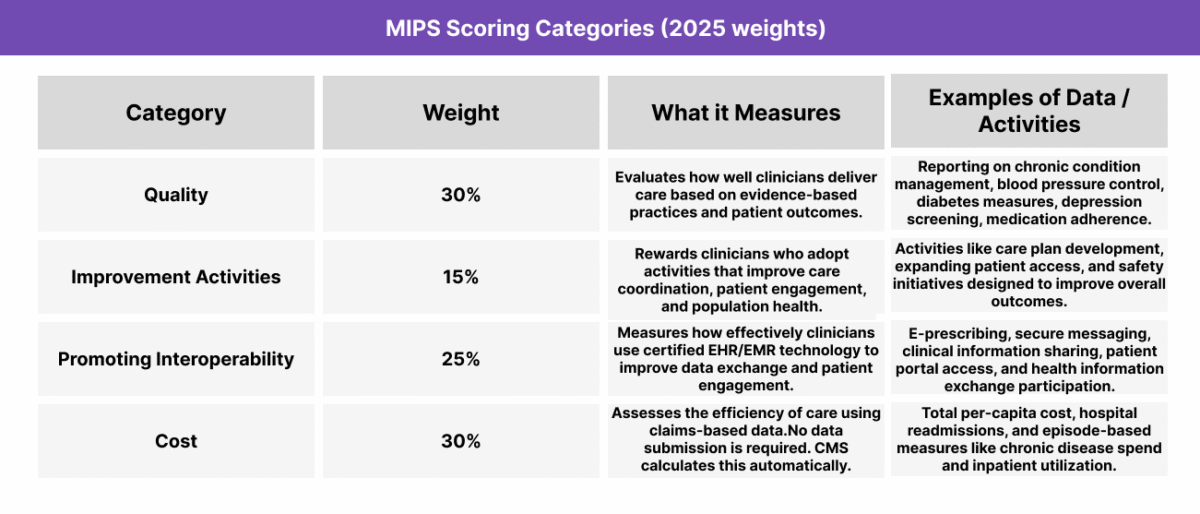
The MIPS program evaluates clinician performance across four weighted scoring categories. Together, these determine your final composite performance score — a single number between 0 and 100 that directly impacts your Medicare payment adjustment for the following year.
Each category measures different aspects of care delivery, from patient outcomes to technology adoption and cost efficiency. Understanding how these categories work — and where to focus your efforts — is essential for maximizing your score.
How the Scoring Works
- Each category’s performance is measured individually and weighted based on its percentage.
- The four weighted scores are added together to calculate your composite performance score.
- That composite score determines your payment adjustment:
- Above the performance threshold → Positive adjustment
- At the threshold → Neutral adjustment
- Below the threshold → Negative adjustment
- In 2025, the performance threshold is expected to stay around 75 points (final CMS rule pending).
How MIPS Works in Practice
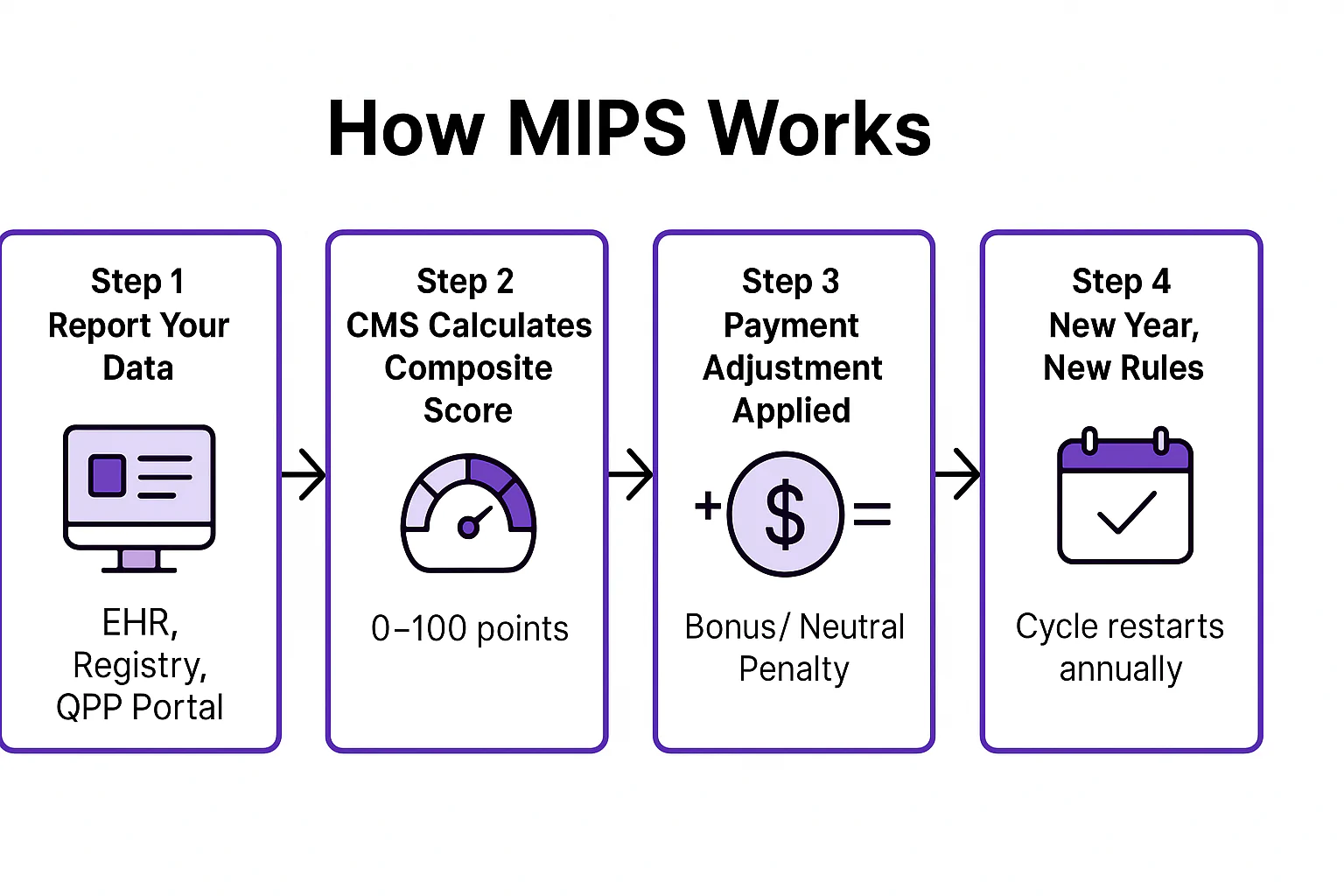
MIPS evaluates clinician performance based on annual reporting. Providers collect and submit data in specific performance categories, CMS calculates a composite score, and that score determines whether they receive a bonus, no change, or penalty on future Medicare payments.
Here’s a step-by-step breakdown of how the program works:
Step 1 — Choose and Report Your Measures
- Clinicians select quality measures and improvement activities relevant to their practice.
- Data is collected from EHRs/EMRs, registries, or claims.
- Reporting happens through the QPP portal, a registry, your EMR vendor, or a qualified clinical data registry (QCDR).
- Submission deadlines typically fall by March of the following year (e.g., March 31, 2026 for 2025 performance year).
Step 2 — CMS Calculates Your Composite Score
- Each category (Quality, Improvement Activities, Promoting Interoperability, Cost) contributes a weighted score.
- These weighted results are combined into a composite performance score between 0 and 100 points.
- Your score determines which payment tier you fall into.
Step 3 — Receive Your Payment Adjustment
The composite score directly affects your Medicare Part B payment rate two years later:
- Above threshold → Positive adjustment (bonus)
- At threshold → Neutral adjustment
- Below threshold → Negative adjustment (penalty)
For the 2025 performance year, payment adjustments will apply to 2027 reimbursements.
Step 4 — Continuous Program Evolution
- CMS updates weights, thresholds, and eligible measures every year.
- Staying compliant requires annual monitoring of QPP rule changes and measure updates.
MIPS Billing and Reimbursement?
MIPS directly impacts how much clinicians are reimbursed for Medicare Part B services. Your composite performance score determines whether you earn a bonus, receive no change, or face a penalty on future Medicare payments. These adjustments are always applied two years after the performance year — meaning data you report in 2025 will affect your 2027 reimbursement rates.
How Payment Adjustments Work
- Positive Adjustment (Bonus): If your score is above the performance threshold (expected to be around 75 points in 2025), you may receive upward payment adjustments on your Medicare claims.
- Neutral Adjustment: Clinicians who meet the threshold avoid penalties but do not receive additional incentives.
- Negative Adjustment (Penalty): Scoring below the threshold results in a reduction to your Medicare reimbursements, up to the maximum penalty CMS sets for the year.
Why This Matters for Providers
- A high MIPS score can increase revenue by earning performance-based bonuses.
- Missing reporting deadlines or submitting incomplete data can trigger automatic penalties, even if quality of care is high.
- Staying current with CMS updates is essential, since thresholds, weights, and payment adjustment ranges can change annually.
Frequently Asked Questions about MIPS
1. What is the MIPS performance threshold for 2025?
For the 2025 performance year, the MIPS performance threshold is expected to remain around 75 points. Clinicians who meet or exceed this score avoid penalties, while those below the threshold may receive a negative payment adjustment. CMS finalizes thresholds each year, so providers should confirm the latest requirements before submitting data.
2. Who is required to participate in MIPS?
MIPS generally applies to clinicians who:
- Bill more than $90,000 annually in Medicare Part B charges
- Provide care to 200 or more Medicare beneficiaries per year
- Deliver 200 or more covered professional services annually
However, there are exceptions. Clinicians may be excluded if they fall below these thresholds, participate in an Advanced Alternative Payment Model (APM), or meet a special exemption set by CMS.
3. How are MIPS scores calculated?
Your MIPS composite performance score is based on four weighted categories:
- Quality (30%)
- Improvement Activities (15%)
- Promoting Interoperability (25%)
- Cost (30%)
CMS converts your reported data into a 0–100 point score. This final score determines whether you receive a bonus, neutral adjustment, or penalty on future Medicare reimbursements.
4. When are MIPS reporting deadlines for 2025?
For the 2025 performance year, MIPS data must typically be submitted by March 31, 2026. Reporting can be completed through:
- The QPP portal
- An EHR/EMR vendor
- A qualified registry or QCDR
Missing the submission deadline generally results in an automatic negative adjustment, regardless of performance.
5. What happens if I don’t participate in MIPS?
Clinicians who are required to participate but fail to submit data automatically receive the maximum negative payment adjustment for the applicable adjustment year. In 2025, failing to report could result in reduced reimbursements in 2027. Staying compliant not only avoids penalties but may also unlock incentive bonuses for high performers.
