

What is MSP (Medicare Second Payer) in Healthcare?
Medicare Secondary Payer (MSP) refers to the set of federal rules that determine when Medicare pays secondary to another insurer rather than acting as the primary payer. Under MSP rules, Medicare does not pay first when another entity—such as an employer group health plan, workers’ compensation, liability insurance, or no-fault insurance—is responsible for payment.
Operationally, MSP rules are foundational to Medicare billing and reimbursement. Providers and payers must identify when Medicare is primary versus secondary before submitting claims. Failure to apply MSP correctly can result in denied claims, improper payments, recoupments, and compliance exposure.
From a systems and compliance standpoint, MSP is not optional logic—it is embedded in eligibility checks, coordination of benefits workflows, claims processing, and audit activity. MSP errors are a common trigger for repayment demands because they often result in Medicare paying when it legally should not.
Key Components of Medicare Second Payer (MSP) Rules
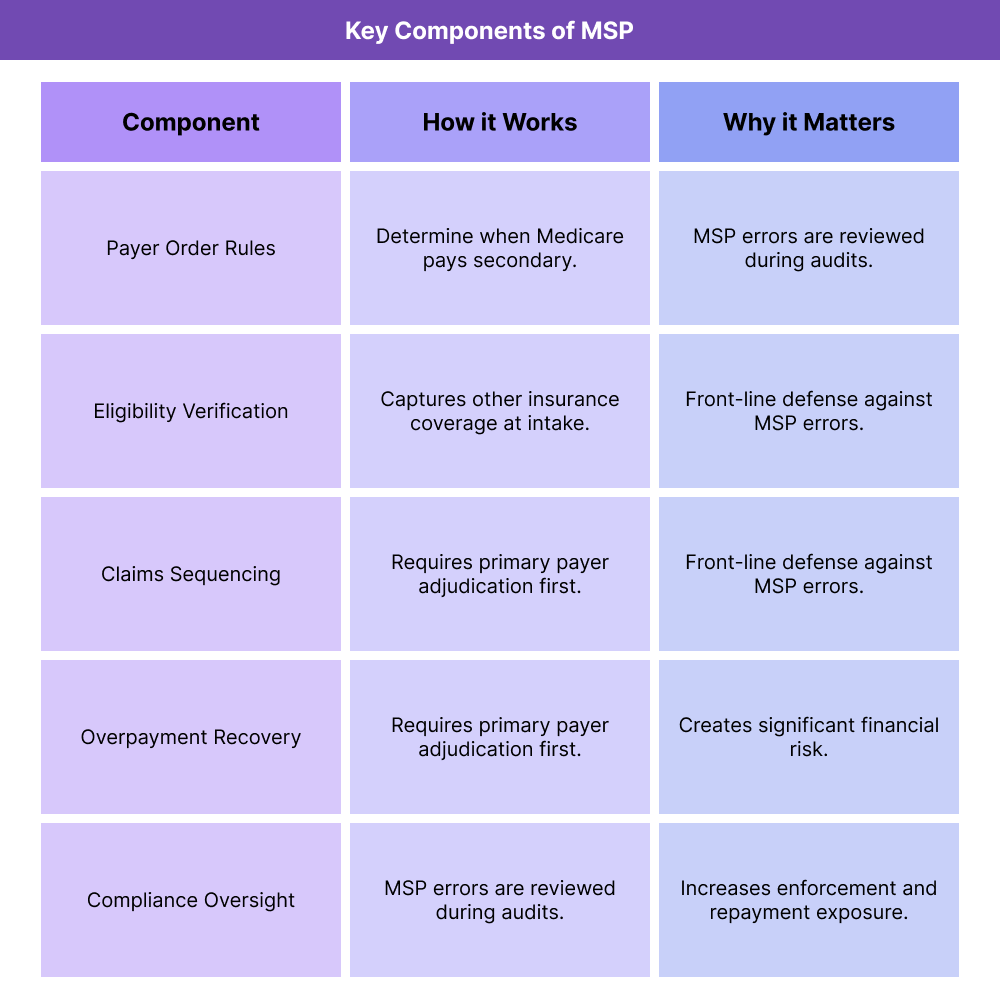
MSP is governed by a defined set of payer-ordering rules that apply across Medicare fee-for-service and Medicare Advantage environments. Understanding these components is essential for billing teams, compliance leaders, and healthcare technology vendors.
Primary vs Secondary Payer Determination
At the core of MSP is determining which payer is responsible first. Medicare is secondary when another payer has legal responsibility for payment, such as:
- Employer-sponsored group health plans
- Workers’ compensation coverage
- Liability or no-fault insurance
- Certain disability-related group coverage
Accurate payer determination must occur before claims are submitted. Errors at this stage cascade into denials, rework, or overpayment recovery.
MSP and Eligibility Verification Workflows
MSP logic begins during eligibility verification and patient intake. Providers must collect and maintain accurate insurance information, including coverage effective dates and policy details.
Operationally, this means MSP compliance depends heavily on front-end workflows. Incomplete or outdated insurance data is one of the most common causes of MSP-related billing errors.
MSP and Claims Submission Rules
When Medicare is secondary, claims must be billed in the correct order. Primary payer adjudication must occur before Medicare is billed, and explanation of benefits (EOB) information must be included.
Failure to follow MSP claims sequencing rules often results in denials or delayed payment and can trigger follow-up reviews.
MSP Recovery, Overpayments, and Recoupment Risk
When Medicare pays incorrectly as primary, it has broad authority to recover funds. MSP-related overpayments are frequently pursued through audits and repayment demands.
This makes MSP compliance especially high-risk from a financial standpoint, even when the underlying clinical services were appropriate.
MSP Compliance and Program Integrity Oversight
MSP enforcement is closely tied to program integrity efforts. Incorrect payer sequencing can be interpreted as improper billing, particularly if errors are systemic.
Organizations with weak MSP controls may face audits, repayment requests, and increased scrutiny tied to broader compliance and FWA monitoring.
How MSP (Medicare Secondary Payer) Works in Practice
In practice, MSP rules come into play long before a claim is submitted. MSP is an intake-to-payment workflow, not just a billing rule. Most MSP failures happen upstream—during registration, eligibility verification, or incomplete insurance capture—rather than in claims logic itself.
Step 1: Insurance Collection and MSP Screening at Intake
MSP workflows begin at patient intake. Providers must collect and verify all active insurance coverage and determine whether another payer may be responsible before Medicare.
Operationally, this includes:
- Asking structured MSP questions (employment status, injury, accident, disability)
- Capturing coverage effective dates accurately
- Updating insurance changes promptly
- Re-validating MSP status for returning patients
Even small intake errors—such as outdated employer coverage—can cause Medicare to pay incorrectly as primary.
Step 2: Payer Order Determination
Once insurance information is collected, systems and staff must determine payer order. Medicare is secondary when another payer has legal responsibility, such as:
- Employer group health plans
- Workers’ compensation
- Liability or no-fault insurance
- Certain disability-related group coverage
This determination must align with MSP rules and be reflected consistently across eligibility, billing, and claims systems.
Step 3: Claims Sequencing and Submission
When Medicare is secondary, claims must be submitted in the correct order:
- Primary payer is billed first
- Primary payer adjudicates the claim
- Medicare is billed second with primary payer EOB information
Submitting Medicare claims out of sequence often results in denials or delayed payment—and, in some cases, improper payment that must later be repaid.
Step 4: Medicare Secondary Payment and Cost Sharing
When Medicare pays secondary, it may cover remaining allowable costs after the primary payer’s payment, subject to Medicare rules.
Operationally, this affects:
- Patient cost-sharing calculations
- Secondary payment posting
- Coordination with patient billing workflows
- Explanation of benefits reconciliation
Clear communication with patients is critical, as MSP situations often create confusion about financial responsibility.
Step 5: Recovery, Audits, and Ongoing MSP Monitoring
If Medicare pays incorrectly as primary, it has authority to recover funds—even months or years later. MSP recovery actions often arise through audits, data matches, or retrospective reviews.
Organizations that monitor MSP accuracy proactively reduce exposure to recoupments and repeat findings.
MSP in Billing, Reimbursement, and System Limitations
MSP rules directly affect reimbursement accuracy and cash flow. Even compliant care delivery can turn into financial risk if payer sequencing is wrong.
How MSP Affects Medicare Billing and Payment
MSP affects billing by determining:
- Whether Medicare should be billed at all
- When Medicare should be billed
- How much Medicare may pay
- Whether patient responsibility applies
Billing Medicare incorrectly as primary can result in payment reversal, refunds, and follow-up audits.
MSP and Overpayment Risk
MSP-related overpayments are particularly risky because Medicare has broad recovery rights. Common drivers include:
- Failure to capture other insurance
- Delayed updates to insurance status
- System defaults that assume Medicare primary
- Inconsistent MSP logic across locations or departments
Once identified, overpayments must be refunded—even if the organization acted in good faith.
System Limitations That Drive MSP Errors
MSP errors are often caused by operational and system constraints, such as:
- Fragmented intake and billing systems
- Limited eligibility rechecks for recurring patients
- Manual insurance data entry
- Inconsistent MSP training for front-desk staff
- Poor visibility into employer or liability coverage changes
Organizations with automated eligibility checks and standardized MSP workflows perform better over time.
How MSP Influences Quality, Access, and Equity in Home Health
While MSP is a payment rule, it has real-world implications for access and patient experience.
MSP and Access to Care
MSP confusion can delay care when providers hesitate to schedule services until coverage is clarified. This is especially common in injury-related cases or complex employer coverage situations.
Clear workflows help minimize delays without increasing financial risk.
MSP and Patient Experience
Patients often do not understand why Medicare did not pay first. Poor communication can lead to surprise bills, dissatisfaction, and complaints.
Strong MSP processes include patient education and clear financial explanations to reduce confusion.
Equity Considerations in MSP Enforcement
MSP complexity can disproportionately affect patients with:
- Multiple jobs or changing employment
- Language barriers
- Limited understanding of insurance coordination
- Injury-related or liability-based coverage
Equity-aware MSP operations emphasize clear intake questions, staff training, and patient-facing explanations rather than punitive billing after the fact.
Frequently Asked Questions about Medicare Second Payer (MSP)
1. What is MSP (Medicare Secondary Payer)?
Medicare Secondary Payer (MSP) rules determine when Medicare pays secondary to another insurer rather than acting as the primary payer. Medicare is secondary when another payer is legally responsible for payment.
2. When is Medicare considered a secondary payer?
Medicare is secondary when another payer—such as an employer group health plan, workers’ compensation, liability insurance, or no-fault insurance—has primary responsibility.
3. Why is MSP important for Medicare billing?
Incorrect MSP determination can cause Medicare to pay when it should not, leading to denials, repayment demands, and audits.
4. How does MSP affect claims submission?
Claims must be submitted to the primary payer first. Medicare is billed second with documentation of the primary payer’s payment.
5. What happens if Medicare pays incorrectly as primary?
Medicare can recover improper payments through audits or repayment requests, even long after the claim was paid.
6. Where do most MSP errors occur?
Most errors occur during intake and eligibility verification, not during claims submission.
7. Does MSP apply to Medicare Advantage plans?
Yes. Medicare Advantage plans must also follow MSP rules, although workflows and enforcement may vary by plan.
8. How can organizations reduce MSP compliance risk?
Organizations reduce risk by standardizing intake questions, verifying insurance regularly, automating eligibility checks, and training staff on MSP rules.
