

What is Tx (Treatment) in Healthcare?
Tx (Treatment) refers to the clinical interventions, services, and actions provided to a patient to address a diagnosed condition, manage symptoms, improve function, or prevent disease progression. Tx represents the active delivery of care and is the practical execution of clinical decision-making following Dx (Diagnosis).
In healthcare operations, Tx encompasses a wide range of activities, including medical interventions, therapeutic services, education, monitoring, and care coordination. Tx is not limited to a single encounter or procedure; it often occurs over time as part of a structured episode of care that begins at SOC (Start of Care) and concludes at DC (Discharge).
Tx is tightly linked to documentation, compliance, and reimbursement. Every treatment provided must be supported by an appropriate Dx, aligned with the POC (Plan of Care), and documented in a manner that demonstrates medical necessity—particularly in Medicare-regulated programs.
Because Tx is the most visible and resource-intensive part of care delivery, accuracy, consistency, and alignment across clinical and operational workflows are essential.
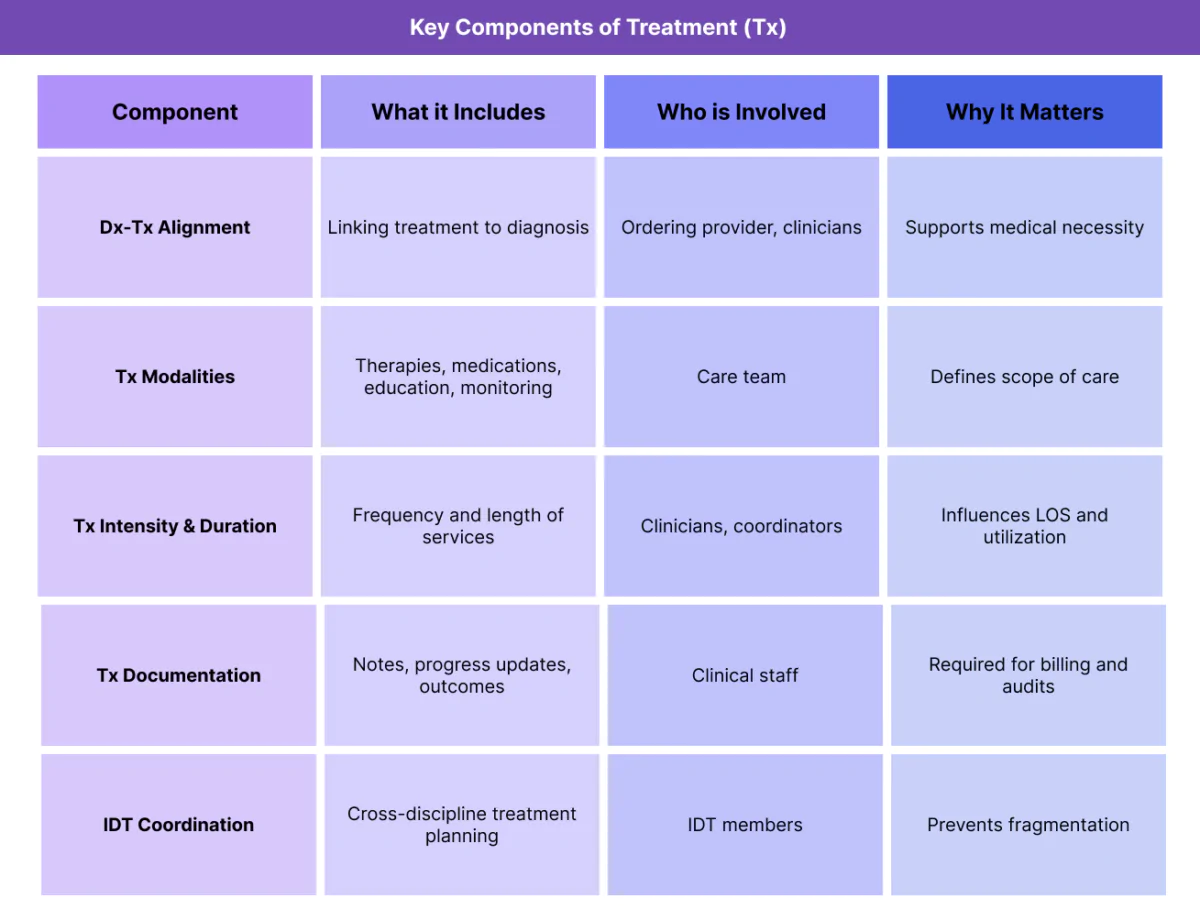
Key Components of Tx (Treatment) in Healthcare
Tx is not a single action but a coordinated set of clinical decisions and services delivered over time.
Alignment Between Dx and Tx
All Tx should directly address the patient’s documented Dx (Diagnosis). Interventions that do not logically connect to Dx create compliance risk and may be questioned during audits.
Clear Dx–Tx alignment is foundational to medical necessity.
Treatment Modalities and Interventions
Tx may include medications, therapies, procedures, education, monitoring, or supportive services. The selected modalities depend on patient needs, care setting, and program requirements.
In post-acute and longitudinal care, Tx is often delivered across multiple visits and disciplines.
Tx Intensity, Frequency, and Duration
Tx is defined not only by what is delivered, but by how often, how long, and by whom. These factors influence the patient’s LOS (Length of Stay) and resource utilization.
Tx intensity must be justified through documentation and reassessment.
Documentation of Tx Delivery
Every Tx must be documented to demonstrate what was provided, how the patient responded, and whether goals are being met. Documentation supports continuity, compliance, and billing.
Incomplete Tx documentation is a common source of denial risk.
Interdisciplinary Treatment Coordination
Tx frequently involves multiple disciplines. Coordination across the IDT (Interdisciplinary Team) ensures that treatments are complementary rather than duplicative.
How Treatment (Tx) Works in Practice
Tx unfolds over time as part of a structured care episode and evolves based on patient response and progress.
Initiating Tx at Start of Care (SOC)
Tx typically begins at SOC (Start of Care), following confirmation of Dx and establishment of the POC (Plan of Care). Early Tx focuses on stabilization, education, and initiating interventions aligned with immediate patient needs.
Initial Tx decisions set the trajectory for the episode.
Delivering Tx According to the Plan of Care (POC)
The POC (Plan of Care) outlines the goals, interventions, frequency, and disciplines involved in Tx. Care teams deliver Tx according to this plan while documenting progress and patient response.
Deviation from the POC requires clinical justification and updates.
Coordinating Tx Across the IDT
Tx delivery often spans nursing, therapy, social work, and other disciplines. The IDT (Interdisciplinary Team) coordinates efforts to ensure treatments are complementary and aligned with shared goals.
Effective coordination improves efficiency and outcomes.
Adjusting Tx During LOS
As the patient progresses through their LOS (Length of Stay), Tx may be intensified, reduced, or modified based on response and reassessment. Adjustments must be documented and supported by clinical findings.
Ongoing reassessment ensures Tx remains medically necessary.
Concluding Tx at Discharge (DC)
Tx concludes at DC (Discharge) when care goals are met or services are no longer medically necessary. Final documentation should reflect the Tx provided, outcomes achieved, and rationale for ending care.
Clear Tx closure supports continuity and compliance.
Tx in Billing, Medical Necessity, and Reimbursement
Treatment is the operational expression of medical necessity. While Tx itself is not a billing code, it is the core activity that billing and reimbursement are meant to reflect.
How Tx Supports Medical Necessity
In Medicare-regulated programs, medical necessity requires that services are reasonable and necessary to diagnose or treat a patient’s condition. Tx must be clearly connected to the documented Dx (Diagnosis) and consistent with the goals and interventions outlined in the POC (Plan of Care).
When Tx is delivered without clear Dx alignment or exceeds what is outlined in the POC without justification, payers may determine that services were not medically necessary—even if care was clinically appropriate.
Tx and Reimbursement Integrity
Accurate Tx documentation ensures that reimbursement reflects what was actually delivered. Under-documentation can result in underpayment or lost revenue, while over-documentation or unsupported Tx increases audit risk.
Tx notes are often reviewed alongside LOS (Length of Stay) to assess whether the duration and intensity of services align with the patient’s condition and progress.
Tx in Episode-Based and Programmatic Payment Models
In episode-based payment models, Tx intensity and frequency influence cost distribution across the episode. Longer or more intensive Tx without corresponding improvement or justification may raise concerns during payer review.
Effective Tx management balances clinical need with operational sustainability.
Common Tx-Related Compliance and Audit Risks
Tx-related compliance risk most often arises from documentation gaps rather than inappropriate care.
Common risks include:
- Tx not clearly linked to Dx
- Tx delivered outside the approved POC
- Lack of progress documentation during extended LOS
- Inconsistent Tx descriptions across disciplines
- Services continuing without reassessment
Auditors frequently evaluate whether Tx documentation demonstrates ongoing necessity and progress.
System and Workflow Challenges Affecting Tx
Tx delivery is highly sensitive to system design and workflow quality.
Fragmented Tx Documentation
When Tx documentation is spread across disconnected systems, it becomes difficult to demonstrate consistency, progress, and necessity.
Limited Visibility Into Tx Progress
Without clear tracking of Tx delivery and response, care teams may miss opportunities to adjust interventions or prepare for DC (Discharge).
Coordination Gaps Across the IDT
Poor communication across the IDT (Interdisciplinary Team) can result in duplicated or misaligned Tx, increasing cost without improving outcomes.
How Tx Influences Quality, Access, and Equity
Tx decisions shape patient experience and system performance.
Tx and Quality of Care Outcomes
Appropriate Tx supports symptom management, functional improvement, and recovery. Tx that is misaligned with Dx or delivered inconsistently can undermine outcomes and patient trust.
Tx and Access to Healthcare Services
Efficient Tx delivery helps organizations serve more patients within existing capacity. Overly prolonged or poorly coordinated Tx can limit access for others who need care.
Equity Considerations in Treatment Delivery
Equity-aware Tx considers cultural context, language access, health literacy, and social barriers. Standard Tx plans may require adaptation to ensure all patients can engage effectively in care.
Failure to address these factors can lead to unequal outcomes even when Tx protocols are followed.
Frequently Asked Questions about Diagnosis (Tx) in Healthcare
1. What does Tx mean in healthcare?
Tx stands for Treatment and refers to the clinical interventions and services provided to address a patient’s diagnosed condition. Tx includes therapies, medications, education, monitoring, and other actions delivered as part of an episode of care, typically guided by the POC and supported by Dx documentation.
2. How is treatment different from diagnosis?
Dx identifies what condition a patient has, while Tx describes what is done to address that condition. Dx establishes medical necessity, and Tx is the delivery of care in response to that diagnosis. Both must align for services to be compliant and reimbursable.
3. How is Tx documented in Medicare programs?
Tx is documented through progress notes, visit documentation, and outcome tracking that describe what services were provided, how the patient responded, and whether goals are being met. Documentation must demonstrate that Tx remains medically necessary throughout the LOS.
4. Can treatment change during an episode of care?
Yes. Tx often evolves as patients respond to care or as conditions change. When Tx is modified, updates should be documented and reflected in the POC to maintain compliance and continuity.
5. What happens if treatment is not documented properly?
Poor Tx documentation can lead to claim denials, audits, delayed payment, or difficulty demonstrating medical necessity. Even appropriate Tx may be challenged if documentation does not clearly support it.
6. How does Tx relate to SOC, LOS, and DC?
Tx typically begins at SOC, is delivered and adjusted throughout LOS, and concludes at DC. Together, SOC, Tx, LOS, and DC define the structure and flow of an episode of care.
7. Can treatment affect audits or reviews?
Yes. Auditors often evaluate whether Tx aligns with Dx, whether services were delivered as planned, and whether documentation supports continued necessity throughout the episode.
