

What is PECOS (Provider Enrollment, Chain, and Ownership System)?
The Provider Enrollment, Chain, and Ownership System (PECOS) is CMS’s secure online platform used to enroll, update, and maintain Medicare provider and supplier records. PECOS serves as the authoritative system of record for validating ownership structures, practice locations, reassignment agreements, and identity credentials required for participation in federal healthcare programs. By centralizing these functions, PECOS ensures that Medicare enrollment data remains accurate, complete, and compliant with federal screening standards.
PECOS supports a wide range of provider types—including physicians, non-physician practitioners, group practices, DMEPOS suppliers, hospitals, and health systems—and interfaces directly with NPPES, MACs, and CMS identity verification tools. Through this integrated ecosystem, PECOS enables providers to complete revalidations, update ownership information, manage enrollment relationships, and reduce administrative errors that can delay reimbursement.
From an operational and billing perspective, PECOS is foundational to Medicare participation. Providers must be fully enrolled and in an approved status within PECOS before claims can be submitted or reassignment arrangements can take effect. Accurate PECOS data helps prevent denied claims, compliance flags, and payment holds, making it a critical element of revenue cycle integrity and regulatory adherence for organizations participating in Medicare.
Key Components of Care Team-Based Services (CTBS)
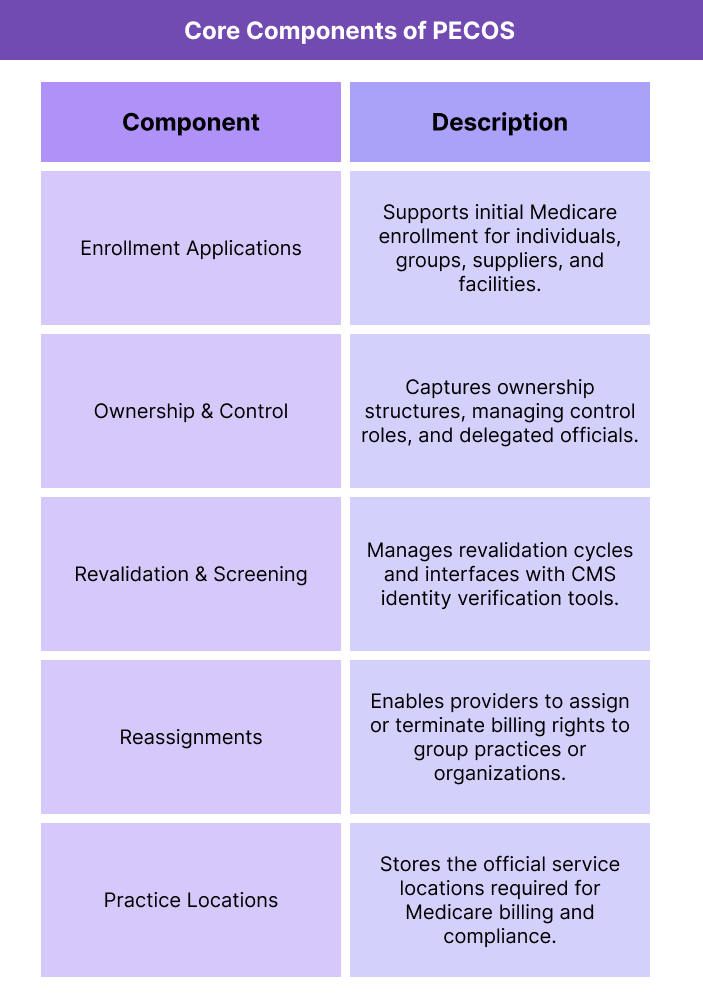
PECOS functions as CMS’s centralized system for managing Medicare enrollment records, identity verification, ownership structures, and billing relationships for providers and suppliers. Its design ensures that enrollment data remains consistent across NPPES, MACs, and federal screening systems, reducing administrative burden and strengthening program integrity.
PECOS integrates multiple operational and compliance processes, allowing healthcare organizations to submit applications, manage reassignments, update practice locations, and complete revalidations through a unified digital workflow.
Enrollment Application Management
PECOS supports initial Medicare enrollment applications for individual practitioners, groups, DMEPOS suppliers, and institutional providers. It allows users to complete, sign, and submit all required forms electronically, replacing traditional paper-based enrollment.
Ownership and Control Tracking
The system captures detailed ownership, managing control, and delegated official information. These data points are used to verify compliance with federal screening requirements and to prevent fraudulent or unverified entities from billing Medicare.
Revalidation and Screening
PECOS automates the tracking of revalidation cycles, prompting providers when they must update and re-confirm their enrollment information. It interfaces with federal verification systems to support identity checks, licensure validation, and screening protocols.
Reassignment and Group Practice Enrollment
Providers can use PECOS to establish or terminate reassignment agreements, join group practices, and update organization affiliations. These relationships determine how claims can be billed and where payments are directed.
Practice Location and Service Address Management
PECOS maintains the official Medicare-recognized locations where services are rendered. Keeping these data accurate helps prevent claim denials and payment holds, particularly during audits or MAC reviews.
How PECOS Works in Practice
PECOS functions as the operational backbone for Medicare enrollment, enabling providers, suppliers, and organizations to complete required enrollment actions through a standardized digital workflow. Because Medicare will not pay claims for unenrolled or improperly enrolled entities, PECOS plays a central role in credentialing, revenue cycle operations, and compliance management across healthcare organizations.
In day-to-day practice, PECOS is used by individual practitioners, billing staff, delegated officials, and compliance teams to maintain accurate information, ensure uninterrupted reimbursement, and avoid administrative denials. The system’s integration with NPPES and MAC processing systems creates a unified enrollment environment that reduces duplicate data entry and accelerates application reviews.
1. Initial Enrollment
A provider or supplier begins by authenticating through Identity & Access (I&A) Management, linking their credentials to NPPES information, and selecting the appropriate enrollment application. PECOS guides users through ownership, location, licensure, and documentation steps required for Medicare participation. Once submitted, the application is routed to the appropriate MAC for review and approval.
2. Managing Reassignments and Group Affiliations
Organizations routinely use PECOS to add or terminate practitioners under their group enrollment. Providers can reassign billing rights to groups, update taxonomies, or adjust affiliations. These updates determine where Medicare payments are directed and which entities may legally bill for services on a provider’s behalf.
3. Updating Ownership or Practice Locations
When a provider adds new service locations, changes ownership, or updates managing control information, PECOS acts as the official source of truth. Accurate and timely updates are critical, as mismatched or outdated information can trigger claim denials, post-payment reviews, or temporary payment suspensions during MAC audits.
4. Revalidation Cycles
PECOS tracks mandatory revalidation intervals and notifies users when they must re-confirm their enrollment information. Providers submit updated documentation, licenses, and ownership details, which are re-reviewed by MACs. Failing to revalidate on time can result in deactivation, halting all Medicare payments until corrective actions are completed.
5. Compliance and Program Integrity Reviews
During audits, site visits, or enrollment screening, PECOS serves as the authoritative record for federal officials. MACs, UPICs, and CMS reviewers rely on PECOS data to verify that billing entities remain compliant with Medicare requirements. Organizations often use PECOS proactively to ensure data accuracy before undergoing operational or financial reviews.
PECOS in Billing, Reimbursement, and Compliance Limitations
PECOS directly influences a provider’s ability to bill Medicare, determine reimbursement eligibility, and maintain uninterrupted revenue flow. Because Medicare requires providers and suppliers to be fully enrolled, accurately listed, and in an “approved” status before claims can be processed, PECOS is effectively tied to every stage of the revenue cycle. Incorrect enrollment data—such as outdated practice locations, incomplete ownership disclosures, or inactive reassignment relationships—can lead to denials, payment delays, or deactivation of billing privileges.
From a reimbursement standpoint, PECOS serves as the authoritative source of truth for verifying whether a provider is eligible to render services, whether an organization is authorized to submit claims on a provider’s behalf, and whether payment routing aligns with Medicare requirements. Enrollment status issues are among the most common reasons for claim holds, payment suspensions, and prepayment or post-payment reviews conducted by MACs, UPICs, and other CMS contractors.
PECOS also introduces several system-level challenges. The application and revalidation process can be time-consuming, particularly for organizations with complex ownership structures or multiple practice locations. Delays in MAC processing, mismatches between NPPES data and PECOS records, and errors in CMS Identity & Access (I&A) management can slow approval timelines or prevent users from accessing their applications. Additionally, providers may face gaps in historical data migration, occasional downtime, and a lack of real-time status visibility during MAC review periods.
Compliance risks arise when PECOS data does not accurately reflect a provider’s operational reality. Missing or outdated information—such as an unreported change in ownership (CHOW), inactive practice location, or lapsed license—can create audit exposure and trigger corrective action requirements. Organizations that rely on reassignment relationships must ensure these connections are continuously updated in PECOS to avoid rendering services that Medicare may later deem nonbillable.
PECOS and Its Impact on Quality, Access, and Equity in Healthcare
PECOS plays a foundational role in ensuring that Medicare beneficiaries have access to qualified providers and that healthcare organizations meet federal participation standards. By maintaining accurate enrollment and screening records, PECOS helps protect program integrity and ensure that only appropriately credentialed practitioners and suppliers deliver services to Medicare populations. This contributes to overall care quality by preventing unverified or non-compliant entities from entering the program.
PECOS also affects access, particularly in regions facing workforce shortages or provider turnover. Delays in enrollment approval or revalidation can temporarily remove providers from active status, reducing service availability and straining access for rural, underserved, or high-need communities. For organizations operating across multiple locations, timely PECOS updates are essential to avoiding service disruption, especially when opening new sites or integrating additional clinicians.
In terms of equity, PECOS supports initiatives aimed at expanding participation among smaller practices, rural clinics, and community-based organizations. Streamlined digital workflows reduce administrative friction that historically disadvantaged resource-limited providers. However, disparities persist: providers with limited administrative staff or limited digital infrastructure may experience longer processing times or higher rates of application errors. Ensuring equitable access to enrollment support is critical to maintaining balanced provider distribution across the Medicare program.
PECOS also influences the quality of care indirectly by shaping reimbursement continuity. When providers experience unexpected deactivation or enrollment holds due to incomplete or outdated PECOS information, patients may face interruptions in care or be redirected to alternative providers. Maintaining precise PECOS records helps stabilize care access, reduce administrative burdens, and support consistent service delivery for vulnerable Medicare populations.
Frequently Asked Questions about PECOS
1. What is PECOS?
PECOS is CMS’s online system for enrolling, updating, and maintaining Medicare provider and supplier records. It verifies ownership, practice locations, reassignment relationships, and enrollment status, determining whether an individual or organization is eligible to bill Medicare.
2. What does PECOS do in the Medicare enrollment process?
PECOS manages initial enrollment applications, revalidation cycles, ownership disclosures, and billing relationships. It serves as the central repository for Medicare enrollment data used by MACs and CMS screening tools.
3. How is PECOS different from NPPES?
NPPES manages NPI information, while PECOS manages Medicare enrollment. NPPES establishes identity; PECOS establishes billing eligibility. Both systems share data but serve different regulatory functions.
4. Who needs to enroll in PECOS?
Any provider or supplier that bills Medicare—including physicians, non-physician practitioners, hospitals, DMEPOS suppliers, and group practices—must enroll and maintain active information in PECOS.
5. How do reassignment relationships work in PECOS?
PECOS allows providers to assign billing rights to a group or organization. These relationships determine where Medicare payments are directed and must be kept up to date to avoid claim denials.
6. What happens if a provider misses their PECOS revalidation deadline?
Missing a revalidation deadline can result in deactivation of billing privileges. Claims will be denied until the provider updates their information and the MAC completes reapproval.
7. How long does PECOS enrollment or revalidation take?
Processing times vary based on provider type and MAC workload. Applications may take several weeks to several months, particularly if ownership structures or documentation require additional review.
8. Can PECOS applications be signed electronically?
Yes. PECOS supports electronic signatures through CMS Identity & Access Management, which eliminates the need for paper forms and accelerates processing.
9. What documents or information are required for PECOS enrollment?
Providers must typically submit licensure information, practice locations, ownership and managing control data, reassignment agreements, and supporting documents specific to their provider type.
10. Can incorrect PECOS data cause claim denials?
Yes. If PECOS data conflicts with NPPES records, practice locations are outdated, or reassignments are inactive, Medicare claims may be denied or placed on hold until corrections are made.
11. Is PECOS required for Medicare Advantage participation?
Yes. Providers must maintain active Medicare enrollment in PECOS even when contracting with Medicare Advantage plans, because CMS requires underlying Medicare eligibility.
12. How can providers check the status of a PECOS application?
Status can be reviewed directly within the PECOS portal, or providers can contact their MAC for detailed updates during the review process.
