

What is Hx (History) in Healthcare?
Hx (History) refers to the documented account of a patient’s past and present health information that is relevant to clinical decision-making. Hx includes prior diagnoses, treatments, medications, procedures, social factors, and other contextual details that inform how care is delivered.
In healthcare operations, Hx serves as the contextual foundation for nearly every downstream workflow. Accurate Hx supports correct Dx (Diagnosis), appropriate Tx (Treatment) selection, and effective care planning throughout an episode of care that begins at SOC (Start of Care) and concludes at DC (Discharge).
Hx is not limited to a single data point or intake form. It is an evolving record that may be updated as new information becomes available or as the patient’s condition changes. In Medicare-regulated programs, Hx documentation plays a critical role in establishing medical necessity, assessing risk, and supporting compliance.
Incomplete, outdated, or inaccurate Hx can lead to misdiagnosis, inappropriate treatment, documentation gaps, and increased audit risk.
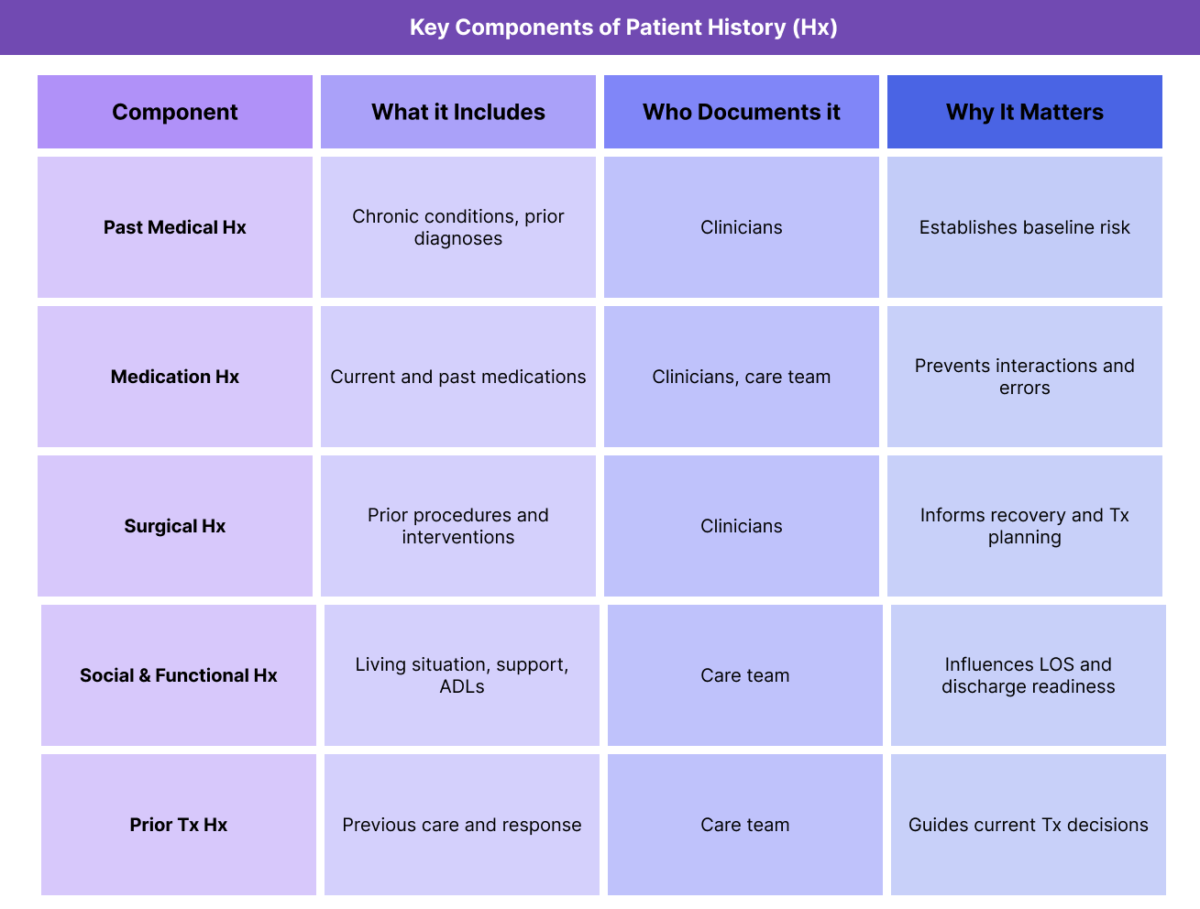
Key Components of Patient History (Hx) in Healthcare
Patient Hx is typically composed of multiple interconnected elements, each contributing to a comprehensive clinical picture.
Past Medical History
Past medical history includes prior diagnoses, chronic conditions, hospitalizations, surgeries, and significant illnesses. This information helps clinicians assess baseline risk and anticipate care needs.
Past medical Hx often influences Dx selection and Tx planning.
Medication History
Medication Hx documents current and prior medications, dosages, adherence, and known adverse reactions. Medication history is essential for avoiding interactions, duplications, or contraindications during Tx.
Surgical and Procedural History
Surgical and procedural Hx captures prior interventions that may affect current function, risk, or treatment options. This history often informs discharge planning and recovery expectations.
Social and Functional History
Social Hx includes living situation, caregiver support, language needs, transportation access, and other non-clinical factors. Functional Hx addresses mobility, cognition, and ability to perform daily activities.
These elements directly influence LOS and discharge readiness.
Family History
Family Hx captures hereditary conditions and risk factors that may inform Dx or preventive care decisions.
Prior Treatment and Care Utilization History
Prior Tx history includes previous therapies, services received, and responses to care. Understanding what has or has not worked in the past helps tailor current interventions.
How History (Hx) Works in Practice
Hx is actively used throughout the lifecycle of care, shaping decisions from intake through discharge.
Collecting Hx During Intake and Start of Care (SOC)
Hx collection typically begins during intake and is formalized at SOC (Start of Care). Clinicians gather information from patient interviews, referrals, prior records, and caregiver input.
Early Hx accuracy is critical because it directly informs initial Dx (Diagnosis) and the POC (Plan of Care).
Using Hx to Inform Diagnosis (Dx)
Clinicians rely on Hx to contextualize symptoms and assessment findings. Past conditions, medication use, and social factors often clarify or narrow diagnostic possibilities.
Incomplete Hx can lead to incorrect or delayed Dx.
Leveraging Hx for Treatment (Tx) Planning
Hx guides Tx (Treatment) selection by identifying what interventions are appropriate, safe, and likely to be effective. Prior Tx response, medication tolerance, and functional baseline all influence care decisions.
Tx that ignores relevant Hx increases risk and inefficiency.
Sharing Hx Across the IDT
Hx must be accessible to the IDT (Interdisciplinary Team) to support coordinated care. When Hx is fragmented or siloed, teams may make inconsistent decisions.
Shared Hx improves alignment and reduces duplication.
Updating Hx Throughout LOS
As care progresses through the patient’s LOS (Length of Stay), Hx may be updated to reflect new diagnoses, treatments, or social changes. These updates help ensure ongoing care remains appropriate.
Referencing Hx at Discharge (DC)
At DC (Discharge), Hx supports continuity by informing follow-up care, referrals, and patient education. Accurate Hx at discharge reduces transition-related risk.
Hx in Billing, Medical Necessity, and Reimbursement
Patient history is not billed directly, but it plays a critical supporting role in whether billed services are considered reasonable, necessary, and compliant—especially in Medicare-regulated care.
How Hx Supports Medical Necessity
In Medicare programs, medical necessity is evaluated in context. Hx (History) provides that context by explaining the patient’s baseline condition, prior care, risk factors, and complexity.
When services are delivered under a POC (Plan of Care), reviewers expect the documented Dx (Diagnosis) and Tx (Treatment) to make sense in light of the patient’s Hx. Missing or incomplete Hx can weaken the justification for services, even when care itself is appropriate.
Hx and Reimbursement Integrity
Accurate Hx documentation helps ensure reimbursement aligns with patient complexity. Chronic conditions, prior hospitalizations, and functional limitations documented in Hx often explain why a patient requires more intensive or prolonged care during their LOS (Length of Stay).
When Hx is understated or omitted, reimbursement may not reflect the true scope of care required.
Hx in Episode-Based and Longitudinal Care Models
In episode-based and longitudinal care models, Hx informs expected care duration, visit frequency, and interdisciplinary involvement. Payers may compare outcomes and utilization against what would reasonably be expected given the patient’s documented history.
Hx gaps can make episodes appear inefficient or unnecessary when reviewed in isolation.
Common Hx-Related Documentation and Compliance Risks
Hx-related compliance issues typically arise from documentation quality rather than clinical decision-making.
Common risks include:
- Incomplete Hx collected at SOC
- Failure to update Hx when conditions change
- Inconsistent Hx across assessments and notes
- Missing social or functional Hx impacting care decisions
- Hx not clearly connected to Dx or Tx
Auditors may question care decisions when Hx does not support the documented level of service.
System and Workflow Challenges Affecting Hx
Hx quality is highly dependent on workflow design and system integration.
Fragmented Hx Across Systems
When Hx is spread across multiple systems or buried in free-text notes, clinicians may miss critical context. Fragmentation increases risk of errors and inconsistent documentation.
Limited Time for Comprehensive Hx Collection
Time constraints during intake or SOC can result in partial Hx collection. Without structured workflows to revisit and update Hx, gaps may persist throughout the episode.
Poor Visibility for the IDT
If Hx is not easily accessible to the IDT (Interdisciplinary Team), care decisions may be made without full context, reducing coordination and effectiveness.
How Hx Influences Quality, Access, and Equity
Hx has a direct impact on care quality and fairness.
Hx and Quality of Care Outcomes
Accurate Hx supports correct Dx, appropriate Tx, and realistic care goals. When clinicians understand a patient’s full background, they are better equipped to deliver effective and safe care.
Hx and Access to Services
Hx influences eligibility and authorization decisions. Missing or unclear history can delay enrollment, referrals, or service initiation at SOC (Start of Care).
Equity Considerations in History Documentation
Social and functional Hx elements—such as housing stability, caregiver support, language needs, and access to resources—are critical for equitable care delivery. Failure to document these factors can result in care plans that do not account for real-world barriers.
Equity-aware Hx practices ensure that care decisions reflect the patient’s lived context, not just clinical data.
Frequently Asked Questions about History (Hx) in Healthcare
1. What does Hx mean in healthcare?
Hx stands for History and refers to the documented record of a patient’s past and present health information, including medical conditions, treatments, medications, and social factors. Hx provides the context needed to make informed clinical and operational decisions.
2. Why is patient history important in healthcare?
Patient Hx helps clinicians understand baseline risk, identify patterns, and avoid unsafe or ineffective interventions. Accurate Hx supports correct Dx, appropriate Tx, and better outcomes across the episode of care.
3. How is Hx used in Medicare programs?
In Medicare-regulated programs, Hx supports medical necessity by explaining why services are needed and how care decisions align with patient complexity. Reviewers may evaluate Hx alongside Dx, Tx, LOS, and DC documentation.
4. Does patient history need to be updated during care?
Yes. Hx should be updated as new diagnoses, treatments, or social changes occur. Keeping Hx current helps ensure care remains aligned with the patient’s condition and circumstances.
5. What happens if patient history is incomplete or inaccurate?
Incomplete or inaccurate Hx can lead to misdiagnosis, inappropriate treatment, documentation gaps, and increased audit risk. It can also negatively affect patient outcomes and experience.
6. How does Hx relate to SOC, LOS, and DC?
Hx is collected and confirmed at SOC, informs care decisions throughout LOS, and supports continuity and transition planning at DC. Together, Hx, SOC, LOS, and DC define the structure and flow of an episode of care.
7. Can poor history documentation affect audits or payment?
Yes. Auditors may question the necessity or appropriateness of care when Hx does not support documented Dx, Tx, or LOS. Strong Hx documentation reduces this risk.
