

What is ADR (Additional Documentation Request) in Medicare?
An Additional Documentation Request (ADR) is a formal Medicare medical review letter sent by a Medicare Administrative Contractor (MAC) when more documentation is needed to support payment of a claim. The ADR tells a provider which claim is under review and specifies the medical records or supporting documents CMS needs to confirm that the billed service meets Medicare coverage, coding, and billing requirements.
ADRs are part of Medicare’s routine compliance and medical review process. They can be triggered by prepayment review (before a claim is paid) or postpayment review (after payment, as part of audits or error-prevention programs). Providers must respond with the requested records by the deadline stated in the ADR, or the claim is usually denied for “no documentation” regardless of whether the service was medically necessary. Medicare guidance emphasizes that nonresponse is one of the most common avoidable denial causes.
In practice, ADRs are a key inflection point in the denial-and-appeals pipeline. A fast, complete ADR response can prevent a denial outright and reduce the need for redetermination or QIC reconsideration later. For billing and compliance teams, ADR handling is a foundational workflow for protecting reimbursement and maintaining audit readiness.
Key Components of a ADR
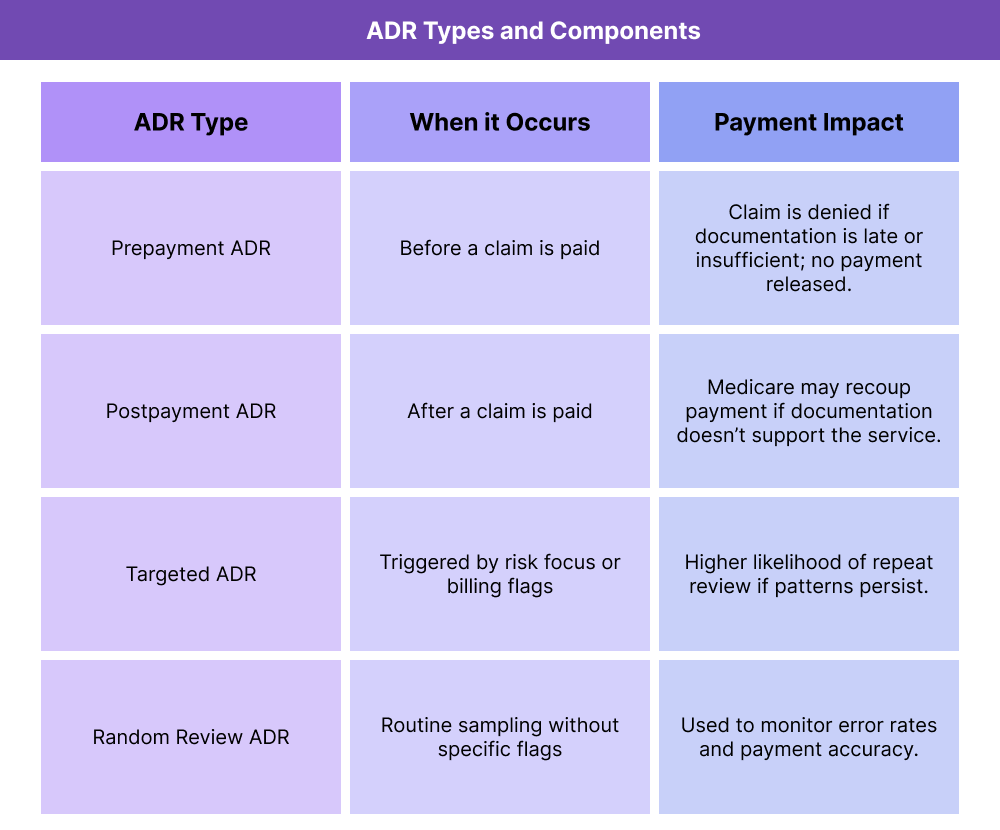
Medicare ADRs are designed to standardize how documentation is requested and reviewed before or after claims payment. While the format of an ADR letter is consistent, the reason an ADR is issued and how it affects payment can vary based on the review type and where the claim sits in the payment lifecycle.
Understanding the core ADR categories helps providers respond correctly and predict operational impact.
Prepayment ADRs (Before Payment)
A prepayment ADR is issued when a MAC needs documentation to validate a claim before releasing payment. These reviews are often tied to higher-risk services, billing pattern flags, or targeted medical review initiatives.
If documentation is not submitted on time or does not support coverage criteria, the claim is denied and no payment is released.
Postpayment ADRs (After Payment)
A postpayment ADR is sent after a claim has already been paid. Medicare uses these reviews to confirm that payment was appropriate under coverage and documentation rules.
If documentation does not support the paid claim, Medicare may recoup payment. This makes postpayment ADRs especially important for audit readiness.
Targeted ADRs vs. Random Review ADRs
ADRs can be issued through different review programs:
- Targeted ADRs focus on specific codes, provider types, or billing patterns that have been identified as higher-risk.
- Random review ADRs occur as part of routine error-rate monitoring even when no risk flags are present.
- Providers should treat both the same operationally: respond completely, on time, and aligned to policy.
- ADR Deadlines and Submission Expectations
Every ADR includes a response deadline and submission instructions. Medicare expects providers to submit:
- The exact records listed in the request
- Documentation that clearly supports medical necessity and coverage rules
- A complete packet rather than piecemeal submissions
Missing the deadline typically triggers an automatic denial.
How Medicare ADRs Work in Practice
ADRs follow a clear operational sequence tied to Medicare medical review. Providers who understand the workflow can respond faster, reduce avoidable denials, and limit escalation into formal appeals.
Step 1: A Claim Is Flagged for Medical Review
A Medicare Administrative Contractor (MAC) selects a claim for review either before payment (prepayment) or after payment (postpayment). Selection may be random or targeted to services, provider types, or billing patterns that Medicare considers higher risk.
Step 2: The MAC Issues an ADR Letter
The MAC sends an ADR letter identifying:
- The specific claim under review
- The exact documentation needed
- The submission deadline
- How and where to submit records
This letter is the provider’s formal notice that payment depends on documentation support.
Step 3: The Provider Submits the Documentation Packet
The provider compiles and submits a complete record set, typically including the clinical notes, orders, care plans, test results, or other evidence that matches the coverage requirement for the billed service.
Operationally, the strongest ADR responses:
- Mirror the ADR checklist exactly
- Highlight the medical necessity storyline clearly
- Include any required signatures, dates, and linked supporting records
Submitting partial or disorganized records increases denial risk even when care was appropriate.
Step 4: Medicare Reviews and Makes a Determination
The MAC evaluates whether the submitted documentation supports the claim under Medicare coverage and billing rules. Outcomes include:
- Payment approval (or no recoupment if postpayment)
- Partial reduction or adjustment
- Denial due to insufficient documentation
- Denial due to no response
Step 5: If Denied, the Claim Enters Appeals
If a claim is denied after ADR review, the provider can move into the appeal pathway, starting with redetermination at the MAC level and potentially progressing to QIC reconsideration if needed.
ADRs in Billing, Reimbursement, and System Limitations
ADRs sit at a high-leverage point in the Medicare revenue cycle because they determine whether a claim gets paid, denied, or recouped based on documentation support. Even when services were clinically appropriate, Medicare will not pay if the record submitted during the ADR window does not meet policy requirements.
How ADRs Protect or Disrupt Payment
When a MAC issues an ADR, it is essentially pausing the claim’s status until documentation proves compliance. If the response is complete and timely, the claim can be paid (prepayment ADR) or kept paid (postpayment ADR). If records are missing, late, or don’t support coverage criteria, the claim is denied or recouped.
Operationally, ADR outcomes usually fall into three buckets:
- Pay/affirm when documentation clearly supports coverage and coding
- Adjust when parts of the claim are unsupported
- Deny/recoup when documentation is insufficient or not received
Because denial for nonresponse is avoidable, ADR response management is one of the most direct ways to reduce preventable Medicare denials.
ADRs as the Front Door to Appeals
If an ADR results in denial, the claim moves into the formal appeals pipeline:
- Level 1 redetermination with the MAC
- Level 2 QIC reconsideration if needed
- Higher levels only after those steps
That means a strong ADR response can save weeks or months of future appeal work. A weak ADR response usually increases downstream burden and lowers reversal odds.
System Limitations and Operational Watch-Outs
ADRs create predictable failure points for billing teams:
- Address or portal mismatch causing ADR letters to be missed
- Late chart completion (notes, orders, signatures) leading to incomplete packets
- Fragmented records across systems that delay assembly
- Sending extra irrelevant records that obscure the medical necessity story
- Duplicate submission methods that slow review or create processing errors
The safest ADR workflow treats each request like a mini-audit: mirror the request list exactly, package records cleanly by date of service, and ensure every required element is signed, dated, and legible.
How ADRs Influence Quality, Access, and Equity in Healthcare
Even though ADRs are administrative, their outcomes affect whether care remains financially sustainable and accessible—especially for Medicare-heavy practices.
Quality and Documentation Integrity
ADRs reinforce Medicare’s expectation that the medical record clearly supports the service billed. Over time, consistent ADR handling strengthens documentation habits by pushing organizations to:
- Tie services to coverage criteria in the note
- Maintain clean order/signature workflows
- Standardize how “medical necessity” is expressed
- Reduce variation between clinicians and sites
Better documentation doesn’t just prevent denials—it also improves internal care consistency and audit readiness.
Access and Continuity Effects
When ADRs delay or deny payment, providers may experience cash-flow disruption, rework load, and slowed throughput in high-review service lines. If denials persist, some organizations reduce participation in certain Medicare-covered services due to administrative cost.
Fast, accurate ADR response helps preserve continuity by stabilizing reimbursement and keeping covered services viable.
Equity Considerations
Administrative denial risk tends to hit hardest in settings with fewer support resources—rural clinics, safety-net providers, and smaller groups. When ADR processes are unclear or burdensome, these providers can see higher avoidable denial rates, which can translate into reduced local service availability for vulnerable Medicare populations.
Strong ADR infrastructure helps protect equitable access by preventing documentation friction from becoming a care gap.
Frequently Asked Questions about ADRs
1. What is an ADR (Additional Documentation Request)?
An ADR is a Medicare medical review letter sent by a Medicare Administrative Contractor (MAC) asking a provider to submit specific documentation to support payment of a claim.
2. Why did I receive an ADR from Medicare?
ADRs are issued when Medicare needs to confirm that a billed service meets coverage, coding, and medical necessity requirements. They can be random or targeted based on service type or billing patterns.
3. What happens if I don’t respond to an ADR?
If you don’t respond by the deadline, Medicare typically denies the claim for “no documentation,” even if the service was medically necessary.
4. What is the difference between a prepayment and postpayment ADR?
A prepayment ADR is issued before Medicare pays the claim; payment is held until documentation is reviewed. A postpayment ADR is issued after payment; Medicare may recoup the payment if the documentation doesn’t support the claim.
5. How long do I have to respond to an ADR?
The ADR letter includes the response deadline. Providers must submit the complete documentation packet by that date or risk automatic denial.
6. What should be included in an ADR submission?
You should submit exactly the records requested in the ADR, organized and complete, with clear evidence of medical necessity, correct orders, signatures, dates, and any policy-required elements tied to the service.
7. What if my claim is denied after an ADR?
If the claim is denied, you can appeal through the Medicare appeals process starting with redetermination and, if needed, QIC reconsideration.
