

CPT 98013 Description, Billing Rules, & Use Cases
CPT 98013 is used to bill for a synchronous audio-only evaluation and management (E/M) service with an established patient that involves low-complexity medical decision making (MDM) or at least 20 minutes of total provider time on the date of the encounter.
Introduced in 2025 as part of the expanded audio-only telehealth E/M code set (98008–98015), CPT 98013 replaced the retired telephone codes (99441–99443). It represents the second level of complexity for established-patient audio-only visits and is used for encounters requiring a longer and more in-depth discussion than CPT 98012, but less complex than CPT 98014 or 98015.
The service typically includes:
- Assessment and management of one or more stable chronic conditions requiring active follow-up
- Review of recent labs or diagnostic tests with minor treatment adjustments
- Preventive or chronic-care counseling conducted via audio-only communication
- Care coordination for conditions that require monitoring but pose low to moderate clinical risk
- Documentation of clinical decisions and patient education provided during the call
Billing Notes:
- Use for established-patient audio-only E/M visits requiring low-complexity MDM or ≥ 20 minutes of provider time.
- The provider must personally perform the service using real-time, two-way audio communication.
- The visit cannot overlap with an in-person or audio-video E/M service on the same calendar day.
- Documentation must include patient consent, mode of communication (audio-only), and total time or MDM level.
- Encounters under 20 minutes should be reported with CPT 98012 (if > 10 minutes) or CPT 98016 (for 5–10 minutes).
What Is CPT Code 98013?
CPT 98013 is an evaluation and management (E/M) code for audio-only telemedicine visits with established patients that require low-complexity medical decision making (MDM) or at least 20 minutes of total provider time on the date of service.
Introduced in 2025, CPT 98013 is part of the audio-only telehealth E/M series (98008–98015) created to replace the deleted telephone visit codes (99441–99443). It is used when an established-patient encounter—conducted entirely by phone or another synchronous audio platform—requires a focused discussion, limited data review, and moderate patient interaction that extends beyond brief follow-up care.
Key points about CPT 98013:
- Used for established-patient audio-only visits requiring low-complexity MDM or ≥20 minutes of total provider time.
- The encounter must include a medically appropriate history and/or exam as deemed necessary by the provider.
- The visit must be real-time and synchronous (not asynchronous messaging).
- Appropriate for conditions needing more than routine follow-up but not complex management.
- Must be personally performed by a qualified healthcare provider (physician, NP, or PA).
- Cannot occur on the same day as an in-person or audio-video E/M service for the same patient.
In summary: CPT 98013 captures low-complexity audio-only telehealth encounters for established patients that require extended discussion (≥20 minutes) and limited decision-making beyond brief check-ins or medication renewals.
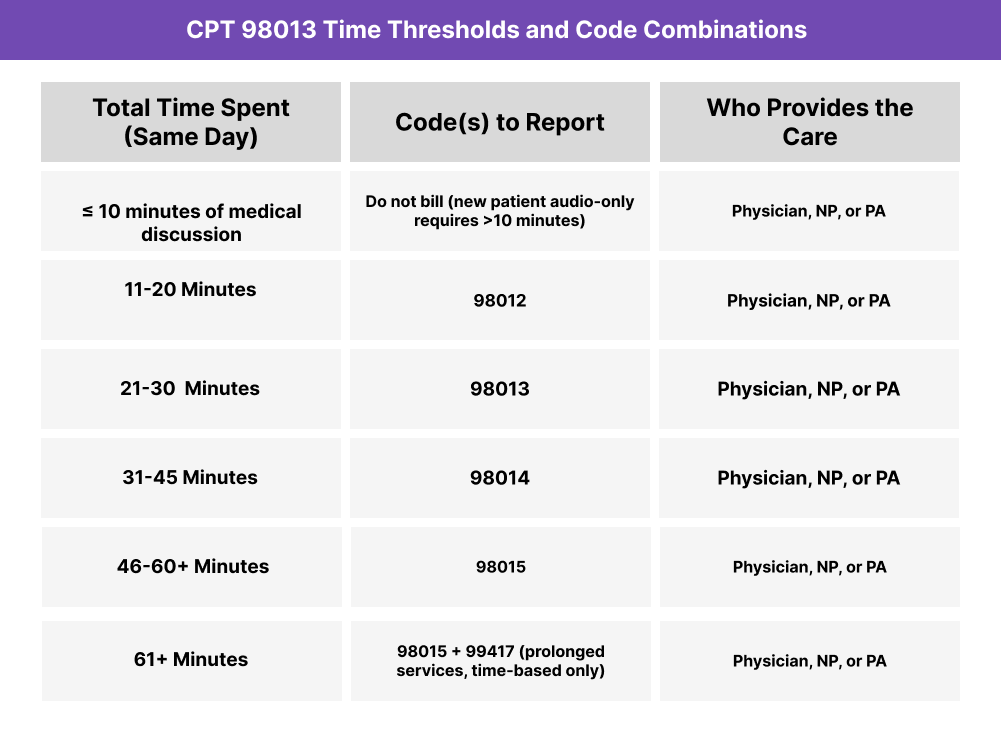
CPT 98013 Time Thresholds and Code Combinations
CPT 98013 represents a synchronous audio-only evaluation and management (E/M) service for an established patient that involves low-complexity medical decision making (MDM) or at least 20 minutes of total provider time on the date of service.
Understanding the Time Component
When selecting by time, the provider must personally spend 20 minutes or more on the encounter and all related work performed that same day.
Included time may involve:
- Reviewing current and prior notes, labs, or diagnostic tests
- Conducting a focused audio-only evaluation with patient education or medication discussion
- Adjusting ongoing treatment plans for stable or mildly symptomatic conditions
- Coordinating care or confirming adherence with other providers
- Documenting findings and recommendations in the medical record
If total time is less than 20 minutes, report CPT 98012.
Encounters exceeding 30 minutes may qualify for CPT 98014.
If time substantially exceeds 60 minutes, add CPT 99417 (prolonged services) to 98015 when applicable.
Understanding the MDM Component
When selecting by MDM, documentation must demonstrate low complexity, typically involving:
- Evaluation of a single chronic or minor condition with minimal risk
- Limited data review and simple testing or prescription adjustment
- Low risk of morbidity or treatment complications
When to Use CPT 98013: Common Scenarios and Use Cases
CPT 98013 is appropriate when a physician, nurse practitioner (NP), or physician assistant (PA) provides a synchronous audio-only evaluation and management (E/M) visit with an established patient that involves low-complexity medical decision making (MDM) or at least 20 minutes of total provider time on the same day.
Here are examples of how CPT 98013 is used in practice:
Chronic Disease Monitoring With Medication Adjustment
A primary care provider conducts a structured audio-only follow-up with a patient managing hypertension and hyperlipidemia to:
- Review recent lab results and discuss blood pressure logs
- Make a minor medication adjustment and confirm adherence
- Counsel on diet and exercise goals
Total time: 23 minutes
Billing: 98013

Behavioral Health Follow-Up for Stable Depression
A psychiatrist provides a telephonic follow-up visit to:
- Review the patient’s PHQ-9 score and current medication response
- Reinforce therapy compliance and self-care routines
- Plan the next check-in in four weeks
Total time: 25 minutes
Billing: 98013

Post-Operative Recovery Review
A surgical PA contacts a patient recovering from minor outpatient surgery to:
- Assess wound healing and confirm absence of infection
- Review pain management and refill a mild analgesic
- Provide guidance for activity restrictions and follow-up appointment scheduling
Total time: 28 minutes
Billing: 98013

CPT 98013 Billing Requirements and Eligibility
CPT 98013 is used to report a synchronous audio-only evaluation and management (E/M) visit with an established patient that involves low-complexity medical decision making (MDM) or at least 20 minutes of total provider time on the date of service.
This code represents the second level of complexity for established-patient audio-only E/M services, introduced in 2025 as part of the new telehealth code set that replaced the discontinued telephone codes (99441–99443).
Patient Eligibility
To qualify for CPT 98013:
- The patient must be established (seen by the same provider or group within the past three years).
- The encounter must be conducted using real-time, two-way audio-only communication.
- The patient must provide verbal consent for telehealth delivery and agree to an audio-only format.
- The condition(s) discussed must require low-complexity MDM or ≥20 minutes of provider time.
- The service must occur on a separate calendar day from any in-person or audio-video E/M service.
Provider Eligibility
The encounter must be personally performed by a physician, nurse practitioner (NP), or physician assistant (PA) qualified to report E/M services.
The provider must:
- Conduct the entire encounter personally using audio-only communication.
- Document the time spent or MDM level used for code selection.
- Include the modality (audio-only) and patient consent within the visit note.
- Provide a clinical assessment and plan consistent with E/M documentation standards.
Service Requirements
- Minimum provider time: 20 minutes on the date of service.
- Countable time includes chart review, the audio discussion, care coordination, and same-day documentation.
- Non-countable time includes administrative tasks, scheduling, and unrelated communication outside the encounter.
- Code selection may be based on total time or MDM, but documentation must support the higher criterion.
- A follow-up plan or next appointment must be documented.
Documentation Requirements
The visit note must clearly include:
- Start and end time, or total provider time (≥20 minutes).
- Patient consent for audio-only telehealth care.
- Statement of modality (e.g., “audio-only telehealth encounter, no video used”).
- Chief complaint or reason for visit.
Low-complexity MDM elements, including:
- Problems: One or more stable chronic or minor conditions.
- Data: Limited review of tests, notes, or medication changes.
- Risk: Low risk of morbidity or complications.
- Summary of the discussion, assessment, and care plan.
- Provider attestation confirming personal performance and record accuracy.
- Non-duplication statement confirming the visit was not combined with other same-day E/M services.
Medicare and Payer Coverage Notes
- Medicare: CPT 98013 currently carries a status indicator “I” (invalid for Medicare billing).
- Commercial payers: May recognize CPT 98013 under RBRVS valuation for reimbursement.
- Providers should confirm payer-specific audio-only telehealth policies, as coverage may vary by state and insurer.
CPT 98013 Billing Documentation Checklist
To support compliant billing for CPT 98013, documentation must confirm that the encounter was a real-time, audio-only telehealth visit with an established patient, requiring low-complexity medical decision making (MDM) or at least 20 minutes of total provider time.
Your encounter record should include:
- Patient consent for the use of audio-only telehealth, documented at the start of the encounter.
- Verification of patient identity using at least two identifiers (e.g., name and date of birth).
- Provider credentials and role (physician, NP, or PA) clearly listed.
- Statement of modality specifying “audio-only synchronous communication” (no video used).
- Chief complaint or reason for visit outlining the purpose of the encounter.
- Total provider time documented as ≥20 minutes, including:
- Exact start and end times, or
- Total duration on the date of service.
- Low-complexity MDM documentation, showing:
- Problems: One or more stable chronic or acute conditions.
- Data: Limited review or ordering of tests, results, or medications.
- Risk: Low risk of treatment complications or morbidity.
- Summary of clinical discussion, including:
- Patient updates or symptom review.
- Provider’s assessment, care plan, and any treatment adjustments.
- Follow-up instructions or coordination with other providers.
- Provider attestation confirming personal performance and accuracy of documentation.
- Non-overlap statement verifying that no other E/M (in-person or video) service was billed on the same date.
- Follow-up plan documented, noting next scheduled contact or revisit interval.
Common CPT 98013 Billing Mistakes (and How to Avoid Them)
❌ Billing Without 20 Minutes of Documented Time
When coding by time, providers must clearly record at least 20 minutes of total provider time on the date of service. Encounters under this threshold should be billed with CPT 98012 (11–20 minutes) or CPT 98016 (5–10 minutes).
❌ Missing Low-Complexity MDM Justification
If selecting the code based on MDM, documentation must support low complexity — typically one or more stable conditions, limited data review, and low risk of management.
❌ Failing to Specify Audio-Only Modality
Every note must explicitly state that the visit was conducted via audio-only synchronous communication (no video used). Missing this line often leads to payer denials.
❌ Omitting Patient Consent or Identity Verification
Providers must document verbal consent for telehealth delivery and verify patient identity at the beginning of the call.
❌ Using CPT 98013 for New Patients
CPT 98013 applies only to established-patient encounters. New-patient audio-only services fall under CPT 98008–98011, depending on time or complexity.
❌ Counting Non-Billable Time
Time spent on administrative tasks, scheduling, or unrelated communications cannot be counted toward total provider time. Only medically necessary, same-day provider work is billable.
❌ Reporting 98013 With Same-Day E/M Codes
Audio-only E/M codes (98008–98015) may not be reported with in-person or audio-video E/M services for the same patient on the same date.
❌ Incomplete Clinical Summary
Even brief audio-only encounters require a clear clinical narrative — documenting the history, findings, assessment, plan, and follow-up. Incomplete summaries increase audit and denial risk.
