

What is LOS (Length of Stay) in Healthcare?
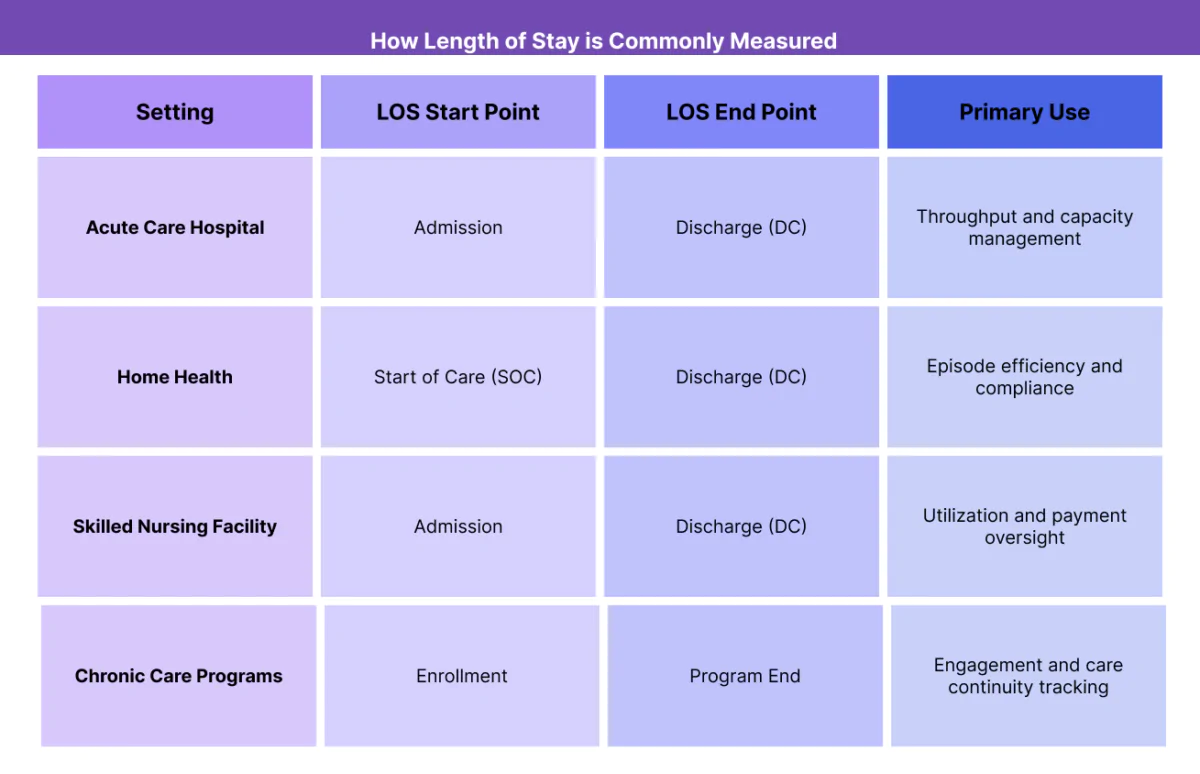
Length of Stay (LOS) is a healthcare metric that measures the total amount of time a patient receives care within a defined setting, program, or episode. LOS is most commonly expressed as a number of days, though the specific start and end points used to calculate LOS vary depending on the care model, clinical setting, and payer requirements.
In acute care environments, LOS typically spans from hospital admission to discharge. In post-acute, home health, and longitudinal Medicare programs, LOS is more often measured from Start of Care (SOC) to Discharge (DC) or program completion. Across all settings, LOS serves as a foundational indicator of care intensity, resource utilization, and clinical efficiency.
LOS is not inherently a measure of quality on its own. A longer LOS does not automatically indicate inefficiency, just as a shorter LOS does not guarantee effective care. Instead, LOS must be interpreted in context—considering patient acuity, clinical goals, regulatory requirements, and outcomes achieved during the episode of care.
Because LOS directly affects cost, capacity, and compliance, it is closely monitored by healthcare organizations, payers, and regulators, particularly within Medicare-regulated programs.
Key Components of LOS (Length of Stay)
LOS is shaped by multiple interrelated clinical, operational, and regulatory factors. Understanding these components helps organizations manage LOS appropriately rather than simply trying to reduce it.
LOS Measurement Start and End Points
Every LOS calculation depends on clearly defined boundaries. In hospitals, LOS often begins at formal admission and ends at discharge. In home health and post-acute care, LOS usually starts at SOC and ends at DC, even if services are intermittent during that period.
Inconsistent or unclear LOS boundaries can distort reporting, complicate benchmarking, and increase audit risk.
Patient Acuity and Clinical Complexity
Patient acuity is one of the strongest drivers of LOS. Individuals with multiple chronic conditions, functional limitations, or complex social needs often require longer care episodes to safely achieve goals.
Comparing LOS across populations without accounting for acuity can lead to misleading conclusions.
Care Plan Scope and Service Intensity
The scope of the Plan of Care—including visit frequency, discipline mix, and intervention complexity—directly influences LOS. Broader or more intensive care plans often necessitate longer stays to deliver services appropriately.
LOS should reflect what is clinically necessary, not arbitrary time targets.
Documentation and Regulatory Requirements
Medicare and other payers impose documentation and assessment requirements that shape LOS. Required reassessments, recertifications, and progress documentation can extend LOS even when clinical improvement is steady.
Failure to align documentation workflows with LOS expectations can result in compliance gaps.
Discharge Readiness and Transition Criteria
Clear discharge criteria help prevent unnecessary extension of LOS. When discharge readiness is poorly defined, care can continue without clear purpose, increasing utilization without improving outcomes.
How Length of Stay Works in Practice
In practice, LOS unfolds across the full lifecycle of a care episode, evolving as patient needs and progress change.
Establishing Expected LOS at Start of Care
At SOC or admission, clinicians develop an initial expectation for LOS based on diagnosis, functional status, risk factors, and care goals. This expectation is not a fixed endpoint but a working estimate that guides early planning.
Establishing an expected LOS helps teams anticipate service intensity, documentation needs, and discharge planning requirements from the outset.
Delivering Care Relative to LOS Expectations
As care is delivered, LOS serves as a reference point for pacing and progress. Clinicians assess whether patients are advancing toward goals within the expected timeframe or whether adjustments to the Plan of Care are needed.
Regular review helps prevent both premature discharge and unnecessary prolongation of services.
Monitoring Progress and LOS Variance
Care teams monitor progress against expected milestones. When LOS begins to deviate—either shorter or longer than anticipated—teams assess whether changes are driven by clinical need, system delays, or workflow inefficiencies.
Identifying LOS variance early allows for proactive intervention.
Preparing for Discharge Throughout the Episode
Effective LOS management treats discharge planning as an ongoing process rather than a final step. Education, coordination, and transition planning begin early to support timely and appropriate discharge.
This approach reduces avoidable extensions of LOS.
Closing the Episode and Finalizing LOS
LOS formally ends at discharge or program completion. Final documentation ties outcomes back to the LOS period, supporting quality reporting, compliance review, and future planning.
LOS in Billing, Reimbursement, and Compliance Oversight
Length of Stay has significant downstream effects on billing accuracy, reimbursement integrity, and regulatory scrutiny, even in care models where LOS is not billed directly.
How LOS Influences Medicare Billing and Payment
In Medicare-regulated programs, LOS influences reimbursement in several indirect but critical ways. Many payment models assume an expected duration of care based on diagnosis, functional status, and program type. When LOS extends significantly beyond these expectations, organizations must demonstrate ongoing medical necessity through documentation.
Conversely, unusually short LOS can raise concerns about underutilization or premature discharge, particularly if outcomes or follow-up utilization suggest unresolved needs.
LOS also affects the timing of required assessments, certifications, and recertifications, all of which carry billing implications.
LOS and Episode-Based and Bundled Payment Models
In episode-based or bundled payment models, LOS affects how resources are distributed across the episode window. Longer LOS often increases labor, administrative effort, and documentation burden without a proportional increase in reimbursement.
Effective LOS management helps organizations align care delivery with payment assumptions while maintaining quality.
LOS as a Trigger for Audit and Review
Payers and regulators frequently analyze LOS patterns to identify outliers. Episodes that are consistently longer or shorter than benchmarks may be flagged for medical review, particularly when documentation does not clearly justify duration.
LOS alone does not determine compliance risk, but unexplained variance increases scrutiny.
Common LOS-Related Compliance Risks
LOS-related compliance risks often stem from operational breakdowns rather than clinical decision-making.
Common risks include:
- Prolonged LOS without updated clinical justification
- Misaligned SOC and DC dates
- Documentation gaps during extended episodes
- Discharge delays unrelated to patient need
- System and Workflow Challenges That Affect LOS
LOS inefficiencies often reflect system limitations rather than patient complexity.
Limited Visibility Into LOS Progression
When teams lack real-time visibility into LOS, episodes may continue without clear awareness of duration or proximity to discharge readiness.
Fragmented Documentation and Care Planning
Disconnected assessment, documentation, and care planning systems make it difficult to track progress relative to LOS expectations.
Administrative and Coordination Delays
Delays related to orders, authorizations, or interdisciplinary coordination frequently extend LOS beyond what is clinically necessary.
How LOS Influences Quality, Access, and Equity
LOS is not only an operational metric—it shapes patient experience and system performance.
LOS and Quality of Care Outcomes
Appropriate LOS supports recovery, functional improvement, and care continuity. Episodes that are too short or too long relative to need can compromise outcomes and satisfaction.
LOS and Access to Healthcare Services
Reducing avoidable LOS improves capacity, allowing organizations to serve more patients without increasing staff or infrastructure.
Equity Considerations in Length of Stay Management
Social determinants of health (SDOH) such as housing instability, language barriers, limited caregiver support, or transportation challenges can extend LOS. Equity-aware LOS management addresses these barriers directly rather than treating them as inefficiencies.
Frequently Asked Questions about Length of Stay (LOS)
1. What does LOS mean in healthcare?
LOS refers to the length of time a patient receives care within a specific healthcare setting or episode.
2. How is LOS measured in Medicare programs?
LOS is measured using defined start and end points, such as admission and discharge or Start of Care and Discharge, depending on the program.
3. Is a shorter Length of Stay always better?
No. LOS should align with clinical need, care goals, and patient circumstances.
4. Why does Medicare monitor LOS?
Medicare uses LOS to assess utilization, efficiency, and potential compliance risk.
5. Can LOS impact audits or payment reviews?
Yes. Unusual LOS patterns may trigger audits, especially when documentation does not justify duration.
