

What is SOC (Start of Care) in Healthcare?
Start of Care (SOC) refers to the point at which a patient formally begins receiving services under a defined episode of care. SOC marks the initiation of clinical responsibility and triggers key documentation, assessment, and compliance requirements, particularly in Medicare-regulated settings such as home health.
In practice, SOC establishes the baseline for care delivery, documentation, and reimbursement. It is the reference point for assessments, care planning, quality measurement, and episode timing. Many downstream workflows—including Plans of Care, interdisciplinary coordination, and billing—are anchored to the SOC date.
Because SOC defines when care officially begins, accuracy and timeliness are critical. Errors at SOC can cascade into documentation gaps, compliance risk, and payment issues later in the episode.
Key Components of SOC (Start of Care)
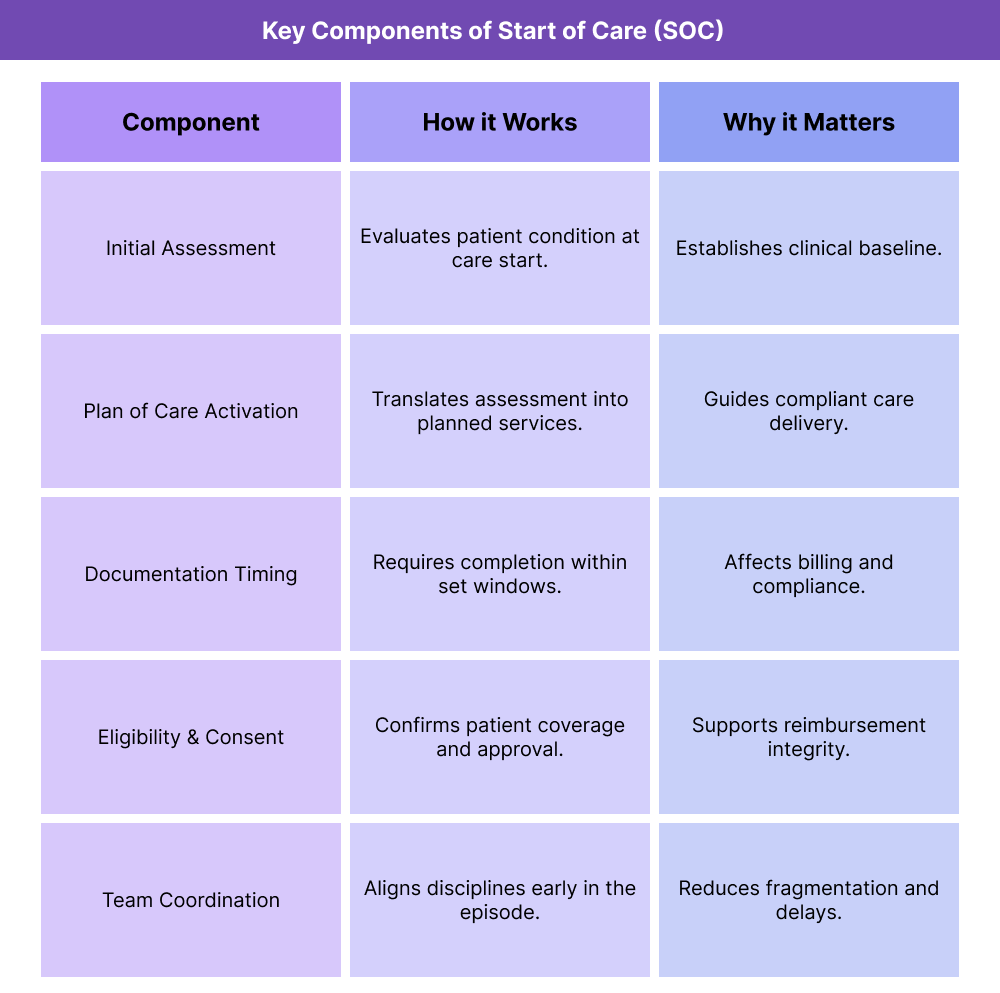
SOC is not a single action; it is a coordinated set of activities that formally initiate care.
Initial Patient Assessment
At SOC, clinicians complete an initial assessment to evaluate the patient’s condition, needs, and eligibility for services. This assessment establishes the clinical baseline for the episode.
In post-acute and Medicare settings, this assessment often includes standardized data collection requirements.
Establishment of the Plan of Care
SOC is closely tied to the creation or activation of the Plan of Care (POC). Clinical findings from the SOC assessment inform diagnoses, goals, and planned services documented in the POC.
Care delivered after SOC is expected to align with this plan.
Documentation and Timing Requirements
SOC documentation must be completed within defined timeframes. Timeliness is essential because SOC dates often determine episode start, billing eligibility, and quality measurement windows.
Late or incomplete SOC documentation is a common compliance issue.
Patient Consent and Eligibility Confirmation
SOC workflows typically include confirmation of patient consent, eligibility, and coverage. Accurate verification ensures services are appropriately authorized and billable.
Interdisciplinary Involvement
SOC may involve multiple disciplines, especially for complex patients. Early coordination helps ensure services are delivered efficiently and in alignment with patient needs.
How Start of Care Works in Practice
In practice, SOC initiates the full lifecycle of a care episode.
Step 1: Referral and Intake
SOC begins after a referral or intake decision. Information is gathered to determine eligibility, appropriateness of services, and readiness to begin care.
Step 2: SOC Visit and Assessment
A clinician conducts the SOC visit, completing required assessments and documenting the patient’s status. This visit establishes the official start date of care.
Step 3: Care Planning and Documentation
Assessment findings are used to finalize the Plan of Care. Documentation from the SOC visit supports medical necessity and defines the scope of services.
Step 4: Care Delivery Begins
Following SOC, scheduled services are delivered according to the POC. Documentation references the SOC assessment as the baseline.
Step 5: Monitoring and Updates
As care progresses, clinicians monitor changes relative to the SOC baseline and update documentation and plans as needed.
SOC in Billing, Reimbursement, and System Limitations
SOC plays a foundational role in reimbursement and compliance.
How SOC Affects Billing and Payment
The SOC date often determines:
- Episode start and end dates
- Eligibility for reimbursement
- Timing of assessments and documentation
Incorrect SOC dates or incomplete documentation can result in denied or delayed payment.
Common SOC-Related Compliance Risks
Common risks include:
- Late SOC documentation
- Missing assessments
- Misaligned SOC dates
- Services delivered before formal SOC
These issues are frequent audit findings.
System and Workflow Challenges
SOC workflows are vulnerable when systems lack:
- Clear task tracking
- Alerts for required assessments
- Integration between assessment and care planning tools
Strong workflow design helps prevent SOC-related errors.
How SOC Influences Quality, Access, and Equity
SOC affects more than compliance—it shapes early care delivery.
SOC and Quality of Care
A thorough SOC assessment supports accurate care planning and early identification of risks, improving outcomes over the episode.
SOC and Access to Services
Delays or inefficiencies at SOC can postpone care initiation. Streamlined SOC workflows help patients access services more quickly.
Equity Considerations at Start of Care
Equity-aware SOC processes consider language, social context, and barriers to care engagement from the outset, reducing disparities later in the episode.
Frequently Asked Questions about Start of Care (SOC)
1. What is Start of Care (SOC) in healthcare?
SOC is the point at which a patient officially begins receiving services under an episode of care, triggering assessments, documentation, and billing requirements.
2. Why is SOC important in Medicare programs?
SOC establishes the baseline for care delivery, reimbursement, and quality measurement.
3. Is SOC the same as the first visit?
Often, but not always. SOC refers to the official initiation of care, which may align with or be defined by specific documentation requirements.
4. How does SOC relate to the Plan of Care?
SOC assessments inform and activate the Plan of Care that guides services.
5. Can billing occur before SOC is established?
Services delivered before formal SOC may not be billable and can create compliance risk.
6. How does SOC relate to OASIS?
In home health, SOC is closely tied to OASIS assessments, which collect standardized data at care initiation.
7. What happens if SOC documentation is late or incomplete?
Late or incomplete SOC documentation can lead to denials, audits, or delayed payment.
