

What is POC (Plan of Care) in Healthcare?
A Plan of Care (POC) is a structured clinical document that outlines a patient’s diagnoses, goals, interventions, and services required to manage their care. The POC serves as the central roadmap for care delivery, guiding clinical decisions and coordination across providers and disciplines.
In Medicare-regulated settings, the Plan of Care is more than a clinical tool — it is a compliance and reimbursement requirement. Many programs require that services be delivered in accordance with an established and approved POC, and documentation must demonstrate alignment between care provided and the plan itself.
POCs are especially important in settings involving interdisciplinary care, chronic disease management, and post-acute services, where coordination and continuity are critical.
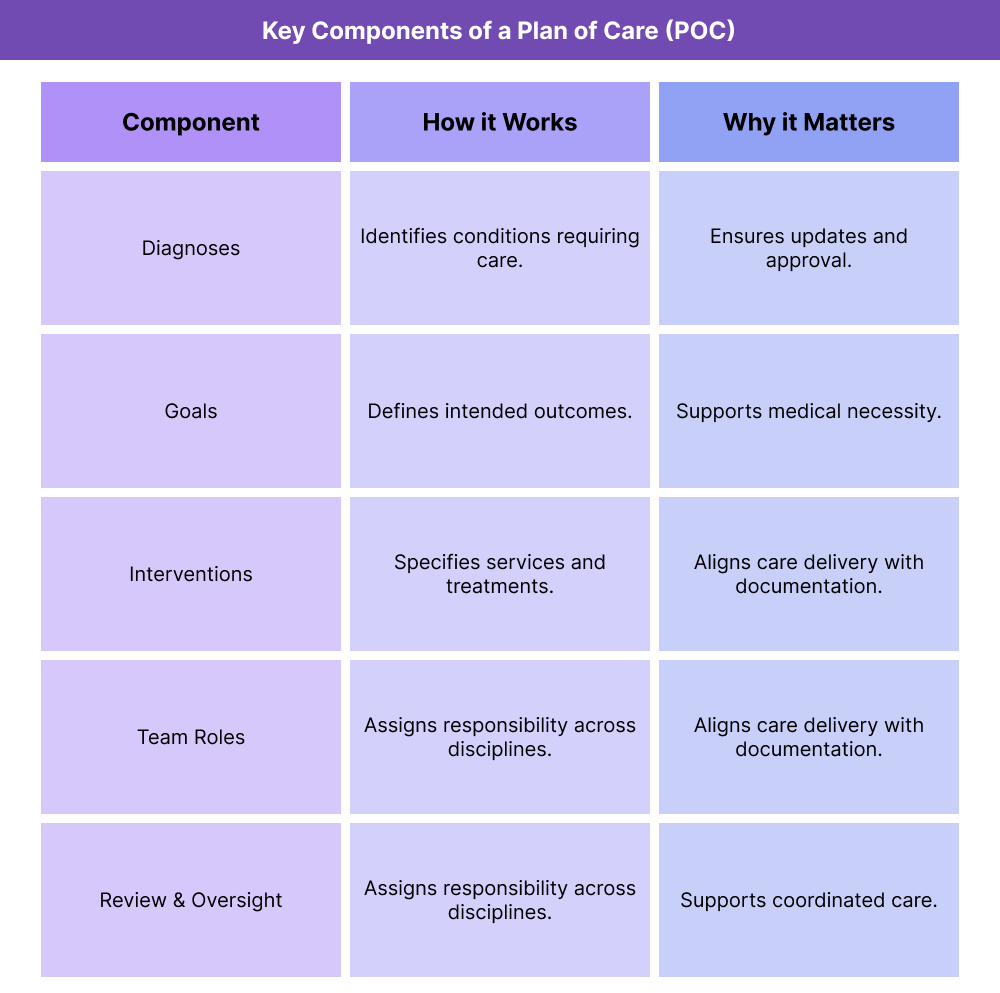
Key Components of a POC (Plan of Care)
While the format of a POC may vary by setting, effective Plans of Care share common elements that support clinical clarity and regulatory compliance.
Patient Diagnoses and Clinical Problems
The POC identifies the patient’s relevant diagnoses and clinical conditions that justify services. These diagnoses establish medical necessity and provide the foundation for care planning.
Clear linkage between diagnoses and services is essential for Medicare compliance.
Measurable Goals and Outcomes
A POC includes defined goals that describe the intended outcomes of care. Goals may address symptom management, functional improvement, disease stabilization, or preventive objectives.
Measurable goals support progress tracking and justify ongoing services.
Planned Interventions and Services
The POC outlines the specific services, treatments, and interventions to be provided. This may include medical management, therapy, behavioral health support, or care coordination activities.
Services delivered must align with what is specified in the POC.
Roles and Responsibilities Across the Care Team
In team-based models, the POC clarifies which disciplines are responsible for different aspects of care. This supports coordination across clinicians, therapists, nurses, and other care team members.
This component ties closely to IDT workflows.
Review, Updates, and Physician Oversight
Plans of Care are not static. They must be reviewed and updated based on patient progress, changes in condition, or new clinical information. In many Medicare programs, physician or practitioner review and approval is required.
Timely updates are critical for compliance.
How Plans of Care Work in Practice
In practice, the POC serves as the anchor document for care delivery, documentation, and oversight.
Step 1: Initial Assessment and Care Planning
Care planning begins after patient assessment. Clinical findings are translated into diagnoses, goals, and proposed interventions documented in the POC.
Step 2: Care Delivery Aligned to the POC
Clinicians deliver services according to the POC. Documentation of visits and interventions should clearly tie back to the plan.
Misalignment between care delivered and the POC is a common audit risk.
Step 3: Interdisciplinary Coordination
In team-based care, multiple disciplines contribute to the POC. Coordination ensures that services are complementary rather than duplicative.
Step 4: Ongoing Review and Updates
As patients progress, the POC is reviewed and updated. Changes must be documented and approved when required.
Step 5: Discharge or Transition Planning
The POC supports decisions around discharge, transitions, or changes in care setting, ensuring continuity.
POCs in Billing, Reimbursement, and System Limitations
The Plan of Care plays a direct role in reimbursement and audit outcomes.
How POCs Support Billing and Medical Necessity
Medicare expects billed services to be reasonable, necessary, and consistent with the established POC. Documentation must show that services were planned and clinically justified.
Common POC-Related Compliance Risks
Common risks include:
- Missing or outdated POCs
- Services delivered outside the scope of the plan
- Lack of documented approval
- Poor linkage between documentation and the POC
These issues can lead to denials or recoupments.
System and Workflow Limitations
POC management can be challenging when systems lack:
- Clear version control
- Integrated workflows across disciplines
- Alerts for required updates or approvals
Organizations often rely on CDS tools to reinforce POC compliance.
How Plans of Care Influence Quality, Access, and Equity
POCs affect care delivery beyond compliance.
POCs and Quality of Care
Clear plans support consistent, goal-oriented care and enable better tracking of outcomes.
POCs and Access to Services
Well-managed POCs help ensure patients receive appropriate services without unnecessary delays or duplication.
Equity Considerations in Care Planning
Equity-aware care plans consider social, functional, and environmental factors that affect a patient’s ability to engage in care.
Frequently Asked Questions about Plans of Care (POCs)
1. What is a Plan of Care (POC) in healthcare?
A POC is a clinical document outlining diagnoses, goals, and services required to manage a patient’s care.
2. Is a POC required for Medicare services?
Many Medicare programs require services to be delivered under an established and approved Plan of Care.
3. Who is responsible for the POC?
Responsibility varies by setting, but physician or practitioner oversight is often required.
4. How often must a POC be updated?
POCs must be updated when patient conditions change or at defined review intervals, depending on program rules.
5. Can services be billed if they are not in the POC?
Services delivered outside the scope of the POC may be denied or recouped.
6. How does the POC relate to the IDT?
The POC is often developed and executed by an interdisciplinary team, with roles defined across disciplines.
7. Does CDS interact with the POC?
Yes. CDS tools may prompt updates, alerts, or checks to ensure care aligns with the POC.
