

What is MDS 3.0 (Minimum Data Set)?)
The Minimum Data Set (MDS 3.0) is the standardized resident assessment tool that nursing homes use to document a resident’s clinical status, functional abilities, and care needs in a consistent, CMS-required format. MDS 3.0 is completed at admission, on a recurring schedule, and whenever a significant change in a resident’s condition occurs, creating an ongoing clinical snapshot that guides care delivery over time.
MDS 3.0 is the practical assessment instrument within the Resident Assessment Instrument (RAI) framework. It captures structured information across multiple domains—including diagnoses, cognition, mood, mobility, continence, skin integrity, medications, treatments, and special services—so interdisciplinary teams can identify risks, plan services, and track changes objectively.
In practice, MDS 3.0 is both a care planning foundation and a regulatory cornerstone. Accurate, timely MDS assessments help nursing homes build compliant, individualized care plans, monitor quality trends, and maintain survey readiness. Because CMS uses MDS data in reimbursement and quality measurement systems, strong MDS processes are essential for safe care and operational stability in Skilled Nursing Facilities (SNFs).
Key Components of an MDS 3.0
MDS 3.0 is designed to capture a standardized, comprehensive view of each resident’s status so nursing homes can plan care, monitor risk, and meet CMS assessment requirements. The tool is structured around defined clinical domains and is completed through specific assessment types that occur on a required schedule.
Across all assessment types, MDS 3.0 collects information that supports both individualized care planning and facility-wide quality monitoring. It also serves as the resident assessment instrument required under the RAI framework.
Required MDS 3.0 Clinical Domains
MDS 3.0 captures resident-level data in consistent categories so staff can identify risks and needs objectively. These domains reflect the major factors that influence resident outcomes and care intensity.
Key domains include cognition and mood, functional status, continence, skin integrity, active diagnoses, medications, treatments, special services, and discharge-related needs. Because MDS is standardized, changes in these domains can be tracked over time and compared across residents.
Major MDS 3.0 Assessment Types
CMS requires nursing homes to complete different MDS assessments depending on timing and resident status changes. Each assessment type has its own purpose but draws from the same structured item set.
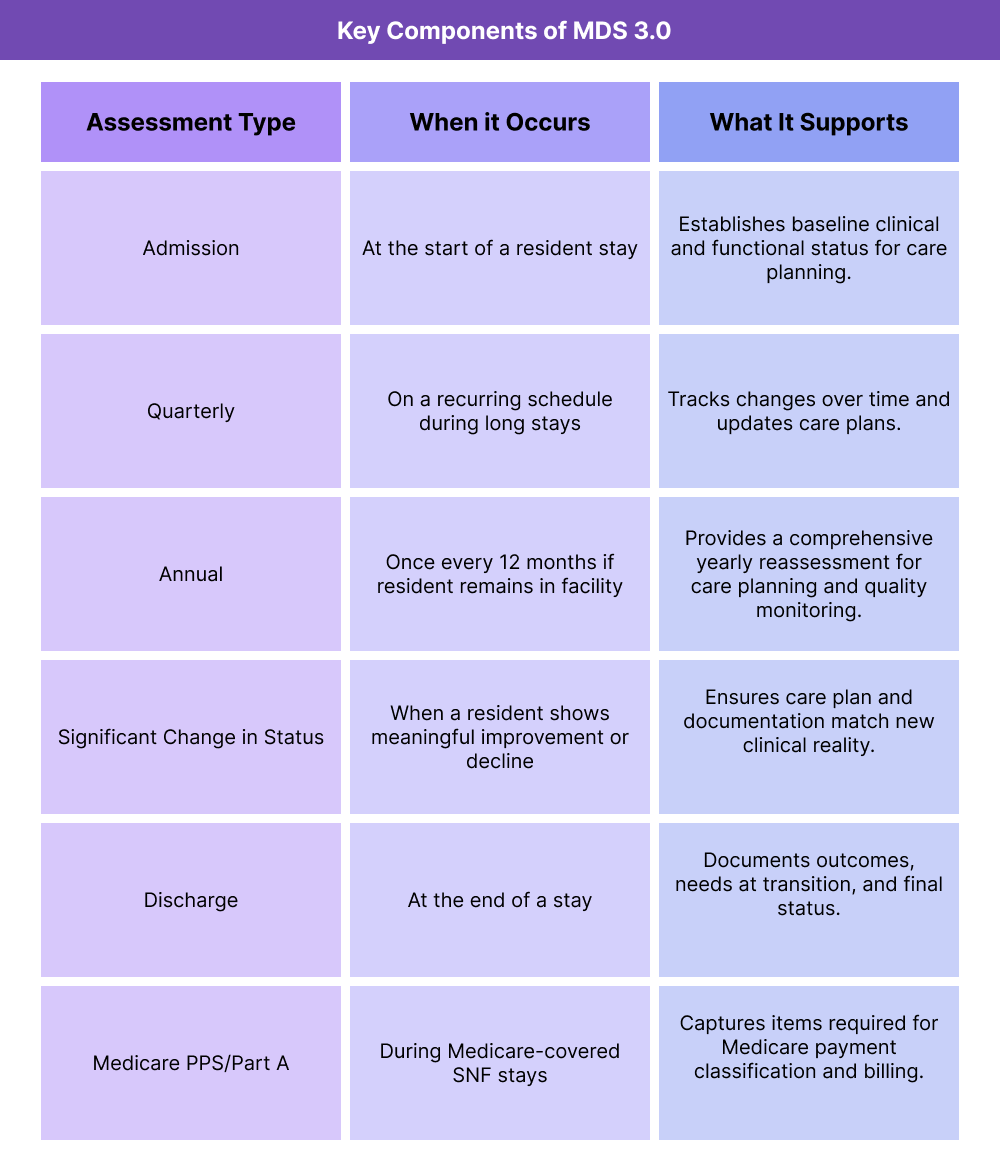
Assessment types include:
- Admission assessments to establish baseline needs
- Scheduled periodic assessments such as quarterly and annual updates
- Significant change assessments when a resident’s condition meaningfully improves or declines
- Discharge assessments to document status at end of stay
- Medicare PPS assessments used for payment classification during Part A stays
Facilities must complete the correct assessment at the correct time to remain compliant and ensure the resident record reflects current needs.
How MDS 3.0 Connects to Care Planning
MDS data is not meant to sit in isolation. The findings are used by interdisciplinary teams to build or update care plans that reflect measured risks and resident goals. When MDS inputs are accurate, care planning becomes more consistent, defensible, and aligned with real needs.
Alt text: Table summarizing the core MDS 3.0 assessment types, when they occur, and what each one is used for in SNF care and compliance.
How MDS 3.0 Works in Practice
MDS 3.0 functions as a recurring assessment cycle inside Skilled Nursing Facilities (SNFs). It is not a one-time intake form. Instead, nursing homes use MDS to repeatedly collect standardized data, interpret changes over time, and drive care planning and compliance workflows.
Step 1: Gather Resident Information Across Disciplines
MDS completion begins with interdisciplinary data gathering. Nurses, therapists, social services, dietary staff, and providers contribute documentation that reflects the resident’s current status. The MDS coordinator pulls from this record to ensure that the assessment is based on real observations, treatments, and outcomes—not assumptions.
Step 2: Complete the Scheduled or Event-Triggered MDS
Facilities complete MDS assessments on required timelines, including admission, quarterly, annual, discharge, and Medicare Part A PPS assessments. They also complete a Significant Change in Status assessment when a resident demonstrates a meaningful shift in clinical or functional condition.
Each assessment type uses the same standardized structure, but the timing and purpose differ depending on the resident’s stay and coverage status.
Step 3: Validate Accuracy and Resolve Documentation Conflicts
Before final submission, facilities verify that MDS responses match the documented medical record. This step is essential because mismatches between the MDS and the narrative chart can create compliance risk and reimbursement errors. Strong facilities treat this as a formal internal quality check, not a casual review.
Step 4: Submit and Use Results for Ongoing Care
After completion, MDS data is submitted through required reporting channels and becomes the resident’s official standardized assessment record. The facility uses the results to:
- Trigger deeper clinical review where risks are flagged
- Update the interdisciplinary care plan
- Monitor resident trends over time
- Support quality oversight and survey readiness
Because MDS assessments repeat, the system creates a longitudinal picture of resident trajectory that guides both daily care and facility improvement.
MDS 3.0 in Billing, Reimbursement, and System Limitations
MDS 3.0 is one of the most financially important documentation tools in a Skilled Nursing Facility (SNF) because its assessment outputs feed Medicare payment classification and case mix calculation. While the MDS itself is not a billable service, the accuracy, timing, and completeness of each assessment directly influence whether Medicare claims are paid correctly and whether the facility is reimbursed at the appropriate level for resident acuity.
How MDS 3.0 Drives Medicare SNF Reimbursement
During a Medicare Part A stay, MDS 3.0 assessment data is used to classify residents into payment groups that reflect expected clinical and therapy resource use. This means that diagnoses, functional status, treatments, and special care indicators captured in the MDS can materially change the payment rate tied to the stay.
If the MDS understates resident complexity or misses key clinical elements, the facility may be underpaid. If it overstates acuity without matching chart support, the facility risks overpayment exposure and audit risk. In both cases, the payment outcome is driven by the MDS record.
MDS 3.0 Assessment Timing and Billing Risk
Medicare reimbursement depends not only on what is captured in MDS 3.0 but also on when it is captured. SNFs must complete and submit required Medicare PPS assessment types within defined windows. Late, missed, or incorrect assessments can result in:
- Incorrect daily payment rates
- Claim delays while assessments are corrected
- Downstream rework that interrupts billing continuity
- Survey citations if assessment schedules are consistently off-track
Facilities therefore manage MDS timing as a compliance-controlled billing workflow, not just a clinical task.
System Limitations and Operational Watch-Outs in MDS 3.0
MDS 3.0 reimbursement reliability depends on the broader documentation ecosystem around it. Common limitations include:
- Interdisciplinary charting arriving late, causing incomplete MDS capture
- Inconsistent staff documentation that makes resident status hard to code
- High coordinator workload leading to missed timing windows
- MDS answers that do not clearly align with the narrative medical record
- Variation between assessors that creates instability in classification
Even with strong tools, MDS accuracy requires disciplined workflows, clear clinical documentation, and tight review processes.
How MDS 3.0 Influences Quality, Access, and Equity in Healthcare
MDS 3.0 affects more than reimbursement. Because it is the standardized resident assessment tool in SNFs, it shapes how resident needs are identified, how care plans are built, and how quality trends are monitored across the facility.
How MDS 3.0 Improves Quality and Resident Safety
MDS 3.0 supports higher-quality care by making resident assessment systematic and repeatable. When completed consistently, it helps SNFs:
- Detect clinical decline and functional loss early
- Identify risks such as falls, pressure injuries, pain escalation, or mood changes
- Track whether care interventions are working over time
- Standardize how resident needs are interpreted across staff and shifts
This reduces reliance on informal observation and helps prevent avoidable safety events.
How MDS 3.0 Supports Access to the Right Level of Care
In long-term care, access often means reliable access to appropriate services within the SNF. MDS 3.0 supports that by ensuring residents are assessed on schedule and that care plans reflect current needs. When assessments are delayed or inaccurate, residents may experience gaps such as:
- Services that no longer match acuity
- Delayed therapy or nursing interventions
- Missed escalation when condition changes
- Avoidable rehospitalizations due to unmet needs
Accurate MDS workflows help facilities maintain continuity and prevent care mismatch.
Equity Implications of Standardized MDS 3.0 Assessment
MDS 3.0 promotes equity by applying the same structured assessment to every resident. This helps reduce subjective variation in how needs are documented and addressed. Equity risks arise when assessment quality varies due to staffing, training, or documentation capacity.
Consistent MDS practice helps ensure that all residents—regardless of background, communication ability, or unit assignment—receive care plans based on measured need rather than situational inconsistency.
Frequently Asked Questions about MDS 3.0
1. What is MDS 3.0 (Minimum Data Set)?
MDS 3.0 is the standardized CMS-required resident assessment tool used in nursing homes to document clinical status, functional ability, and care needs on a recurring schedule.
2. How is MDS 3.0 related to RAI?
MDS 3.0 is the assessment instrument within the Resident Assessment Instrument (RAI) framework. RAI is the overall system, and MDS is the required tool used to implement it.
3. Who completes MDS 3.0 assessments?
MDS assessments are coordinated by an MDS nurse or MDS coordinator, using interdisciplinary documentation from nursing, therapy, social services, dietary, and medical providers.
4. When are MDS 3.0 assessments required?
MDS assessments are required at admission, quarterly intervals, annually, at discharge, during Medicare Part A stays, and whenever a Significant Change in Status occurs.
5. What is a Significant Change in Status MDS assessment?
A Significant Change in Status assessment is completed when a resident shows meaningful improvement or decline in clinical or functional condition, requiring updates to the standardized assessment and care plan.
6. Why does MDS 3.0 affect Medicare reimbursement?
MDS data during Medicare Part A stays feeds resident classification and case mix logic that determines the SNF’s Medicare payment rate. Errors can lead to underpayment, overpayment risk, or billing delays.
7. What happens if MDS assessments are late or inaccurate?
Late or inaccurate assessments can cause incorrect payment rates, claims rework, compliance citations, and care plans that do not match resident needs.
