

What is a QIC (Qualified Independent Contractor) in Healthcare?
A Qualified Independent Contractor (QIC) is an organization contracted by CMS to conduct the second level of appeal in Original Medicare (Parts A and B). After a claim is denied and a provider or beneficiary completes a first-level redetermination with a Medicare Administrative Contractor (MAC), the next step is a QIC reconsideration. The QIC reviews the case independently and issues a formal reconsideration decision based on the administrative record and any additional supporting documentation submitted.
QICs are intended to provide a neutral, clinical, and policy-aligned review that is separate from the initial payer decision. They evaluate whether Medicare coverage rules were applied correctly and whether the medical necessity or documentation supports payment. This makes QIC reconsideration a critical checkpoint for reversing denials before cases move to higher appeal levels.
In practice, the QIC stage is where many Medicare denials are most effectively resolved. A well-supported reconsideration submission—clearly addressing coverage criteria, documentation gaps, and denial rationale—can often prevent the need for escalation to an Administrative Law Judge (ALJ) or later appeal stages.
Key Components of QICs in Healthcare
A QIC exists to provide an independent, second-level review of Medicare claim denials. At this stage, the appeal is called a reconsideration, and it focuses on whether the denial was correct under Medicare coverage rules and whether the documentation supports payment.
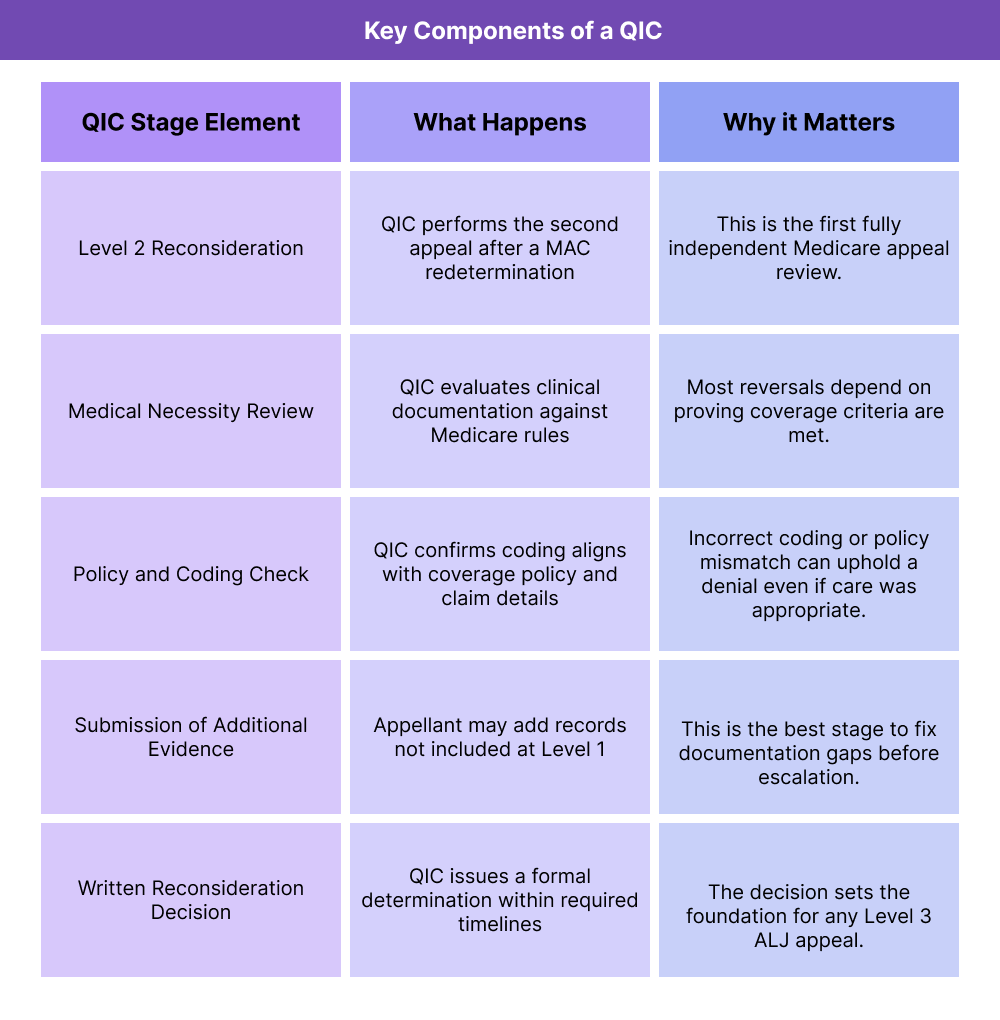
QIC review is built around a defined set of functions and case elements that CMS expects to be handled consistently across appeal types.
Independent Reconsideration Review
After a first-level redetermination by a Medicare Administrative Contractor (MAC), a QIC conducts a fresh review of the denial. The QIC is not involved in the original claim decision, which helps ensure neutrality at Level 2.
Clinical and Policy-Based Evaluation
QICs assess whether the service meets Medicare coverage criteria, including medical necessity, correct coding, and documentation requirements. They compare the submitted record to applicable Medicare policies and consider any additional evidence supplied at reconsideration.
Standardized Timeframes and Decision Outputs
QICs issue a written reconsideration determination within CMS-defined timelines. The decision will either uphold the denial, partially overturn it, or fully overturn it. This decision becomes part of the administrative record if the case is escalated further.
Documentation Completeness at Level 2
Because the QIC decision is based on the record in hand, this stage is often the most important point to correct documentation gaps. Missing signatures, unclear clinical rationale, or incomplete supporting records are common denial drivers that QIC review can resolve when addressed directly.
How QIC Reconsideration Works in Practice
The QIC stage is the second step in the Medicare appeals process and is formally called a reconsideration. It follows a predictable workflow that providers and beneficiaries can prepare for, especially when the denial relates to medical necessity or missing documentation.
Step 1: File a Level 2 Reconsideration Request
After receiving an unfavorable redetermination decision from a Medicare Administrative Contractor (MAC), the appellant submits a reconsideration request to the QIC. This request must be filed within the required appeal window and should include the denial notice, the prior decision, and any additional evidence supporting coverage.
Step 2: Submit Complete Supporting Documentation
The QIC review is record-based, so the quality of the submission is decisive. At this stage, appellants should provide a full, organized package that addresses the denial rationale directly. This may include clinical notes, orders, care plans, therapy logs, test results, or other documentation tied to Medicare coverage criteria.
Because later appeal levels often limit new evidence, Level 2 is the most important opportunity to correct missing or unclear documentation.
Step 3: QIC Conducts Independent Review
The QIC evaluates the reconsideration using Medicare policy and clinical standards. Reviewers assess whether the service was reasonable and necessary, whether documentation supports the claim as billed, and whether the MAC applied coverage rules correctly.
Step 4: Receive a Written Reconsideration Decision
The QIC issues a written decision that either upholds, partially overturns, or fully overturns the denial. If the decision is unfavorable, the case can be escalated to Level 3 with an Administrative Law Judge (ALJ), using the QIC record as the foundation.
QIC in Billing, Reimbursement, and System Limitations
QIC reconsideration is a critical revenue-protection step in Medicare billing because it is the first fully independent appeal review after a denial. When claims are denied at Level 1, unresolved denials can quickly translate into lost revenue, rework burden, and delayed payment. A successful QIC reconsideration can restore reimbursement without needing to escalate to an Administrative Law Judge (ALJ) appeal.
How QIC Review Affects Payment Outcomes
At the QIC stage, the appeal focuses on whether the service meets Medicare coverage and medical necessity requirements and whether documentation supports the claim. Many denials are overturned at this level when providers submit a complete, policy-aligned record.
Common denial categories that QIC reconsideration can reverse include:
- Medical necessity denials supported by clearer clinical rationale
- Documentation omissions corrected with additional records
- Coding or policy misunderstandings clarified in the appeal
- Timing and authorization issues resolved with proof in the record
Because the QIC decision becomes part of the administrative record, a strong submission here improves chances of success even if the case moves forward.
QIC versus MAC Roles in Appeals
A Medicare Administrative Contractor (MAC) handles the first redetermination appeal and also processes original claims. A QIC is separate from the MAC and is required to provide an independent reconsideration at Level 2. This independence is a key reason providers prioritize this stage for reversal.
System Limitations and Operational Watch-Outs
QIC reconsideration is record-dependent, and limitations at this level usually stem from incomplete submissions or poor alignment to Medicare rules. Key watch-outs include:
- Submitting an appeal without directly addressing the MAC denial rationale
- Failing to include missing clinical documentation at Level 2
- Assuming evidence can be added later at the ALJ stage
- Disorganized records that make medical necessity hard to evaluate
For billing teams and healthcare SaaS buyers, Level 2 reconsideration requires structured evidence capture, clear policy mapping, and strong denial workflow management.
How QIC Influences Quality, Access, and Equity in Healthcare
Although a QIC is part of the reimbursement system, reconsideration decisions can affect care quality and access by shaping whether services remain financially viable and available to Medicare beneficiaries. Appeals outcomes influence which services providers can sustainably deliver and how quickly patients receive covered care.
Quality Implications of QIC Decisions
QIC review reinforces documentation and medical necessity standards tied to quality care. When denials are overturned because documentation clearly supports appropriate services, it validates that care was clinically reasonable and consistent with Medicare expectations.
Over time, this strengthens quality systems by pushing organizations to improve clinical documentation, care justification, and coverage alignment.
Access Implications for Medicare Beneficiaries
Appeals delays can disrupt access, especially when denied services are urgent or time-sensitive. Because QIC reconsideration can resolve denials before escalation to an ALJ, it helps restore coverage faster, reducing care interruptions for Medicare beneficiaries.
In high-volume denial categories, strong QIC processes can also prevent service withdrawal due to financial instability.
Equity Considerations in Medicare Appeals
Access barriers disproportionately affect patients with fewer care options or higher reliance on Medicare coverage. Efficient QIC reconsideration helps reduce the risk that vulnerable populations experience longer gaps in covered care due to preventable denials or prolonged appeals.
Frequently Asked Questions about QIC
1. What is a QIC (Qualified Independent Contractor)?
A QIC (Qualified Independent Contractor) is a CMS-contracted organization that conducts the Level 2 reconsideration appeal for Original Medicare claims after a Medicare Administrative Contractor (MAC) redetermination.
2. What level of Medicare appeal is a QIC?
A QIC handles Level 2 appeals. This stage is called reconsideration and follows a Level 1 redetermination decision from the MAC.
3. What does a QIC review during reconsideration?
A QIC reviews whether the denied service meets Medicare coverage and medical necessity requirements and whether documentation supports payment under applicable policy.
4. How long does a QIC reconsideration take?
QIC reconsideration decisions are issued within CMS-defined timelines. The exact timeframe can vary by appeal type, but Level 2 is designed to resolve denials before cases move to an Administrative Law Judge (ALJ).
5. Can providers submit new evidence at the QIC stage?
Yes. Level 2 reconsideration is the most important opportunity to submit additional evidence that was missing or unclear at Level 1. Later appeal levels may limit new evidence.
6. What happens if the QIC upholds the denial?
If the QIC upholds the denial, the appellant can escalate the case to Level 3 for review by an Administrative Law Judge (ALJ), using the QIC record as the foundation.
7. Why is the QIC stage important for reimbursement?
Because it is the first independent appeal review, many Medicare denials are overturned at Level 2 when documentation and policy alignment are clearly presented. This can restore payment without requiring an ALJ appeal.
