

What is a QAPI (Quality Assurance and Performance Improvement)?
Quality Assurance and Performance Improvement (QAPI) is a structured, organization-wide approach healthcare providers use to continuously assess and improve the quality, safety, and effectiveness of care. QAPI blends routine quality assurance monitoring with ongoing performance improvement activities so organizations can identify gaps, understand why they occur, and implement changes that lead to measurable, lasting improvement.
Rather than focusing only on whether standards are being met, QAPI emphasizes proactive problem-solving and prevention. It relies on data to track outcomes and operational performance over time, then uses that information to detect patterns, reduce risk, and improve systems that affect patient care. This makes QAPI a practice of continuous refinement, not a one-time compliance task.
In CMS-regulated settings—especially skilled nursing facilities—QAPI is a required framework that must involve leadership oversight, interdisciplinary staff participation, and documented performance improvement projects. A compliant QAPI program shows that an organization is not only monitoring quality, but actively using evidence and structured methods to improve care delivery and resident outcomes.
Key Components of QAPI
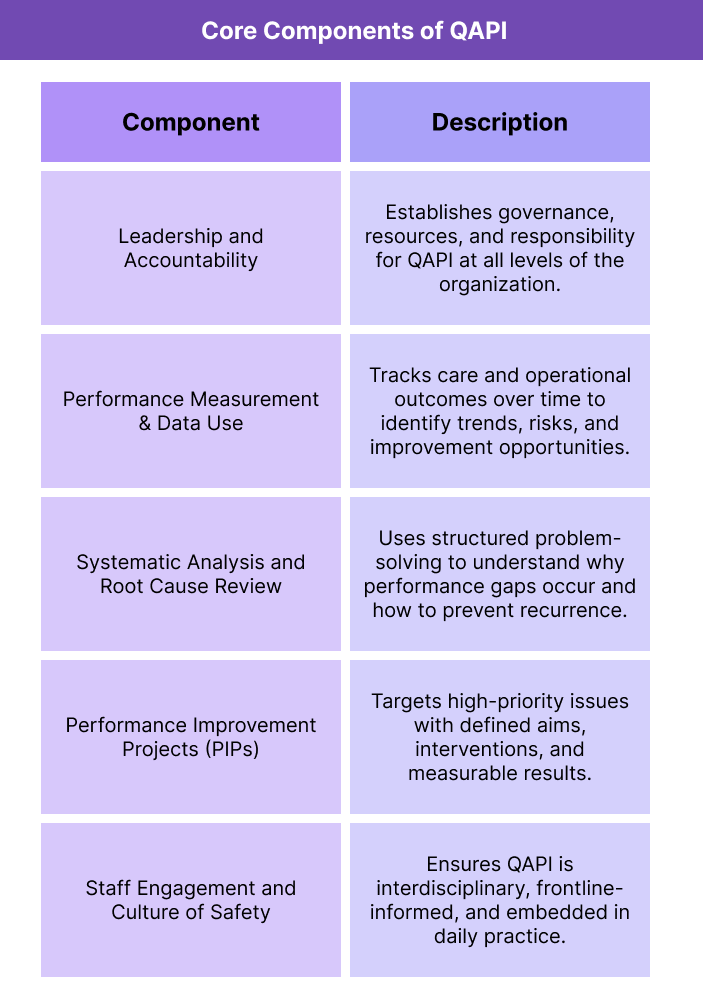
QAPI is designed to create a continuous, organization-wide system for improving care quality and safety. In CMS-regulated environments such as skilled nursing facilities, QAPI must be comprehensive, data-driven, and capable of producing measurable improvement over time. Programs that are narrow, informal, or reactive do not meet QAPI expectations.
At a high level, CMS expects every QAPI program to include several core elements that work together to identify performance gaps, implement improvements, and sustain better outcomes.
Leadership and Accountability in QAPI
A QAPI program must be led and supported by organizational leadership. This includes setting priorities, assigning ownership, ensuring adequate staffing and resources, and holding teams accountable for improvement results. Leadership involvement demonstrates that QAPI is a strategic operational function, not a side task.
QAPI Performance Measurement and Data Use
QAPI depends on continuous measurement of key outcomes and processes, such as clinical quality indicators, safety events, resident experience, and operational performance. Data must be used actively—both to detect performance problems early and to evaluate whether improvement changes are working.
Systematic Analysis and Root Cause Review in QAPI
When a performance gap or adverse event is identified, QAPI requires structured analysis to determine underlying causes. This prevents surface-level fixes and supports long-term risk reduction by improving the system that produced the problem.
QAPI Performance Improvement Projects (PIPs)
PIPs are the action engine of QAPI. Each project focuses on a specific, high-impact issue and includes a clear aim statement, measurable targets, interventions, and outcome tracking. PIPs show that the organization is not only monitoring quality, but actively improving it.
Staff Engagement and a Culture of Safety in QAPI
QAPI must involve staff across disciplines and roles, including frontline caregivers. A strong QAPI program builds a culture where issues are reported without fear, improvement is shared ownership, and safer, more effective care becomes part of everyday workflows.
How QAPI Works in Practice
QAPI functions as a continuous cycle of measurement, analysis, action, and re-measurement. Instead of treating quality as a one-time audit event, QAPI builds improvement into regular operations so organizations can spot issues early, respond systematically, and sustain better performance over time.
At its core, QAPI follows a repeatable workflow that turns real-world performance data into targeted improvements.
Step 1: Identify Performance Priorities
Organizations begin by reviewing key data sources—such as quality measures, incident reports, resident or patient feedback, and operational metrics—to determine where performance gaps or risks exist. Priorities are typically chosen based on impact to patient outcomes, safety, compliance exposure, or organizational goals.
Step 2: Measure and Track Baseline Performance
QAPI requires establishing a clear baseline before changes are made. This allows teams to quantify the size of a problem, understand patterns over time, and define what “success” will look like after improvements are implemented.
Step 3: Analyze Root Causes
Once an issue is selected, interdisciplinary teams use structured methods to determine why the gap is occurring. Root cause analysis helps organizations avoid surface-level fixes and instead address the systems, processes, or behaviors driving poor performance.
Step 4: Launch a Performance Improvement Project (PIP)
Improvement actions are organized into a PIP with a defined aim, interventions, responsible owners, and measurable targets. PIPs are designed to test changes in real workflows, monitor results, and refine approaches as needed.
Step 5: Sustain and Standardize Gains
If the PIP produces improvement, the organization integrates the successful changes into standard operations. This may include updating policies, retraining staff, adjusting tools or workflows, and continuing routine monitoring to prevent backsliding.
QAPI in Billing, Reimbursement, and System Limitations
QAPI is not a billing program, but it directly affects reimbursement because it shapes the quality systems behind regulated care delivery. In value-based and CMS-governed environments, strong QAPI practices help organizations reduce avoidable events, improve documented outcomes, and maintain compliance—all of which influence revenue stability.
How QAPI Supports Reimbursement Outcomes
Although QAPI activities do not generate billable codes on their own, they strengthen the care processes that reimbursement depends on. Effective QAPI programs help providers:
- Reduce preventable adverse events that can trigger denials, penalties, or lower quality scores
- Improve care consistency across teams, which supports reliable documentation and coding
- Demonstrate active quality oversight when participating in payer audits or performance reviews
- Maintain readiness for CMS surveys that can affect certification and payment eligibility
In practice, QAPI functions as the quality engine that protects revenue by stabilizing the clinical and operational performance payers measure.
Where QAPI Intersects With Billing-Driven Programs
QAPI often overlaps with reimbursable care models such as Chronic Care Management, Transitional Care Management, and other longitudinal care programs. These services require consistent workflows, time tracking, and audit-ready documentation. QAPI initiatives frequently target the same risk areas that lead to billing breakdowns, including:
- Incomplete or inconsistent care documentation
- Workflow gaps that cause missed visits or unreported time
- Variation in care plan execution across staff
- Safety or escalation failures that create downstream costs
When QAPI identifies these patterns, performance improvement projects can tighten processes that indirectly improve billing accuracy and payer confidence.
System Limitations and Common Misunderstandings
QAPI is sometimes misunderstood as a standalone compliance binder or a one-time corrective action plan. CMS expectations require QAPI to be continuous, data-driven, and organization-wide. Common limitations include:
- Treating QAPI as a quarterly meeting rather than an active improvement cycle
- Relying on anecdotal issues instead of measurable data trends
- Running improvement projects without baselines or tracked outcomes
- Limiting QAPI to clinical staff instead of including operational and administrative workflows
For healthcare SaaS buyers, the key takeaway is that QAPI is a structural improvement framework. Technology can support measurement and improvement tracking, but the organization must still own governance, priorities, and sustained execution.
How QAPI Influences Quality, Access, and Equity in Healthcare
QAPI influences more than internal compliance—it shapes how consistently an organization delivers safe, effective, and accessible care. Because QAPI is built around continuous measurement and improvement, it affects the real-world outcomes patients experience, the reliability of service delivery, and the organization’s ability to identify and reduce disparities.
How QAPI Improves Care Quality and Patient Safety
QAPI strengthens care quality by turning performance data into targeted improvements. When organizations regularly track outcomes and system performance, they can identify patterns of risk early and intervene before issues become widespread or harmful. Over time, this leads to fewer adverse events, more consistent clinical execution, and better long-term outcomes.
Common quality gains from a strong QAPI program include safer transitions of care, better chronic disease follow-up, fewer preventable complications, and improved care plan adherence across teams.
How QAPI Supports Patient Access and Continuity of Care
Access problems often come from workflow breakdowns—missed outreach, delayed escalations, inconsistent follow-up, or uneven staffing coverage. QAPI addresses these gaps by measuring where access failures occur and improving the processes that create them.
For example, organizations may use QAPI to reduce missed care management touchpoints, increase timely post-discharge follow-ups, or standardize triage pathways. These improvements help patients stay connected to care and reduce the likelihood that access issues turn into avoidable emergencies.
How QAPI Helps Identify and Reduce Health Inequities
QAPI can also support equity when performance data is segmented and reviewed through a disparity lens. By tracking outcomes across different patient groups, organizations can identify where certain populations are receiving lower-quality care, experiencing more delays, or facing higher risk.
Equity-focused QAPI work might address gaps such as unequal follow-up rates, inconsistent medication adherence support, language-access barriers, or higher complication rates in specific subgroups. When improvement projects target these patterns directly, QAPI becomes a tool for narrowing outcome disparities over time.
Frequently Asked Questions about QAPI
1. What is QAPI in healthcare?
QAPI (Quality Assurance and Performance Improvement) is an organization-wide, data-driven framework used to monitor care quality and safety, identify performance gaps, and implement continuous improvements that lead to better outcomes over time.
2. What does QAPI stand for?
QAPI stands for Quality Assurance and Performance Improvement. It combines routine quality monitoring with structured improvement work to prevent recurring problems and strengthen care delivery.
3. Is QAPI required by CMS?
Yes. CMS requires certain provider types—especially skilled nursing facilities—to maintain an active QAPI program that is continuous, measurable, and organization-wide, rather than a one-time compliance activity.
4. What are the five elements of QAPI?
The five commonly recognized elements of a compliant QAPI program are:
Design and Scope
- Governance and Leadership
- Feedback, Data Systems, and Monitoring
- Performance Improvement Projects (PIPs)
- Systematic Analysis and Systemic Action
Together, these elements ensure QAPI is broad, data-driven, and capable of producing sustained improvement.
5. What is a QAPI plan?
A QAPI plan is the written description of how an organization runs its QAPI program. It outlines the program’s scope, leadership oversight, data systems, improvement approach, and how performance improvement projects are selected and tracked.
6. What is the difference between QAPI and QAA?
QAA (Quality Assurance and Assessment) is more focused on monitoring whether standards are met. QAPI includes QA monitoring but goes further by requiring continuous, proactive improvement work based on root cause analysis and measurable performance change.
7. What is a QAPI Performance Improvement Project (PIP)?
A PIP is a targeted improvement initiative within a QAPI program. It focuses on a high-priority quality or safety gap, sets a measurable aim, tests workflow or care changes, and tracks results until improvements are sustained.
8. How does QAPI affect reimbursement?
QAPI does not create billable services, but it supports reimbursement by improving the care and operational systems that prevent denials, penalties, and audit risk. Better QAPI performance often leads to more consistent documentation, safer care, and stronger quality outcomes that payers measure.
