

What is COB (Coordination of Benefits) in Healthcare?
Coordination of Benefits (COB) is the process used by insurance payers to determine which health plan is primary and which is secondary when a patient is covered by more than one insurance policy. The goal of COB is to ensure that payments for healthcare services are properly allocated between payers, preventing duplicate reimbursement and clarifying patient responsibility.
In medical billing, COB rules guide providers and payers in processing claims accurately. The primary insurer pays first, up to its plan limits. Any remaining eligible balance is then submitted to the secondary insurer, which may cover additional costs depending on its benefits structure.
For providers and revenue cycle teams, COB is a critical part of claims management. If COB is not applied correctly, it often results in claim denials, payment delays, or rework. For payers, consistent COB processes reduce administrative errors and ensure compliance with state and federal regulations.
Key Components of Coordination of Benefits (COB)
COB ensures that healthcare claims are paid accurately when multiple insurance policies are involved. For providers and billing teams, understanding how COB rules apply is essential for avoiding denials, payment delays, and compliance issues.
Primary vs. Secondary Insurance
- The primary insurer pays claims first according to its benefits and coverage rules.
- The secondary insurer reviews the balance left after primary payment and may cover additional eligible costs.
- COB rules prevent duplicate payments and clarify how much of the cost shifts to patients.
Order of Benefit Determination Rules
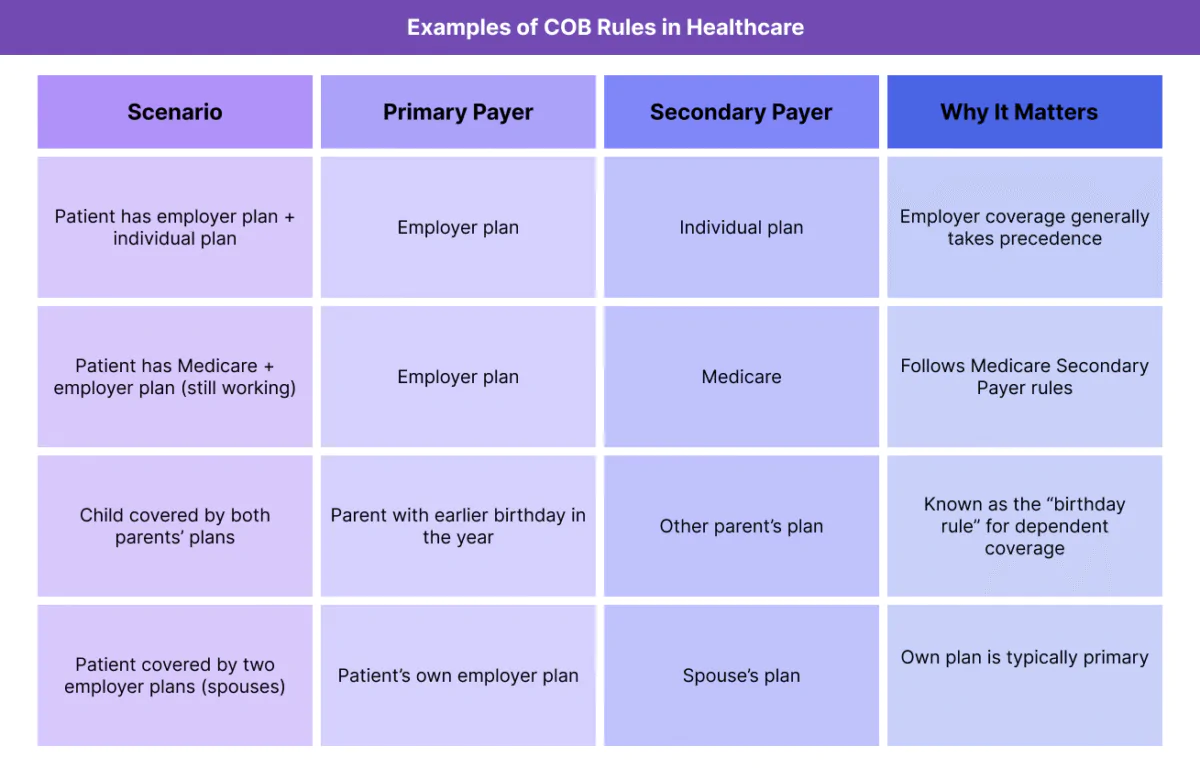
- Employment-based coverage is typically primary over individual coverage.
- Medicare Secondary Payer (MSP) rules apply in specific situations, such as when a patient is still working and covered under an employer plan.
- Dependent coverage rules (such as the “birthday rule” for children) determine which parent’s plan is primary.
COB and Claim Processing
- When providers submit claims, payers apply COB logic to decide responsibility.
- If COB details are missing or incorrect, payers may issue COB-related denials, often flagged with CARC and RARC codes.
- Correct COB processing ensures timely reimbursement and reduces accounts receivable days.
How COB Works in Healthcare Billing Workflows
Coordination of Benefits (COB) is built into the claims adjudication process, ensuring providers are reimbursed accurately and payers avoid duplicate payments. In practice, COB involves multiple checkpoints for providers, patients, and insurers.
Step 1: Patient Registration and Insurance Verification
- At intake, providers collect insurance details and determine if multiple policies are active.
- Eligibility tools or payer portals often flag patients with secondary coverage.
Step 2: Claim Submission to Primary Payer
- The provider submits the claim to the primary insurer.
- The claim is adjudicated, and the payer issues an EOB or ERA 835 detailing what was covered and what remains the patient’s responsibility.
Step 3: Claim Submission to Secondary Payer
- Using the EOB/ERA from the primary insurer, the provider submits the balance to the secondary payer.
- The secondary payer applies its benefits to determine whether additional costs will be covered.
Step 4: COB Denials and Adjustments
- If COB details are missing, outdated, or incorrectly applied, payers may deny or pend the claim.
- Denials often come with CARC/RARC codes indicating issues such as “information required for COB” or “secondary payer not on file.”
Step 5: Reconciliation and Patient Billing
- Once both payers have processed the claim, providers reconcile payments.
- Any remaining balance is billed to the patient according to the coordinated determination of benefits.
Step 6: Reporting and Compliance Tracking
- Providers monitor COB denials and delays as part of denial management KPIs.
- Payers track COB compliance to ensure claims follow state regulations and Medicare Secondary Payer rules.
COB in Billing, Reimbursement, and Claim Adjudication
Coordination of Benefits (COB) has a direct impact on how providers get paid and how patients are billed. When applied correctly, COB ensures accurate reimbursement across multiple insurers. When applied incorrectly, it is one of the leading causes of claim denials, delays, and rework in the revenue cycle.
Direct vs. Indirect Role in Reimbursement
- Direct: COB rules determine which payer reimburses first and how the secondary payer covers any balance. Correct COB application ensures providers receive the maximum allowable reimbursement.
- Indirect: COB influences how quickly payments are received. Incorrect COB information can trigger denials or cause payers to pend claims, increasing administrative workload.
Impact on Revenue Cycle Management
- COB is a frequent cause of claim denials, especially when secondary insurance coverage is not identified upfront.
- Secondary claims cannot be processed without the EOB or ERA 835 from the primary payer, slowing cash flow.
- Providers must monitor COB-related denials using CARC and RARC codes to identify payer-specific trends and training gaps.
Limitations and Challenges
- Information Gaps: Patients may not disclose secondary coverage at registration, leading to downstream denials.
- Complex Rules: COB rules vary between commercial payers, Medicare, and Medicaid, requiring staff training and payer-specific knowledge.
- Administrative Burden: Submitting secondary claims adds extra steps to the billing workflow, increasing AR cycle time.
- Appeal Complexity: Denials tied to COB can be difficult to overturn without clear documentation of both coverage policies.
COB and Its Impact on Quality, Transparency, and Equity
Coordination of Benefits (COB) affects more than just payment workflows. By clarifying payer responsibilities and patient obligations, COB contributes to data quality, transparency in billing, and equitable access to care.
Improving Data Accuracy and Claim Integrity
- COB ensures that claims are processed in the correct order, reducing duplicate payments and errors.
- Accurate COB data strengthens the integrity of billing records, making audits smoother and compliance more reliable.
- Providers gain clearer visibility into reimbursement flows, which helps reconcile accounts faster.
Enhancing Transparency for Patients and Providers
- COB reduces confusion by clarifying which payer is responsible and what portion of costs the patient must cover.
- Patients benefit from aligned billing: once COB is applied, the provider’s statement matches the insurer’s determination.
- For providers, transparency in COB lowers call volume from patients disputing balances or questioning duplicate charges.
Supporting Compliance and Regulatory Requirements
- CMS and state regulations require proper COB processing, especially under Medicare Secondary Payer (MSP) rules.
- COB data is used in audits to confirm that providers are not billing patients for amounts covered by secondary payers.
- Consistent COB workflows help organizations demonstrate adherence to payer contracts and government oversight.
Equity and Access Considerations
- COB ensures patients with multiple coverages — such as dual Medicare/Medicaid enrollees — receive the maximum benefit available.
- When COB is mishandled, vulnerable populations risk overpaying or delaying care due to billing disputes.
- Clear and standardized COB explanations help level the playing field, making it easier for patients and smaller providers to navigate complex insurance rules.
Frequently Asked Questions about COB
1. What is COB in healthcare insurance?
COB (Coordination of Benefits) is the process insurers use to decide which plan pays first (primary) and which pays second (secondary) when a patient has more than one insurance policy.
2. How does COB work with secondary insurance?
The primary insurer pays first according to its rules. The secondary insurer reviews the remaining balance and may pay some or all of the leftover costs, depending on its benefits.
3. What are common COB denial reasons?
COB denials occur when secondary coverage is missing, outdated, or incorrectly applied.
Examples include:
- Secondary payer not on file.
- COB information not provided.
- Primary EOB/ERA not submitted with secondary claim.
4. How do providers determine primary vs. secondary insurance?
Rules vary, but common guidelines include:
- Employer-based plans are primary over individual coverage.
- A patient’s own employer plan is primary over a spouse’s plan.
- For children with dual coverage, the “birthday rule” assigns primary status to the parent whose birthday comes first in the year.
5. What is the difference between COB and subrogation?
- COB: Determines order of payment between multiple insurers covering the same patient.
- Subrogation: When an insurer seeks reimbursement from another responsible party (e.g., auto insurer after an accident).
6. What role does COB play in revenue cycle management?
Correct COB processing ensures timely payment from all responsible insurers. Errors lead to denials, rework, and delayed cash flow, making COB a critical revenue cycle priority.
7. Does Medicare have specific COB rules?
Yes. Medicare Secondary Payer (MSP) rules outline when Medicare pays first or second. For example, if a patient is actively employed with employer coverage, that plan typically pays primary, and Medicare pays secondary.
