

What is HL7 (Health Level Seven International)?
Health Level Seven International (HL7) is a nonprofit standards organization that develops widely used frameworks for sharing electronic health information. In healthcare, the term “HL7” refers both to the organization itself and to its messaging standards that enable hospitals, clinics, payers, and health IT systems to exchange patient data consistently.
These standards define how critical information — such as patient demographics, lab results, diagnoses, and billing codes — is formatted and transmitted across different electronic health record (EHR) and electronic medical record (EMR) systems. HL7 provides the foundation for interoperability in healthcare, ensuring that information flows smoothly between providers and systems.
Key Components of HL7
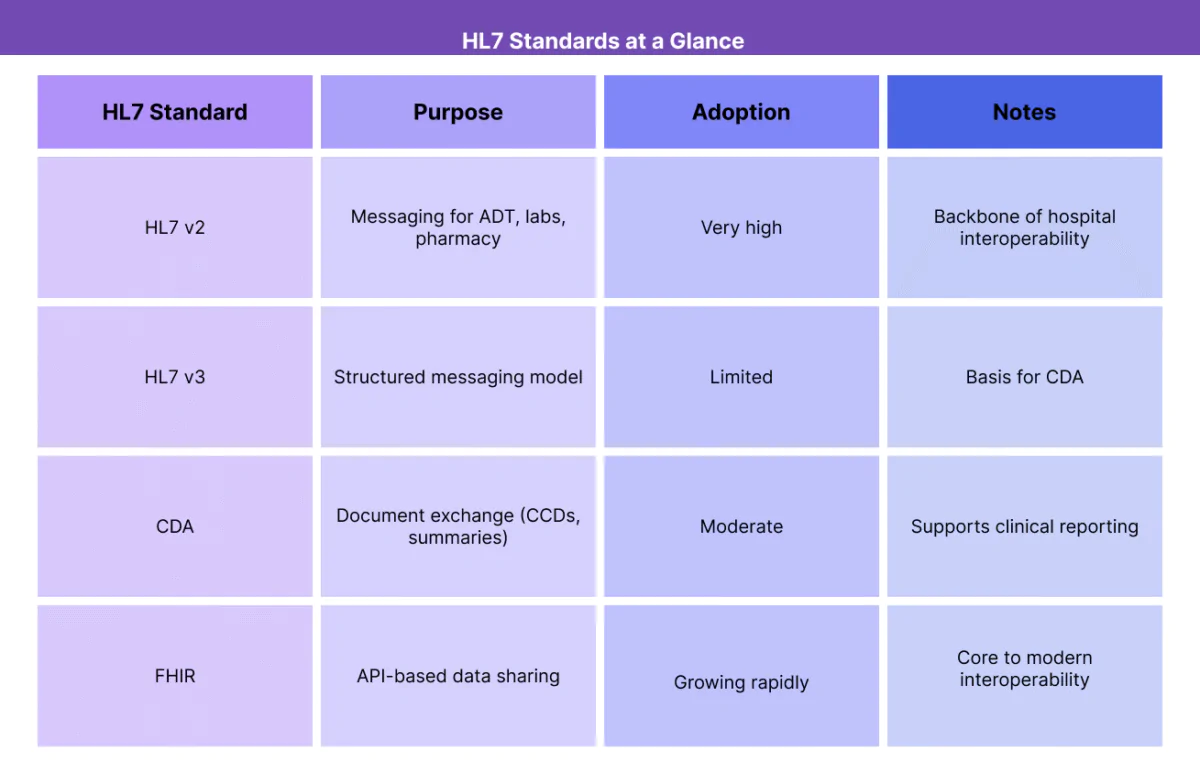
HL7 standards have evolved over time to meet the changing needs of healthcare data exchange. Each version or framework was designed to solve specific challenges, from early hospital system integrations to modern web-based interoperability. The four most widely referenced HL7 standards are HL7 v2, HL7 v3, the Clinical Document Architecture (CDA), and Fast Healthcare Interoperability Resources (FHIR).
HL7 v2
Introduced in the late 1980s, HL7 v2 remains the most widely implemented standard worldwide. It supports real-time messaging for admissions, discharges, transfers (ADT), lab orders, results reporting, and pharmacy communications. Its flexibility led to rapid adoption, though implementations vary by vendor.
HL7 v3
Developed to improve consistency, HL7 v3 is built on a more formal reference model. While technically robust, it proved complex to implement and saw limited uptake. Its main legacy is serving as the foundation for the CDA standard.
CDA (Clinical Document Architecture)
CDA provides a structured way to exchange clinical documents such as discharge summaries, care plans, and consultation notes. It is commonly used for Continuity of Care Documents (CCDs) and required in some CMS reporting workflows.
FHIR (Fast Healthcare Interoperability Resources)
FHIR is HL7’s modern standard, designed with web technologies like RESTful APIs and JSON. It supports app-based healthcare interoperability, allowing EHRs, payers, and digital health apps to exchange data securely and flexibly. FHIR adoption is expanding rapidly, supported by regulatory requirements and industry demand.
HL7 in Practice: Examples of Healthcare Data Exchange
HL7 standards are not just technical specifications — they shape the way healthcare data moves between systems in everyday clinical and administrative workflows. Here’s how HL7 shows up in practice:
Step 1: Patient Registration
When a patient checks in at a hospital or clinic, an HL7 v2 message transmits demographic and admission data to the EHR and downstream systems.
Step 2: Ordering & Results
A provider orders a lab test, and the order is sent electronically to the lab. Once processed, the lab result is returned as another HL7 message, automatically populating the patient’s chart.
Step 3: Clinical Documentation
A discharge summary or care plan is structured using CDA, ensuring that another provider can receive and interpret the document without losing context.
Step 4: App-Based Integration
A third-party digital health app connects to an EHR using FHIR APIs, securely pulling medication lists or pushing new patient-reported outcomes into the record.
HL7 Billing, Reimbursement, and Limitations in Healthcare
HL7 standards don’t appear directly on a claim form, but they structure the data pipelines that billing, compliance, and reporting systems depend on. For provider organizations, payers, and vendors, HL7 is a critical enabler of revenue integrity and operational efficiency.
Direct vs. Indirect Impact on Billing
Direct: HL7 messages don’t generate CPT or HCPCS codes.
Indirect: Accurate HL7 data exchange ensures that demographic details, diagnoses, and encounter information are properly captured, reducing denials and rework for billing teams.
HL7’s Role in Value-Based Care
- Quality reporting: HL7 supports standardized data collection for CMS programs and payer contracts.
- Risk adjustment: Clean HL7-driven data exchange improves the accuracy of HCC and RAF scoring.
- Compliance: CMS interoperability mandates lean heavily on HL7 FHIR adoption, making it strategically important for providers and payers.
Limitations and Challenges
- Fragmentation: HL7 v2 dominates U.S. hospitals but lacks consistency across vendors, creating costly integration projects.
- Adoption barriers: FHIR is the future of HL7, but full implementation requires investment in APIs, staff training, and vendor alignment.
- Complexity: Earlier frameworks like HL7 v3 never achieved widespread adoption due to their steep learning curve.
HL7 Quality, Equity, and Data Integrity in Healthcare
Beyond interoperability and billing workflows, HL7 standards play a central role in data quality, patient safety, and equitable care delivery. For provider organizations, payers, and health IT vendors, HL7 is not just about moving data — it’s about making that data reliable, actionable, and compliant with federal mandates.
Improving Data Quality and Patient Safety
- Structured HL7 messages reduce errors from manual re-entry, improving clinical decision support.
- HL7 standards enable consistent transmission of lab results, medication lists, and diagnostic data, minimizing gaps in patient records.
- For organizations, this translates into fewer adverse events and higher trust in shared data.
Supporting Care Coordination
- HL7 allows smooth transitions of care, such as when patients move between hospitals, specialists, and post-acute facilities.
- HL7 CDA documents and FHIR APIs help ensure care teams have a shared, up-to-date patient record, reducing duplication and delays.
- Payers and ACOs rely on this data flow to manage population health effectively.
Advancing Equity and SDOH Integration
- Modern HL7 standards, especially FHIR, support capture of Social Determinants of Health (SDOH), such as housing, transportation, and food insecurity.
- This enables providers and payers to address barriers beyond clinical care, aligning with CMS requirements for health equity reporting.
- By integrating Z codes and other non-clinical data, HL7 makes equity-focused interventions measurable and reportable.
Challenges and Adoption Barriers
- Smaller clinics and rural health organizations may lack the resources to fully implement HL7 updates, widening gaps in interoperability.
- Vendor variation in HL7 implementation still creates friction, despite regulatory pressure.
- Ensuring that equity-focused data is collected consistently and respectfully remains an ongoing challenge.
Frequently Asked Questions about HL7
1. What is HL7 in healthcare?
HL7 (Health Level Seven International) is a nonprofit organization that develops standards for exchanging health information electronically. In practice, “HL7” refers to both the organization and its widely used messaging standards that connect EHRs, payers, labs, and other health IT systems.
2. How is HL7 used in healthcare data exchange?
HL7 standards structure how patient demographics, lab results, clinical documents, and billing information move between systems. Hospitals use HL7 v2 messages for admissions and lab workflows, while FHIR APIs enable modern app-based data sharing.
3. What are examples of HL7 standards?
The most common HL7 standards include:
- HL7 v2 for messaging across hospital systems.
- HL7 v3 for structured communication.
- CDA (Clinical Document Architecture) for documents like discharge summaries.
- FHIR (Fast Healthcare Interoperability Resources) for modern API-based integration.
4. Does HL7 impact billing and reimbursement?
HL7 does not directly create billing codes, but it structures the data that flows into claims and compliance reports. Accurate HL7 data exchange reduces denials, supports quality reporting, and helps organizations meet CMS requirements for value-based care.
5. How does HL7 relate to other healthcare standards like SNOMED or LOINC?
6. Who uses HL7 standards?
HL7 is used across the healthcare ecosystem — by hospitals, clinics, laboratories, payers, EHR vendors, and government agencies like CMS. It underpins interoperability efforts across value-based care, compliance programs, and population health initiatives.
7. What is HL7 FHIR and why is it important?
FHIR (Fast Healthcare Interoperability Resources) is the modern HL7 standard built on web technologies like REST APIs and JSON. It enables EHR systems, payers, and third-party apps to share health data more easily and securely. FHIR is central to CMS interoperability mandates and is rapidly becoming the foundation for digital health innovation.
