

What is UCUM (Unified Code for Units of Measure)?
UCUM (Unified Code for Units of Measure) is a standardized coding system for representing units of measure in healthcare and science. It provides a universal way to express quantities such as lab results, vital signs, and medication dosages, ensuring that units are interpreted consistently across electronic systems.
UCUM was designed to eliminate ambiguity in unit representation. For example, the unit for milligrams per deciliter can appear as “mg/dL,” “mg/dl,” or “milligrams per deciliter” — UCUM provides a single, machine-readable standard to prevent misinterpretation.
UCUM is used alongside other healthcare standards to ensure data integrity:
- With LOINC, it standardizes the units of measure for lab and observation results.
- With SNOMED CT, it supports coded clinical data.
- In FHIR and C-CDA, UCUM units are embedded within resources and documents to ensure interoperability.
By providing a consistent coding framework for measurements, UCUM helps reduce errors, supports interoperability, and strengthens data quality for patient care, research, and Value-Based Care (VBC) initiatives.
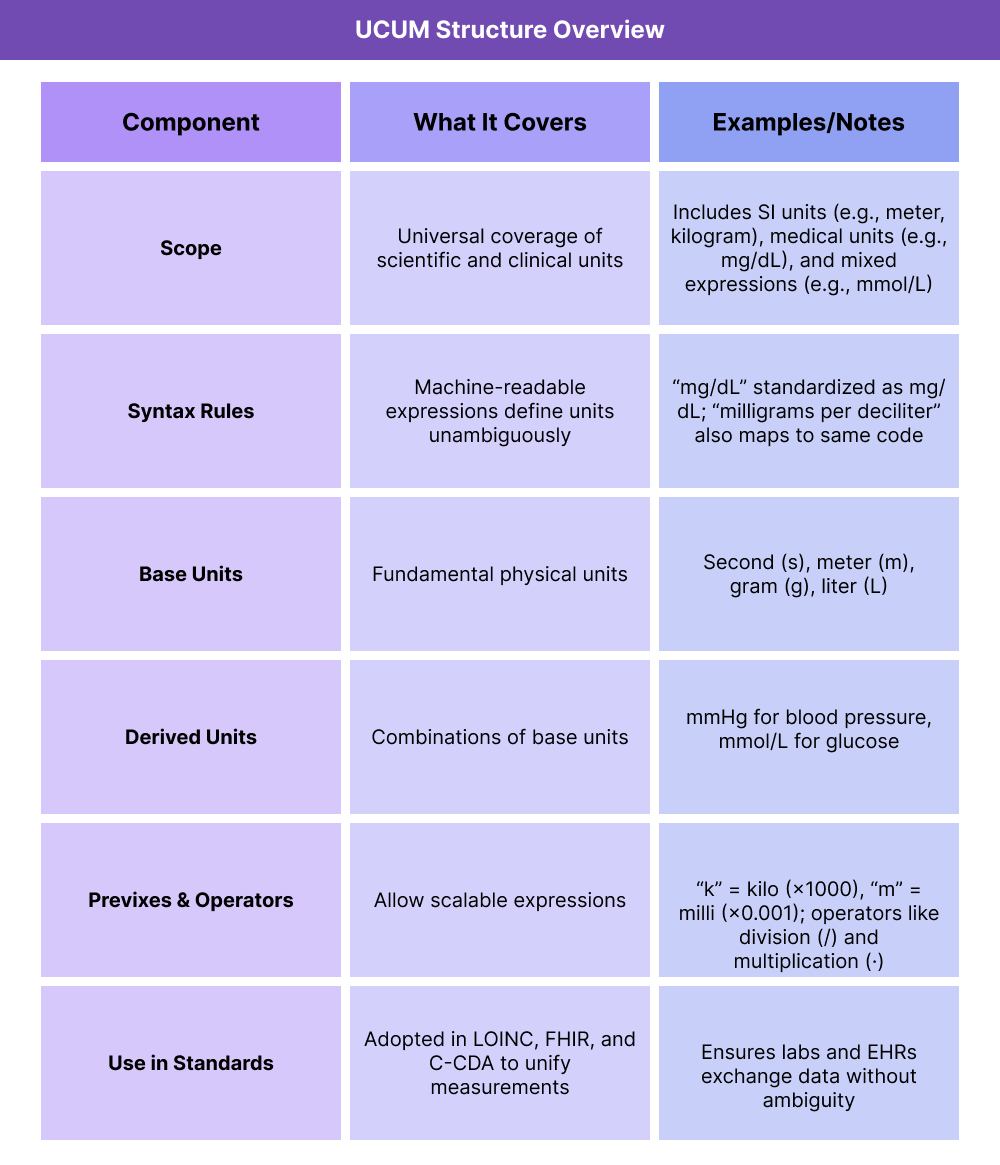
Key Components of UCUM
The Unified Code for Units of Measure (UCUM) was created to provide a single, unambiguous way to represent units in electronic systems. In healthcare, inconsistent units can create serious risks — for example, reporting glucose as “mg/dl” vs. “mmol/L” could lead to confusion if systems don’t interpret the values correctly. UCUM ensures that no matter how a unit is written by humans, it has one standardized, machine-readable representation.
Scope of UCUM
UCUM is designed to cover all units of measure relevant to healthcare, science, and engineering. This includes:
- International System of Units (SI) such as meters, grams, and seconds
- Common medical units like milligrams per deciliter (mg/dL), millimeters of mercury (mmHg), and international units (IU)
- Mixed expressions that combine multiple units, such as mmol/L for lab values or kg·m² for body mass index calculations
Syntax Rules
UCUM defines strict syntax rules so that every unit has a unique digital representation. Variants like “mg/dL,” “mg/dl,” and “milligrams per deciliter” all resolve to the same canonical UCUM expression. This consistency eliminates ambiguity when exchanging data across EHRs, labs, or public health systems.
Base and Derived Units
- Base units in UCUM are fundamental physical measures such as seconds (s), meters (m), grams (g), and liters (L).
- Derived units are combinations of base units that represent clinical or scientific measures, such as mmHg for blood pressure or mmol/L for glucose concentration.
Prefixes and Operators
UCUM supports the use of prefixes and mathematical operators to scale and combine units:
- Prefixes like kilo (k = ×1000) or milli (m = ×0.001) allow precision scaling.
- Operators like division (/) and multiplication (·) let users construct compound expressions.
This flexibility makes UCUM capable of representing nearly any measurable quantity in healthcare or research.
Integration with Other Standards
UCUM is widely used in combination with other interoperability standards:
- LOINC relies on UCUM to specify the units of laboratory and observation codes.
- SNOMED CT concepts often pair with UCUM units to provide precise, standardized data.
- FHIR and C-CDA embed UCUM units in resources and documents so that lab results, vitals, and medication dosages are consistent across systems.
UCUM Use Cases
UCUM plays a critical role in day-to-day healthcare operations:
- Lab reporting: Standardizes units in test results, such as blood glucose in mg/dL.
- Vital signs: Ensures measures like mmHg for blood pressure or °C for temperature are consistent.
- Medication dosing: Provides clarity for units like mg, mL, or IU in prescribing and pharmacy workflows.
- Research and public health: Enables large-scale aggregation and comparison of data across studies and institutions.
How UCUM Is Used in Practice
Step 1 — Measurement Is Taken
A clinician records a vital sign, lab result, or medication dosage. Examples: blood pressure, blood glucose, or insulin units.
Step 2 — Unit Is Assigned
The measurement is expressed in a unit, such as mg/dL for glucose, mmHg for blood pressure, or mL for a medication dose.
Step 3 — Unit Is Encoded in UCUM
The EHR or laboratory system converts the unit into its UCUM representation, ensuring that the expression is machine-readable and standardized. For example:
- “mg/dl,” “mg/dL,” and “milligrams per deciliter” → mg/dL in UCUM
- Blood pressure in millimeters of mercury → mm[Hg]
Step 4 — Data Is Exchanged Across Systems
The UCUM-encoded unit travels with the clinical result when it is shared using standards like LOINC, FHIR, or C-CDA. This ensures the receiving system interprets the unit correctly, regardless of local conventions.
Step 5 — Integration Into Patient Records
The result is incorporated into the patient’s record in a consistent format, avoiding ambiguity in care coordination, analytics, or decision support tools.
Step 6 — Use in Analytics and Research
Standardized UCUM units allow aggregation of data across populations and institutions. Public health agencies and researchers can analyze lab results or vital signs at scale without confusion over unit differences.
Billing and Reimbursement for UCUM
How UCUM Fits Into Healthcare Data
- UCUM provides the standardized units of measure for clinical results and medication quantities.
- It is used within EHRs, labs, and exchange standards to ensure that values such as lab results or medication dosages are consistent and comparable.
- Unlike ICD-10 or CPT, UCUM is not a billing code set and does not appear directly on claims.
Does UCUM Affect Reimbursement?
No direct payment role: UCUM codes themselves are not reimbursable.
- Indirect impact: By ensuring consistent measurement units, UCUM supports accurate reporting, risk adjustment, and quality metrics that feed into value-based care (VBC) reimbursement models.
- Regulatory alignment: Programs that mandate the use of LOINC or FHIR inherently require UCUM because these standards rely on UCUM for units of measure.
Limitations of UCUM in Billing
- Not recognized as a financial coding system by payers.
- Providers may be unaware of UCUM because it operates “under the hood” of EHRs and labs.
- Adoption is uneven in some international contexts outside of U.S. and EU systems.
Future Outlook
- UCUM’s role will continue to expand as interoperability mandates grow.
- It will remain an invisible but essential foundation for billing-related standards (LOINC-coded labs, medication dosing in claims, and FHIR-based reporting).
Quality and Equity Implications of UCUM
Improving Patient Safety
- Standardized units reduce the risk of dangerous misinterpretations in labs and prescribing.
- Example: Ensures that a glucose result in “mg/dL” is not confused with “mmol/L,” preventing dosing errors.
- In medication safety, UCUM ensures that units like mg, mL, and IU are consistently interpreted by pharmacies and EHRs.
Enhancing Data Quality
- UCUM makes lab and clinical measurements machine-readable and unambiguous.
- Supports clean data flows across systems, enabling accurate analytics and quality reporting.
- Facilitates aggregation of data across providers, payers, and research organizations.
Supporting Value-Based Care (VBC)
- Accurate, standardized units are critical for quality measures tied to outcomes, such as blood pressure control or HbA1c management.
- UCUM-enabled consistency improves reliability of metrics that directly affect reimbursement in value-based care models.
Advancing Health Equity
- By standardizing measurement units across institutions, UCUM ensures that disparities in care are measured accurately.
- Enables fair comparisons across populations, supporting CMS’s push for equity-focused initiatives.
- Allows aggregation of SDOH-linked clinical metrics (e.g., blood pressure, BMI) for vulnerable populations.
Challenges
- Clinician awareness is low since UCUM operates in the background of EHR systems.
- Implementation quality depends on vendors properly embedding UCUM in software.
- Gaps in adoption outside major standards (LOINC, FHIR, C-CDA) can reduce consistency.
Frequently Asked Questions about UCUM
1. What is UCUM in healthcare?
UCUM (Unified Code for Units of Measure) is a standard system for representing units of measure in a consistent, machine-readable way. It eliminates ambiguity in labs, vitals, and medication dosing.
2. What is an example of a UCUM code?
Examples include:
- mg/dL for milligrams per deciliter (blood glucose)
- mm[Hg] for millimeters of mercury (blood pressure)
- mL for milliliters (medication dose)
3. How is UCUM used in healthcare data?
UCUM codes are embedded in electronic health records (EHRs), lab systems, and interoperability standards like LOINC and FHIR. They ensure that units are consistent across systems and prevent errors.
4. Does UCUM affect billing or reimbursement?
Not directly. UCUM is not a billing code set like ICD-10 or CPT. However, it indirectly supports billing by ensuring measurement data is standardized for quality reporting and value-based care models.
5. How does UCUM relate to other coding standards?
- LOINC → UCUM defines the units of measure for lab and observation codes.
- SNOMED CT → pairs with UCUM units for clinical concepts.
- FHIR and C-CDA → embed UCUM in resources and documents to ensure interoperability.
6. Who uses UCUM?
UCUM is used globally by EHR vendors, laboratories, pharmacies, payers, and public health organizations. It underpins many interoperability and reporting initiatives, though most clinicians encounter it indirectly through their systems.
