

What is SNOMED CT? (Systematized Nomenclature of Medicine – Clinical Terms)
SNOMED CT (Systematized Nomenclature of Medicine – Clinical Terms) is a standardized clinical terminology used worldwide to encode medical concepts, including diagnoses, findings, procedures, body structures, organisms, and substances. Unlike classification systems such as ICD-10, which group conditions for reporting and billing, SNOMED CT provides detailed, precise terms designed to capture the full clinical picture in electronic health records (EHRs).
SNOMED CT supports interoperability by allowing different healthcare systems to exchange and interpret patient data consistently. It also maps to other code sets, including LOINC (for labs and observations) and ICD-10 (for billing), and is commonly used in data standards like FHIR to support clinical exchange across platforms.
For providers and health IT organizations, SNOMED CT ensures accurate documentation, enables data-driven care management, and strengthens the foundation for quality reporting and value-based care (VBC).
Key Components of SNOMED CT
SNOMED CT is built to function as the most comprehensive clinical terminology available, designed to capture the full detail of patient care in a structured and interoperable way. Unlike billing-oriented classifications such as ICD-10, SNOMED CT is optimized for clinical documentation and data exchange. Its key components make it valuable for providers, payers, researchers, and health IT developers alike.
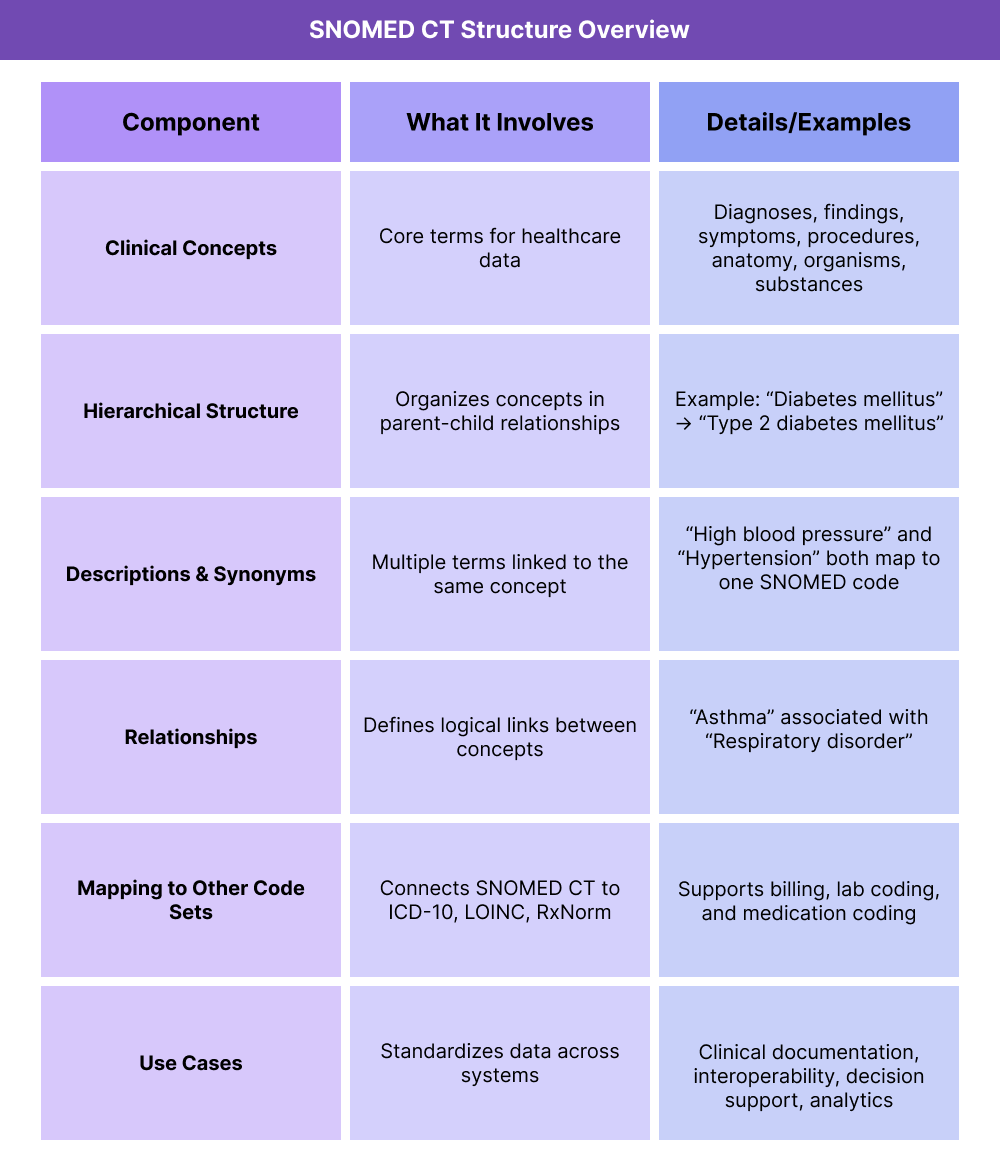
1. Clinical Concepts
SNOMED CT contains hundreds of thousands of standardized medical concepts that cover every domain of healthcare. These include:
- Diseases and clinical findings
- Signs and symptoms
- Procedures and interventions
- Body structures and anatomical locations
- Organisms and substances (e.g., bacteria, allergens, medications)
This breadth allows it to capture details at the point of care with more precision than ICD-10 or CPT alone.
2. Hierarchical Structure
Concepts are arranged in a parent-child hierarchy, making it easy to organize and search. For example, “Diabetes mellitus” branches into “Type 1 diabetes mellitus” and “Type 2 diabetes mellitus.” This enables both broad population-level reporting and highly granular tracking.
3. Descriptions and Synonyms
Each concept can have multiple descriptions so that common variations in clinical language are captured. For instance, “Hypertension” and “High blood pressure” both link to the same SNOMED CT code. This helps ensure consistency across providers, even if they use different terms.
4. Relationships Between Concepts
SNOMED CT doesn’t just list terms; it defines logical relationships that connect them. For example, “Asthma” is linked as a type of “Respiratory disorder.” This ontology-like structure supports clinical decision support systems and automated reasoning.
5. Mapping to Other Code Sets
SNOMED CT can be mapped to other coding systems such as ICD-10 (for reporting and billing), LOINC (for laboratory and observation data), and RxNorm (for drugs). These mappings allow data to flow seamlessly between clinical documentation, billing, and analytics.
6. Use Cases
SNOMED CT supports a wide range of practical applications:
- Accurate clinical documentation in EHRs
- Interoperability across health IT systems through standards like FHIR
- Decision support tools that rely on structured terminology
- Population health analytics and research based on consistent data
How SNOMED CT is Used in Practice
Step 1 — Clinical Documentation
Providers enter information into the electronic health record (EHR) using everyday clinical language. Behind the scenes, those terms are mapped to the correct SNOMED CT codes to ensure standardized documentation.
Step 2 — Coding & Mapping
The SNOMED CT terminology links clinical terms to standardized codes. If billing or reporting is required, these codes can also be mapped to ICD-10-CM, CPT, LOINC, or RxNorm depending on the use case.
Step 3 — Data Sharing & Interoperability
SNOMED CT serves as a foundation for health data exchange. Through standards like FHIR and C-CDA, coded data can move between providers, payers, labs, and registries while keeping its meaning intact.
Step 4 — Clinical Decision Support
Because SNOMED CT encodes relationships between concepts, it supports decision support systems. For example, an EHR can trigger alerts when a diagnosis (“Asthma”) is linked to a contraindicated medication.
Step 5 — Analytics & Population Health
Aggregated SNOMED CT data supports research, quality reporting, and population health analytics. Organizations can identify trends across patient populations (e.g., prevalence of chronic conditions) and stratify risk more effectively.
Step 6 — Global Adoption & Governance
SNOMED CT is maintained by SNOMED International, a nonprofit organization. It is used in more than 40 member countries, making it a global standard that enables cross-border healthcare research and data sharing.
How SNOMED CT Impacts Billing and Reimbursement
Not a Billing Code Set
SNOMED CT is a clinical terminology, not a billing or reimbursement system. It is designed to describe the patient’s condition and care in detail, but it does not directly drive payment. For reimbursement, providers still rely on code sets like ICD-10-CM, CPT, and HCPCS.
Indirect Role in Reimbursement
Even though SNOMED CT itself is not used for payment, it plays an important role in billing workflows:
- Mapping to ICD-10 and CPT: SNOMED CT codes can be crosswalked to billing codes, ensuring that clinical documentation aligns with claim requirements.
- Support for Value-Based Care (VBC): Detailed documentation supports accurate quality reporting and risk adjustment, both of which influence reimbursement under models like ACO REACH or Medicare Advantage (MA).
- Reducing Coding Errors: By capturing precise clinical information, SNOMED CT reduces the risk of miscoding that can delay or reduce reimbursement.
Limitations in Billing Contexts
- No direct payment mechanism — SNOMED CT cannot be used alone on claims.
- Mapping complexity — Not every SNOMED concept has a one-to-one match in ICD-10 or CPT, which can cause gaps.
- Workflow adoption — Many organizations underutilize SNOMED CT because it requires EHR systems to handle terminology mappings smoothly.
Future Outlook
As healthcare shifts toward interoperability and population health management, SNOMED CT is expected to become even more central. While it may never replace billing code sets, its role in data quality and equity reporting is likely to expand.
Quality & Equity Implications of SNOMED CT
Improving Data Quality
SNOMED CT creates a consistent language for documenting clinical concepts, reducing ambiguity in patient records. By standardizing terminology across providers and systems, it ensures that data captured at the point of care can be trusted for analytics, reporting, and care coordination.
Supporting Value-Based Care (VBC)
- Accurate and detailed coding is critical to the success of value-based care initiatives. SNOMED CT enables:
- More precise tracking of chronic conditions and comorbidities
- Stronger risk adjustment models to reflect true patient complexity
- Better alignment of clinical documentation with quality measures used in ACO REACH, MSSP, and Medicare Advantage
Equity and Population Health
SNOMED CT contributes to health equity by enabling the structured capture of patient data that goes beyond traditional diagnoses. For example:
- Documenting social and behavioral health factors in parallel with medical diagnoses
- Identifying disparities in care across demographic or clinical subgroups
- Feeding into population health dashboards that guide equity interventions
Integration With Other Standards
SNOMED CT is most powerful when combined with other standards:
- Z codes (ICD-10-CM) for social determinants of health
- LOINC for lab tests and observations
- FHIR for exchanging structured data between EHRs
Together, these tools provide the foundation for equity-focused reporting and care delivery.
Challenges to Equity Impact
- Adoption gaps: Not all EHRs fully support SNOMED CT, leading to inconsistent use.
- Training needs: Clinicians may document with free text instead of coded terms, limiting downstream analytics.
- International variation: While globally adopted, usage and implementation differ across countries, affecting comparability.
Frequently Asked Questions about SNOMED CT
1. What is SNOMED CT in healthcare?
SNOMED CT (Systematized Nomenclature of Medicine – Clinical Terms) is a standardized clinical terminology used worldwide to code medical concepts such as diseases, findings, procedures, and anatomy. It provides a detailed, structured language for documenting care in electronic health records (EHRs).
2. How is SNOMED CT used in practice?
Clinicians document patient encounters using everyday language, which is mapped to SNOMED CT codes in the EHR. These codes ensure consistent data capture, support decision support tools, enable interoperability, and feed into analytics and population health management.
3. Is SNOMED CT the same as ICD-10?
No. ICD-10 is a classification system used primarily for billing and reporting. SNOMED CT is a clinical terminology designed for detailed documentation and interoperability. SNOMED codes can be mapped to ICD-10 codes when billing is required.
4. Does SNOMED CT affect reimbursement?
Not directly. SNOMED CT is not a billing code set. However, it indirectly supports reimbursement by improving documentation quality, reducing coding errors, and aligning with quality reporting and risk adjustment models in value-based care.
5. Can you give an example of a SNOMED CT code?
Yes. For example, the concept “Type 2 diabetes mellitus” is represented by the SNOMED CT code 44054006. Multiple synonyms (e.g., “Type II diabetes,” “Adult-onset diabetes”) all map to the same standardized code.
6. Who uses SNOMED CT?
SNOMED CT is used globally by providers, health systems, payers, and researchers. It is adopted in more than 40 countries and is maintained by SNOMED International, making it the most widely recognized clinical terminology worldwide.
