

What is Enhancing Oncology Model (EOM)?
Enhancing Oncology Model (EOM) is a value-based care model from the Centers for Medicare & Medicaid Services (CMS) that launched in July 2023. It was created as the successor to the Oncology Care Model (OCM) and is designed to improve the quality and coordination of cancer treatment while lowering costs.
Under EOM, oncology practices and payers take on accountability for the total cost and quality of care for Medicare patients receiving chemotherapy for common cancer types. Participants are supported with prospective payments, risk-sharing opportunities, and performance incentives tied to patient outcomes.
EOM is part of CMS’s broader strategy to advance value-based care (VBC). It complements programs like Chronic Care Management (CCM), which supports cancer patients with multiple chronic conditions, and it overlaps with Medicare Advantage (MA) plans that may offer supplemental oncology benefits.
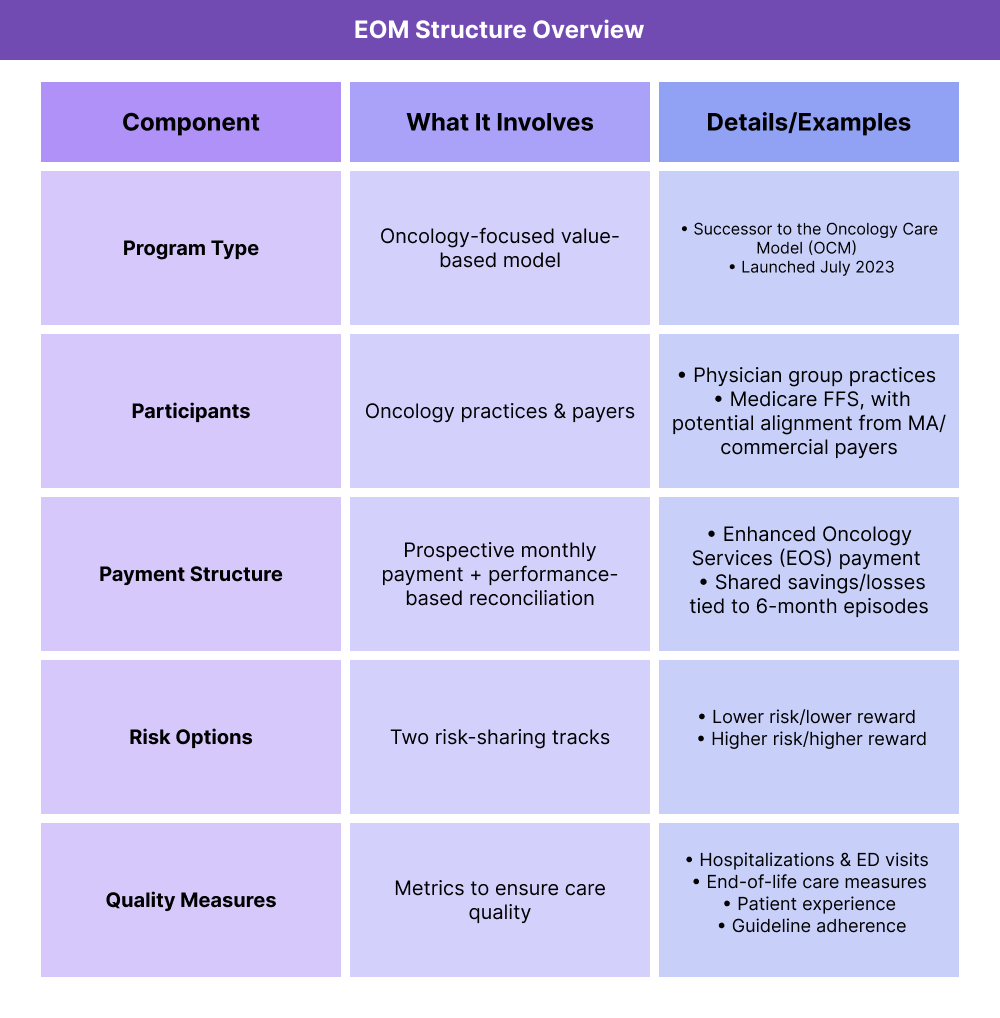
Key Components of the Enhancing Oncology Model (EOM)
How the EOM Model Works
- Focuses on patients receiving systemic chemotherapy for seven common cancer types.
- Oncology practices and payers share accountability for cost and quality during 6-month episodes of care.
- Builds directly on lessons from the retired Oncology Care Model (OCM).
Participants in EOM
- Oncology physician group practices
- Payers (Medicare Fee-for-Service, with some commercial/MA payers eligible to align)
- Practices must meet care delivery requirements, including enhanced patient support and care coordination.
Payment and Risk Options in EOM
- Monthly Enhanced Oncology Services (EOS) payment to practices for care coordination and patient management.
- Two risk tracks: one with lower risk/lower reward, one with higher risk/higher reward.
- Shared savings/losses based on episode benchmarks and quality outcomes.
Quality Measures in EOM
- CMS ties performance to clinical quality and patient-reported outcomes.
- Measures include:
- Hospitalizations and ED visits during treatment
- Timely hospice referral and end-of-life care measures
- Patient experience and satisfaction surveys
- Adherence to evidence-based oncology guidelines
How the Enhancing Oncology Model (EOM) Works in Practice
The EOM program follows a structured workflow beginning with patient identification and ending with reconciliation of costs and quality performance.
Step 1 — Participant Enrollment
Oncology physician practices apply and are approved by CMS to participate in EOM. Payers (primarily Medicare Fee-for-Service) also align with the model.
Step 2 — Patient Episode Defined
A Medicare patient begins systemic chemotherapy for one of seven common cancers. CMS defines this as the start of a 6-month oncology care episode.
Step 3 — Enhanced Oncology Services (EOS) Payment
Participating practices receive a prospective monthly EOS payment to support care coordination, symptom management, and patient engagement throughout the episode.
Step 4 — Care Delivered and Coordinated
Providers deliver oncology services while meeting EOM care delivery requirements:
- 24/7 patient access to clinicians
- Use of evidence-based treatment pathways
- Patient navigation and psychosocial support
- Advance care planning discussions
Step 5 — Cost and Quality Benchmarks Measured
CMS evaluates episode spending against target benchmarks. Performance is tied to quality metrics such as hospitalizations, ED visits, end-of-life care, and patient-reported outcomes.
Step 6 — Reconciliation of Payments
- If total costs are below benchmarks and quality thresholds are met → practices share in savings.
- If costs are above benchmarks → practices repay CMS according to their selected risk track.
Billing & Reimbursement in the Enhancing Oncology Model (EOM)
How Payments Flow in EOM
- CMS provides oncology practices with a prospective Enhanced Oncology Services (EOS) payment each month during a 6-month chemotherapy episode.
- Practices are then evaluated against CMS-set spending benchmarks for that episode.
Risk-Sharing Structure in EOM
- Two risk tracks are available:
- Lower-risk / lower-reward track: Smaller potential gains, but limited downside risk.
- Higher-risk / higher-reward track: Greater upside savings opportunities, but larger repayment responsibility if benchmarks are exceeded.
- This dual-track system allows practices to select a level of risk appropriate to their financial capacity.
Provider Reimbursement Under EOM
- Practices bill Medicare Fee-for-Service (FFS) for clinical services as usual.
- The EOS payment supplements standard FFS, enabling practices to fund care coordination, navigation, and other patient support services that are not always billable under traditional Medicare.
Beneficiary Cost-Sharing
- Patients continue to pay standard Medicare FFS cost-sharing for oncology services.
- EOS payments are not billed to beneficiaries; they are a CMS support payment to practices.
Oversight and Reconciliation
- At the end of each episode, CMS reconciles actual costs with the target benchmark.
- Practices that deliver care below benchmark costs while meeting quality standards share in the savings; practices exceeding benchmarks repay CMS according to their risk track.
The Oncology Care Model (OCM) and Its Transition to EOM
What Was the Oncology Care Model (OCM)?
The Oncology Care Model (OCM) was a CMS demonstration program that ran from 2016 to 2022. It tested bundled payments for oncology episodes and introduced requirements for care coordination, patient navigation, and quality reporting. OCM aimed to reduce costs while improving outcomes for Medicare patients receiving chemotherapy.
Why Did OCM End?
OCM concluded in June 2022 at the end of its planned performance period. CMS evaluation found that while OCM improved care coordination, it struggled with cost savings across diverse cancer types. Stakeholder feedback also highlighted the need for clearer risk-sharing, narrower focus, and stronger equity provisions.
What Happened After OCM?
CMS designed the Enhancing Oncology Model (EOM) as OCM’s successor, launching in July 2023. EOM builds on OCM’s lessons by:
- Narrowing eligibility to seven common cancer types
- Introducing two defined financial risk tracks (lower- and higher-risk options)
- Requiring practices to implement equity-focused care delivery, patient navigation, and advance care planning
- Continuing monthly Enhanced Oncology Services (EOS) payments to support care coordination
Quality & Equity Requirements in the Enhancing Oncology Model (EOM)
Quality Measures in EOM
CMS ties EOM performance to a set of oncology-specific quality measures to ensure that savings do not come at the expense of patient outcomes.
- Hospitalizations and emergency department visits during chemotherapy episodes
- Timely hospice referral and end-of-life care measures
- Patient-reported outcomes and experience surveys
- Adherence to evidence-based oncology treatment guidelines
Equity Requirements in EOM
EOM places greater emphasis on equity compared to OCM, requiring practices to demonstrate how they address disparities in cancer care.
- Development of an Equity Plan to identify and reduce disparities in oncology outcomes
- Collection and reporting of demographic and social needs data
- Enhanced patient navigation services, particularly for underserved populations
- Advance care planning to support patient preferences and goals of care
Safeguards for Oncology Patients
To protect vulnerable patients, CMS enforces strict oversight mechanisms within EOM.
- Transparency requirements in reporting costs and outcomes
- Patient protections to ensure access to necessary oncology services
- Monitoring to prevent underutilization or inappropriate care in pursuit of savings
Frequently Asked Questions about EOM
1. What is the Enhancing Oncology Model (EOM)?
EOM is a CMS value-based care model launched in July 2023. It builds on lessons from the retired Oncology Care Model (OCM) and focuses on improving quality and coordination of cancer care while lowering costs.
2. Who can participate in EOM?
Oncology physician group practices and payers are eligible. Participants must meet care delivery requirements such as patient navigation, 24/7 access, and equity planning.
3. How does EOM work for patients?
Patients continue to receive standard Medicare oncology services, but their providers are supported by monthly Enhanced Oncology Services (EOS) payments. These payments fund care coordination, symptom management, and advance care planning.
4. What happened to the Oncology Care Model (OCM)?
OCM ended in June 2022 after its planned performance period. EOM launched as its successor, narrowing the scope to seven cancer types and adding clearer risk-sharing and equity requirements.
5. How are payments structured in EOM?
Oncology practices receive prospective EOS payments during 6-month chemotherapy episodes. They also share in savings or losses based on whether episode costs fall below or exceed CMS benchmarks, adjusted for quality performance.
6. Is EOM considered an Advanced Alternative Payment Model (APM)?
Yes. EOM qualifies as an Advanced APM under the Quality Payment Program (QPP), meaning eligible clinicians can earn incentive payments for participation while being held accountable for cost and quality outcomes.
