

What is KCC (Kidney Care Choices)?
Kidney Care Choices (KCC) is a value-based care model from the Centers for Medicare & Medicaid Services (CMS) that began in 2022. It was designed to improve outcomes for patients with chronic kidney disease (CKD) and end-stage renal disease (ESRD) by encouraging nephrology practices, dialysis providers, and care management organizations to coordinate care.
The KCC model builds on lessons from the retired Comprehensive ESRD Care (CEC) Model and expands its scope to include patients with advanced CKD, not just those already on dialysis. By supporting earlier intervention, KCC aims to delay disease progression, improve patient quality of life, and reduce costs.
For providers, KCC participation often overlaps with workflows like Chronic Care Management (CCM), and it complements broader CMS initiatives such as Medicare Advantage (MA) and value-based care (VBC).
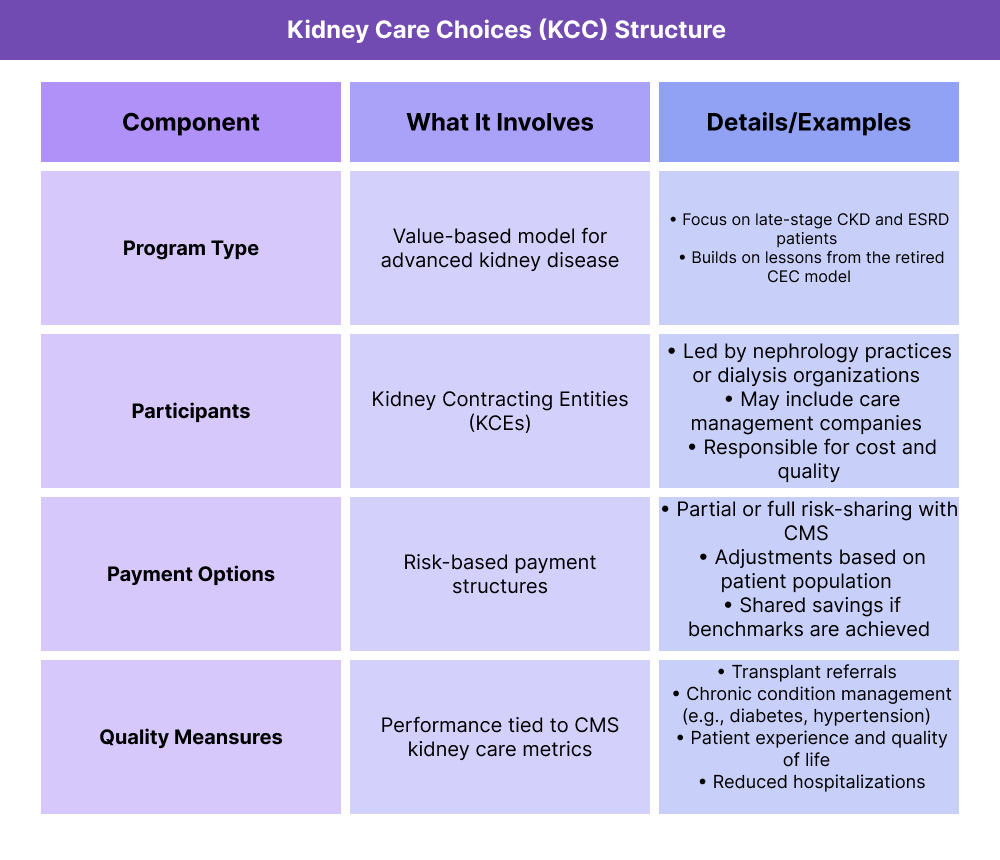
Key Components of Kidney Care Choices (KCC)
How the Kidney Care Choices (KCC) Model Works
The KCC Model brings together nephrology practices, dialysis facilities, and care management organizations to coordinate care for patients with advanced kidney disease. CMS sets spending benchmarks and evaluates participants on quality and cost performance.
- Focuses on patients with late-stage chronic kidney disease (CKD) and ESRD
- Encourages earlier intervention and smoother transitions to dialysis or transplantation
- Promotes care coordination across nephrologists, primary care, and dialysis providers
What Participants of KCC Do
Participants in KCC form Kidney Contracting Entities (KCEs) that take on responsibility for cost and quality.
- Nephrology practices and dialysis organizations lead most KCEs
- Care management companies may also participate
- KCEs create care plans, coordinate services, and report outcomes to CMS
Payment Options in Kidney Care Choices (KCC)
KCC offers risk-based payment structures that reward participants for meeting quality and cost benchmarks.
- Options for partial or full risk-sharing with CMS
- Adjustments based on patient population characteristics
- Opportunities for shared savings if benchmarks are met
What Quality Measures Are Used in KCC
CMS ties performance to specific quality metrics that reflect kidney care best practices.
- Timely referral for transplant evaluation
- Management of comorbid conditions like diabetes and hypertension
- Patient experience and quality of life reporting
- Reduced hospitalizations and avoidable complications
How the Kidney Care Choices (KCC) Model Works in Practice
The Kidney Care Choices model follows a defined process that begins with provider participation and ends with reconciliation of costs and quality performance against CMS benchmarks.
Step 1 — Organizations Apply to KCC
Eligible participants include nephrology practices, dialysis facilities, and care management organizations. These groups form Kidney Contracting Entities (KCEs) that apply to CMS to join the model.
Step 2 — Beneficiaries Are Aligned to KCC
Patients with advanced chronic kidney disease (CKD) or end-stage renal disease (ESRD) are attributed to participating KCEs. Alignment is based on where patients typically receive kidney care services.
Step 3 — Benchmarks and Risk Tracks Are Established
CMS sets financial benchmarks for each KCE based on historical data and patient risk profiles. Participants choose partial or full risk-sharing arrangements.
Step 4 — Care Is Coordinated Across Settings
KCEs implement care management strategies to improve outcomes.
- Care plans for CKD and ESRD patients
- Coordination with primary care and specialty providers
- Patient education and support services to delay progression
Step 5 — Performance Is Evaluated and Reconciled
At year-end, CMS reviews spending against benchmarks and evaluates quality performance.
- KCEs share in savings if costs are below benchmarks and quality is maintained
- KCEs may owe repayments if costs exceed benchmarks under risk-bearing arrangements
Relationship Between Kidney Care Choices (KCC) and the Comprehensive ESRD Care (CEC) Model
What was the CEC Model?
The Comprehensive ESRD Care (CEC) Model was a CMS program launched in 2015 to test ACO-style coordination for dialysis patients. It created ESRD Seamless Care Organizations (ESCOs) to integrate dialysis centers and nephrologists.
What happened to CEC?
CEC ended in 2021. While it improved dialysis coordination, CMS sought a broader approach to include patients earlier in kidney disease progression and to expand participation.
How is KCC different from CEC?
- CEC: Focused solely on ESRD and dialysis facilities
- KCC: Includes both advanced CKD and ESRD patients, enabling earlier intervention
- Both: Value-based care models with risk-sharing and quality accountability
Billing & Reimbursement in Kidney Care Choices (KCC)
How Payments Flow in KCC
The Kidney Care Choices model operates on a population-based payment structure. CMS sets a financial benchmark for each Kidney Contracting Entity (KCE), and actual spending is measured against this benchmark.
- Payments are adjusted for patient risk and population characteristics
- Savings or losses are reconciled annually based on benchmark performance
- Incentives are tied to both cost control and quality outcomes
Risk Options in Kidney Care Choices
KCC participants can choose from different levels of financial accountability.
- Partial Risk: Shared savings and losses on total cost of care with limited downside exposure
- Full Risk: Greater opportunity for shared savings but higher repayment liability if costs exceed benchmarks
How KCC Providers Are Reimbursed
Providers participating in a KCE are paid through the entity’s internal agreements.
- Nephrologists and dialysis facilities may receive payments based on performance and shared savings
- Care management organizations may be compensated for delivering patient support services
- Reimbursement is structured to reward care coordination and proactive disease management
Beneficiary Cost-Sharing in KCC
Beneficiaries in KCC continue to face Medicare’s standard cost-sharing rules. However, coordinated care under KCEs may help reduce unnecessary services and out-of-pocket costs through better management of CKD and ESRD.
- Oversight and Reconciliation in Kidney Care Choices
- CMS requires KCEs to report both financial and clinical data.
- Annual reconciliation compares actual spending to benchmarks
- Quality performance must be demonstrated for shared savings eligibility
- CMS oversight ensures safeguards for patients with complex kidney disease needs
Quality & Equity Requirements in Kidney Care Choices (KCC)
Quality Measures in KCC
KCC participants must meet CMS quality standards to be eligible for shared savings. These measures are designed to ensure that cost reductions do not come at the expense of patient care.
- Timely referral for kidney transplant evaluation
- Effective management of comorbidities like diabetes and hypertension
- Patient experience and satisfaction reporting
- Reduced hospitalizations and avoidable complications
Equity Requirements in Kidney Care Choices
KCC incorporates equity elements to improve access for vulnerable kidney patient populations.
- Attention to underserved and high-risk groups within CKD and ESRD
- Reporting of demographic and clinical data to track disparities
- Care coordination requirements that address patient education, support services, and social needs
Safeguards for Beneficiaries in KCC
To protect patients with complex kidney conditions, CMS enforces beneficiary protections within the model.
- Patients retain freedom of choice in providers and dialysis facilities
- Transparency requirements ensure patients understand their care options
- Oversight mechanisms prevent stinting on necessary services in pursuit of savings
Frequently Asked Questions about Kidney Care Choices (KCC)
1. What is the Kidney Care Choices (KCC) Model?
The Kidney Care Choices (KCC) Model is a CMS value-based care program launched in 2022 to improve outcomes for patients with chronic kidney disease (CKD) and end-stage renal disease (ESRD). It builds on the retired CEC Model and expands support to earlier stages of kidney disease.
2. Who can participate in KCC?
Eligible participants include nephrology practices, dialysis facilities, and care management organizations. These groups form Kidney Contracting Entities (KCEs) that take responsibility for the cost and quality of care.
3. How are payments structured in KCC?
CMS sets a financial benchmark for each KCE. Participants share in savings if costs are below the benchmark and quality standards are met, or may face repayments if costs exceed benchmarks under risk-bearing arrangements.
4. How does KCC affect patients?
Patients aligned to KCEs receive more coordinated care, earlier interventions for CKD, and improved transitions to dialysis or transplant. Standard Medicare cost-sharing rules still apply, but better care management may reduce unnecessary costs.
5. What happened to the CEC Model?
The Comprehensive ESRD Care (CEC) Model ended in 2021. KCC was introduced as its successor, expanding the focus from ESRD-only to include advanced CKD patients and requiring broader participation from nephrology providers.
6. How does KCC fit into CMS’s value-based care strategy?
KCC is part of CMS’s broader effort to advance value-based care (VBC). It complements models like ACO REACH and supports programs such as Chronic Care Management (CCM) by promoting proactive, coordinated care for high-risk populations.
