

What is MA (Medicare Advantage) in Healthcare?
Medicare Advantage (MA) is an alternative to traditional Medicare in which private health plans contract with the Centers for Medicare & Medicaid Services (CMS) to deliver Part A and Part B benefits. Instead of receiving services directly from Medicare, beneficiaries enroll in an MA plan that provides coverage, often including prescription drugs and supplemental benefits.
For providers and healthcare organizations, Medicare Advantage is a central platform for testing innovation models like Value-Based Insurance Design (VBID) and supporting programs such as Chronic Care Management (CCM). MA also plays a major role in the broader shift toward value-based care (VBC), creating opportunities for Accountable Care Organizations (ACOs) and physician groups to participate in alternative payment structures.
Key Components of Medicare Advantage (MA)
How Medicare Advantage Works
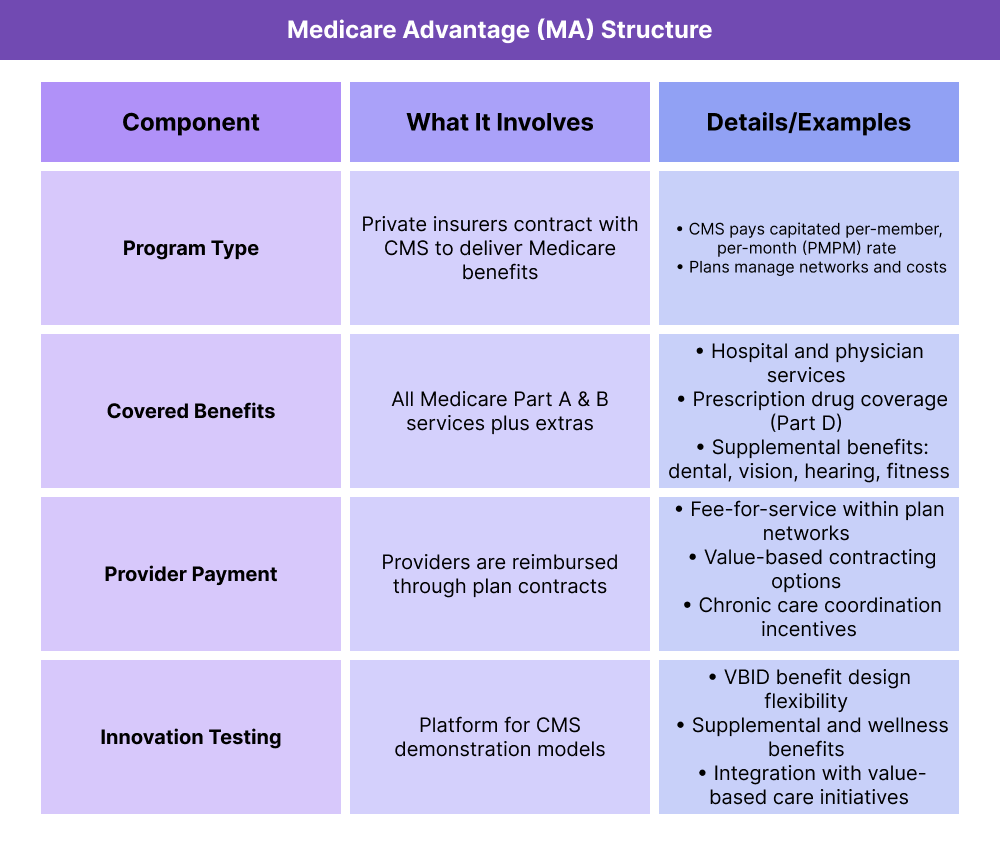
Medicare Advantage plans are offered by private insurers that contract with CMS to deliver Medicare benefits. CMS pays plans a capitated, per-member-per-month (PMPM) rate, and the plans manage costs, benefits, and provider networks.
- CMS sets regional benchmarks and risk-adjusted payments
- Plans assume financial responsibility for providing Medicare Part A and Part B services
- Beneficiaries enroll in a plan instead of traditional Medicare fee-for-service
What Benefits Are Covered in Medicare Advantage?
MA plans must cover all standard Medicare benefits, but they may also offer additional services.
- Hospital and physician services (Part A and B)
- Most include prescription drug coverage (Part D)
- Supplemental benefits such as vision, dental, hearing, and fitness
- Flexibility to add innovative benefits through models like VBID
How Providers Are Paid in Medicare Advantage
Providers in MA plans are reimbursed through plan contracts, not directly by CMS.
- Fee-for-service arrangements within the plan network
- Value-based contracts with incentives for quality and cost management
- Opportunities for care coordination and chronic disease management programs
How MA Supports Innovation Models
- CMS uses MA as a testing ground for new value-based care initiatives.
- VBID demonstration: varying benefits and cost-sharing to promote high-value care
- Integration of wellness, supplemental, and social support services
- Alignment with broader value-based care (VBC) efforts
How the Medicare Advantage (MA) Program Works in Practice
Medicare Advantage plans follow a defined process that starts with CMS contracting and ends with annual evaluation of plan performance.
Step 1 — CMS Contracts with Private Plans
Private insurers apply to CMS to offer Medicare Advantage plans. Approved plans agree to cover all Medicare Part A and Part B services.
Step 2 — Beneficiaries Enroll
Medicare beneficiaries choose to enroll in an MA plan instead of traditional Medicare.
- Enrollment typically occurs during annual open enrollment periods
- Plans may offer added benefits that attract specific populations
Step 3 — CMS Sets Payments
CMS pays participating plans a capitated, per-member-per-month (PMPM) amount, adjusted for region and risk profile of enrollees.
Step 4 — Care Delivered Through Provider Networks
MA plans contract with providers to deliver services to members.
- Fee-for-service rates within networks
- Alternative payment models and value-based arrangements for participating providers
Step 5 — Oversight and Quality Measurement
CMS evaluates MA plans annually using quality ratings and utilization metrics.
- Star Ratings based on preventive care, chronic condition management, and member experience
- Oversight ensures access, quality, and financial accountability
Billing & Reimbursement in Medicare Advantage (MA)
How Medicare Advantage Payments Flow
Medicare Advantage operates under a capitated payment model. CMS pays private insurers a fixed, per-member-per-month (PMPM) rate to cover all Part A and Part B services for enrolled beneficiaries.
- Payments are adjusted based on geographic benchmarks and beneficiary risk scores
- Plans take on financial responsibility for costs and care delivery
- CMS uses risk adjustment to account for enrollees with chronic or complex conditions
How MA Providers Are Reimbursed
Providers do not bill CMS directly under MA. Instead, they are paid through contracts with the Medicare Advantage plan.
- Fee-for-service rates negotiated between the provider and plan
- Value-based arrangements with shared savings or performance incentives
- Care coordination and chronic disease programs may carry added payments
How Medicare Advantage Beneficiaries Share Costs
Enrollees may face different out-of-pocket costs compared to traditional Medicare.
- Copays and coinsurance vary by plan design
- Many plans offer reduced cost-sharing for preventive and high-value services
- Supplemental benefits (e.g., vision, dental, hearing, fitness) may have separate cost structures
Oversight and Reconciliation in MA
CMS monitors financial performance and requires plans to report data on spending, utilization, and quality.
- Annual plan reconciliation adjusts payments based on actual risk scores and coding accuracy
- Plans must maintain network adequacy and nondiscrimination in benefit design
- Oversight ensures beneficiaries receive required services without barriers to care
Quality & Equity Requirements in MA
Quality Measures in Medicare Advantage
CMS evaluates Medicare Advantage plans annually through the Star Ratings system, which scores plans on clinical quality, preventive care, and member experience.
- Preventive screenings and vaccinations
- Chronic condition management outcomes
- Patient experience and satisfaction (CAHPS surveys)
- Hospitalizations, readmissions, and overall utilization patterns
Equity Requirements in MA
Medicare Advantage plans must ensure equal access to covered services and cannot discriminate based on health status or demographics. CMS has also expanded requirements for equity reporting.
- Plans must track disparities in access and utilization
- New rules encourage benefit designs that reduce barriers for underserved populations
- CMS is piloting equity-focused demonstrations within MA, such as targeted VBID models
Safeguards for MA Beneficiaries
To protect enrollees, CMS enforces strict oversight of Medicare Advantage organizations.
- Network adequacy standards to guarantee access to care
- Transparency requirements in plan marketing and benefit design
- Corrective action plans if quality or access standards are not met
Frequently Asked Questions about Medicare Advantage (MA)
1. What is Medicare Advantage (MA)?
Medicare Advantage (MA) is an alternative to traditional Medicare in which private insurers contract with CMS to deliver Part A and Part B benefits, often including prescription drug coverage and supplemental services.
2. Who can enroll in Medicare Advantage?
Any beneficiary eligible for Medicare Part A and Part B can choose to enroll in a Medicare Advantage plan during open enrollment periods, provided a plan is available in their area.
3. How do Medicare Advantage plans get paid?
CMS pays Medicare Advantage organizations a capitated, per-member-per-month (PMPM) amount, adjusted for risk and geography. Plans then manage costs, provider networks, and benefit design within this payment structure.
4. How does Medicare Advantage differ from traditional Medicare?
Traditional Medicare is fee-for-service, with beneficiaries using providers directly paid by CMS. Medicare Advantage shifts payment to private plans, which may offer additional benefits, different cost-sharing, and managed care networks.
5. What quality standards do Medicare Advantage plans follow?
CMS uses the Star Ratings system to evaluate MA plans on preventive care, chronic condition management, hospitalizations, patient experience, and overall utilization. Plans that score higher may receive bonus payments and attract more enrollees.
6. How does Medicare Advantage support innovation models?
CMS uses MA as a platform for testing new value-based care models, including the Value-Based Insurance Design (VBID) demonstration. MA plans can also pilot supplemental benefits like telehealth, nutrition, and transportation to improve care and reduce disparities.
