

What is Primary Care First (PCF)?
Primary Care First (PCF) is a voluntary CMS payment model launched in 2021 to strengthen primary care and improve patient outcomes. Designed as the successor to Comprehensive Primary Care Plus (CPC+), PCF gives participating practices flexible payment options and incentives tied to quality and cost performance.
Under PCF, practices receive a combination of population-based payments and performance-based adjustments rather than relying solely on fee-for-service. The model focuses on improving care coordination, patient access, and management of chronic conditions, while reducing avoidable hospitalizations and emergency visits.
PCF is recognized as an Advanced Alternative Payment Model (APM) under the Quality Payment Program (QPP), allowing qualifying participants to earn additional Medicare incentives for value-based care delivery.
Key Components of Primary Care First (PCF)
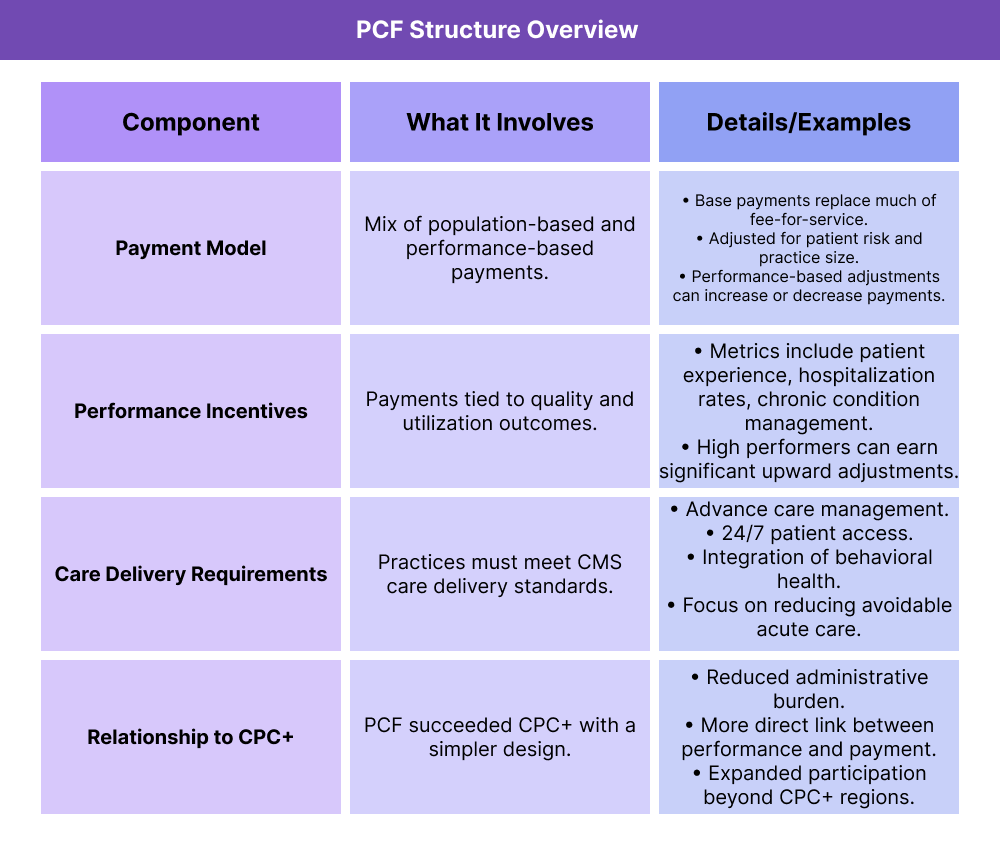
Primary Care First (PCF) builds on lessons from CPC+ but introduces a simpler payment structure and stronger financial incentives. It emphasizes population-based payments, quality-driven adjustments, and care delivery transformation in primary care.
What Is the PCF Payment Model?
PCF replaces much of traditional fee-for-service with population-based payments adjusted by patient risk, practice size, and performance outcomes.
How Are PCF Incentives Calculated?
Practices can earn upward or downward payment adjustments based on performance metrics, such as patient satisfaction, management of chronic conditions, and rates of avoidable hospitalizations.
What Care Delivery Changes Does PCF Require?
Participating practices must implement advanced functions like care management, behavioral health integration, 24/7 patient access, and proactive outreach to high-risk patients.
How Does PCF Differ from CPC+?
While CPC+ had two tracks with multiple payment elements, PCF simplified the approach: fewer payment streams, reduced administrative complexity, and stronger alignment between performance and financial rewards.
How the Primary Care First Model Works in Practice
Primary Care First (PCF) follows a structured workflow that begins with practice participation and continues through payments, care delivery, and performance evaluation.
Step 1 — Practice Application and Participation
Eligible primary care practices apply to CMS to join PCF. Practices must demonstrate readiness to adopt advanced primary care functions.
Step 2 — Base Payments Established
Practices receive population-based base payments instead of relying solely on fee-for-service billing. Payments are adjusted for patient risk, practice size, and other factors.
Step 3 — Care Delivery Transformation
Participating practices must implement advanced care delivery functions, including care management for high-risk patients, 24/7 access, behavioral health integration, and proactive outreach.
Step 4 — Performance Measurement
CMS evaluates practices using metrics such as patient experience, hospitalization rates, and chronic condition management.
Step 5 — Payment Adjustments
Based on performance, practices may receive upward or downward payment adjustments that directly impact revenue.
PCF and its Impact on Billing and Reimbursement
The Primary Care First (PCF) model shifts billing away from fee-for-service and toward population-based payments with performance adjustments. By tying revenue directly to quality and outcomes, PCF changes both how practices are paid and how they deliver care.
Population-Based Payments
- Practices receive monthly base payments per patient, replacing much of traditional fee-for-service billing.
- Payments are risk-adjusted to reflect patient complexity and practice characteristics.
Performance-Based Adjustments
- Practices earn upward or downward adjustments based on CMS metrics such as patient experience, hospital admissions, and chronic care management.
- High-performing practices can receive substantial financial rewards, while underperformers risk reduced payments.
Comparison to CPC+ and Fee-for-Service
- Fee-for-Service: Pays for each service delivered, incentivizing volume.
- CPC+: Combined care management fees, fee-for-service, and prospective payments.
- PCF: Simplifies payments with fewer streams, stronger performance-based adjustments, and reduced administrative burden.
Why PCF Matters in Billing and Reimbursement
PCF links primary care revenue directly to value and patient outcomes. As an Advanced Alternative Payment Model (APM), it also allows qualifying practices to earn a 5% Medicare incentive payment under the Quality Payment Program (QPP).
Frequently Asked Questions about PCF
1. What is PCF in healthcare?
Primary Care First (PCF) is a voluntary CMS payment model launched in 2021. It gives practices population-based payments and performance incentives to improve patient care and reduce costs.
2. How do PCF payments work?
PCF payments include a monthly base payment per patient plus performance-based adjustments. Payments are risk-adjusted for patient complexity and practice size, and may go up or down depending on quality results.
3. What are PCF care delivery requirements?
Participating practices must provide care management, 24/7 patient access, behavioral health integration, and proactive outreach to high-risk patients. These functions are designed to improve access and reduce avoidable hospitalizations.
4. How is PCF different from CPC+?
CPC+ used multiple payment streams across two tracks. PCF simplified the structure with fewer payment types, reduced administrative burden, and stronger performance-payment links.
5. Is PCF an Advanced APM?
Yes. PCF qualifies as an Advanced Alternative Payment Model (APM) under the Quality Payment Program (QPP). Eligible participants can earn a 5% Medicare bonus payment for meeting program criteria.
