

What Is POLST (Physician Orders for Life-Sustaining Treatment)?
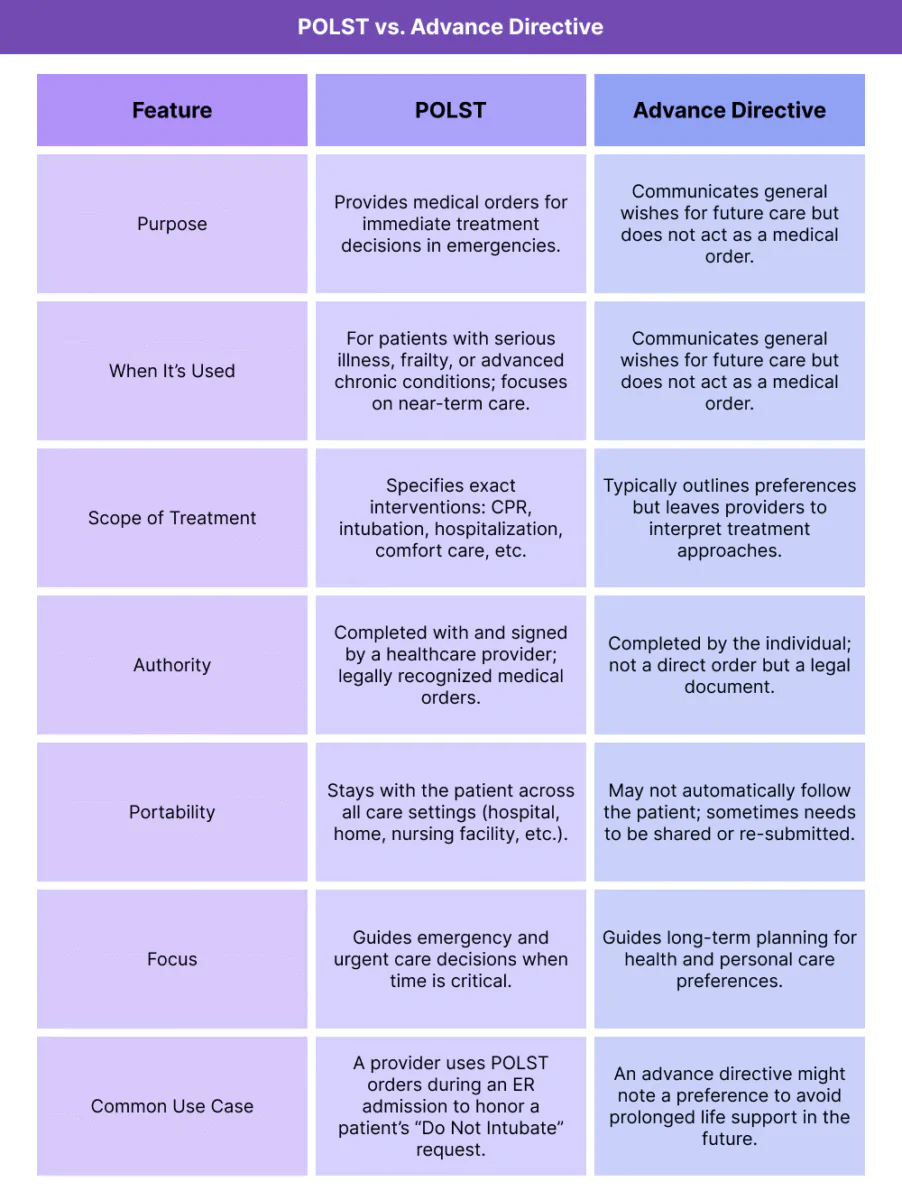
A POLST (Physician Orders for Life-Sustaining Treatment) form is a medical order designed to communicate a patient’s preferences for critical care in the event of a serious illness or emergency. Unlike an advance directive, which outlines general wishes for future care, a POLST provides actionable, signed medical orders that guide healthcare providers in real time.
POLST forms are typically used for patients with serious or life-limiting conditions, such as those managed by CCM and PCM programs, and help ensure that care delivered aligns with the individual’s goals, whether that means full treatment, limited interventions, or comfort-focused measures.
Key Components of a POLST Form
A POLST Form must include the following key elements:
- Patient Eligibility — Intended for patients with serious illness, frailty, or advanced chronic conditions.
- Medical Orders — Specifies treatment choices for CPR, intubation, hospitalization, and other interventions.
- Provider Signature — Must be signed by a physician, nurse practitioner, or physician assistant to be valid.
- Portability — Travels with the patient across care settings, ensuring preferences are respected by all providers.
- Advance Care Integration — Complements, but does not replace, advance directives.
How POLST Works in Practice
POLST forms are designed for patients with serious illness, advanced frailty, or limited life expectancy. Unlike advance directives, which focus on long-term planning, POLST forms provide specific medical orders that guide healthcare providers during emergencies and acute care situations.
Example Scenario
- Patient Context: A patient with advanced heart failure has a POLST indicating “Do Not Intubate” and “Comfort Measures Only.”
- Provider Action: When the patient is transported to the ER, the POLST form immediately informs the emergency care team, helping them honor the patient’s treatment preferences without delay.
- Outcome: Care is aligned with the patient’s wishes while avoiding unnecessary procedures and hospital transfers.
POLST forms are widely used across hospitals, nursing facilities, home health programs, and hospice care to ensure consistent, preference-driven treatment.
Billing and Reimbursement for POLST Forms
Completing a POLST Form itself is not directly billable. However, the conversations required to prepare a POLST — discussing a patient’s treatment preferences, goals of care, and life-sustaining interventions — are often billable under Advance Care Planning (ACP) codes.
Relevant CPT Codes
- CPT 99497 — Covers the first 30 minutes of face-to-face advance care planning, including discussion of POLST or similar forms.
- CPT 99498 — Add-on code for each additional 30 minutes of ACP services.
These codes apply when providers engage in documented discussions with patients (or their surrogates) about:
- Preferences for resuscitation and intubation
- Goals of care for advanced or terminal illness
- How to complete or update a POLST or advance directive
Practical Considerations
- ACP services must be voluntary and patient-driven.
- Time-based billing requires accurate documentation of the discussion.
- Some payers require patient consent or special modifiers for ACP codes.
- POLST-related discussions often take place during Annual Wellness Visits (AWV) or chronic care management planning.
Tip for Providers: A POLST does not replace an advance directive, but the ACP codes allow providers to be reimbursed for helping patients document their wishes in either or both forms.
Frequently Asked Questions about POLST Forms
1. What is a POLST Form?
A POLST Form is a medical order that documents a patient’s treatment preferences for life-sustaining care, such as resuscitation, intubation, and hospitalization. It is designed for patients with serious illnesses or advanced frailty and helps ensure that care aligns with their wishes during emergencies.
2. How is a POLST different from an advance directive?
An advance directive communicates general care preferences for the future but does not function as a medical order. A POLST, by contrast, contains specific, actionable instructions signed by a clinician that guide real-time care decisions in emergencies. Many patients choose to have both documents for comprehensive planning.
3. Who can complete and sign a POLST Form?
A POLST Form is typically completed by a patient or their representative in collaboration with a healthcare provider. It must be signed by a licensed clinician — usually a physician, nurse practitioner, or physician assistant — to be valid.
4. Is completing a POLST billable?
Completing the POLST form itself is not directly billable. However, the discussion that informs a patient’s choices may be billed under Advance Care Planning (ACP) codes:
- CPT 99497 for the first 30 minutes of ACP
- CPT 99498 for each additional 30 minutes
5. Do I still need an advance directive if I have a POLST?
Yes. A POLST is designed for immediate medical decisions in urgent or end-of-life scenarios, while an advance directive serves as a broader planning tool for situations where POLST may not apply. Many providers recommend having both documents.
6. Does a POLST Form travel with the patient?
Yes. POLST Forms are portable and follow patients across care settings — from home to hospital to nursing facility — ensuring that treatment preferences are honored consistently.
