

What is Medical Decision Making (MDM)?
Medical Decision Making (MDM) is a critical component of healthcare documentation and billing that reflects the complexity of a provider’s clinical judgment. It’s one of the key criteria used to determine Evaluation and Management (E/M) service levels in outpatient and inpatient care. MDM captures the thought process behind diagnoses, treatment plans, and risk assessments — and plays a central role in CPT code selection under CMS and AMA guidelines.
Key Components of RVU in Healthcare
RVUs are built from several weighted factors that reflect the effort, cost, and risk involved in delivering a healthcare service.
- Work RVU (wRVU): Captures the provider’s time, skill, and effort
- Practice Expense (peRVU): Reflects clinical overhead like staff, space, and supplies
- Malpractice RVU (mpRVU): Accounts for the cost of liability coverage
- Geographic Adjustment: Modifies payment based on location-specific cost differences
Each component helps determine what a provider gets paid for delivering care.
How Medical Decision Making Works in Practice
Medical decision making isn’t just a billing category — it’s a structured way of reflecting a provider’s clinical reasoning during a patient visit. Each element of the MDM level ties directly to what the provider evaluated and how they made care decisions.
Here’s how it works in a typical outpatient setting:
- A physician sees a patient for new-onset chest pain.
They order an EKG and lab tests, consider differential diagnoses like angina vs reflux, and prescribe a short-term beta blocker. This scenario includes:- A new problem with uncertain prognosis
- Moderate data complexity (labs and diagnostics)
- Moderate risk due to prescription drug management
This qualifies as a moderate MDM level.
- Another provider sees a patient with stable hypertension and renews medication.
- No new tests or decisions are made, and no management changes occur.
This would be considered low or even straightforward MDM.
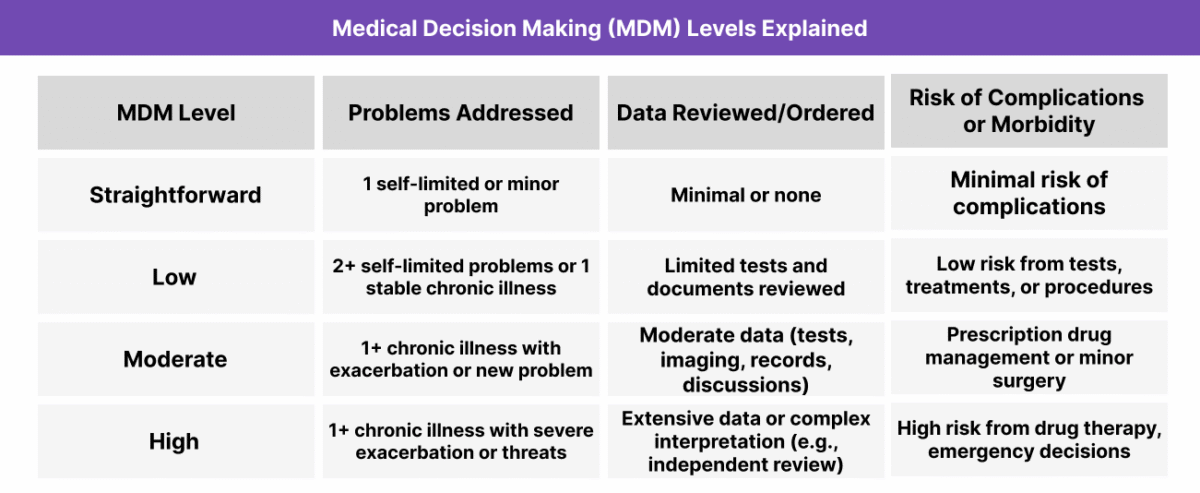
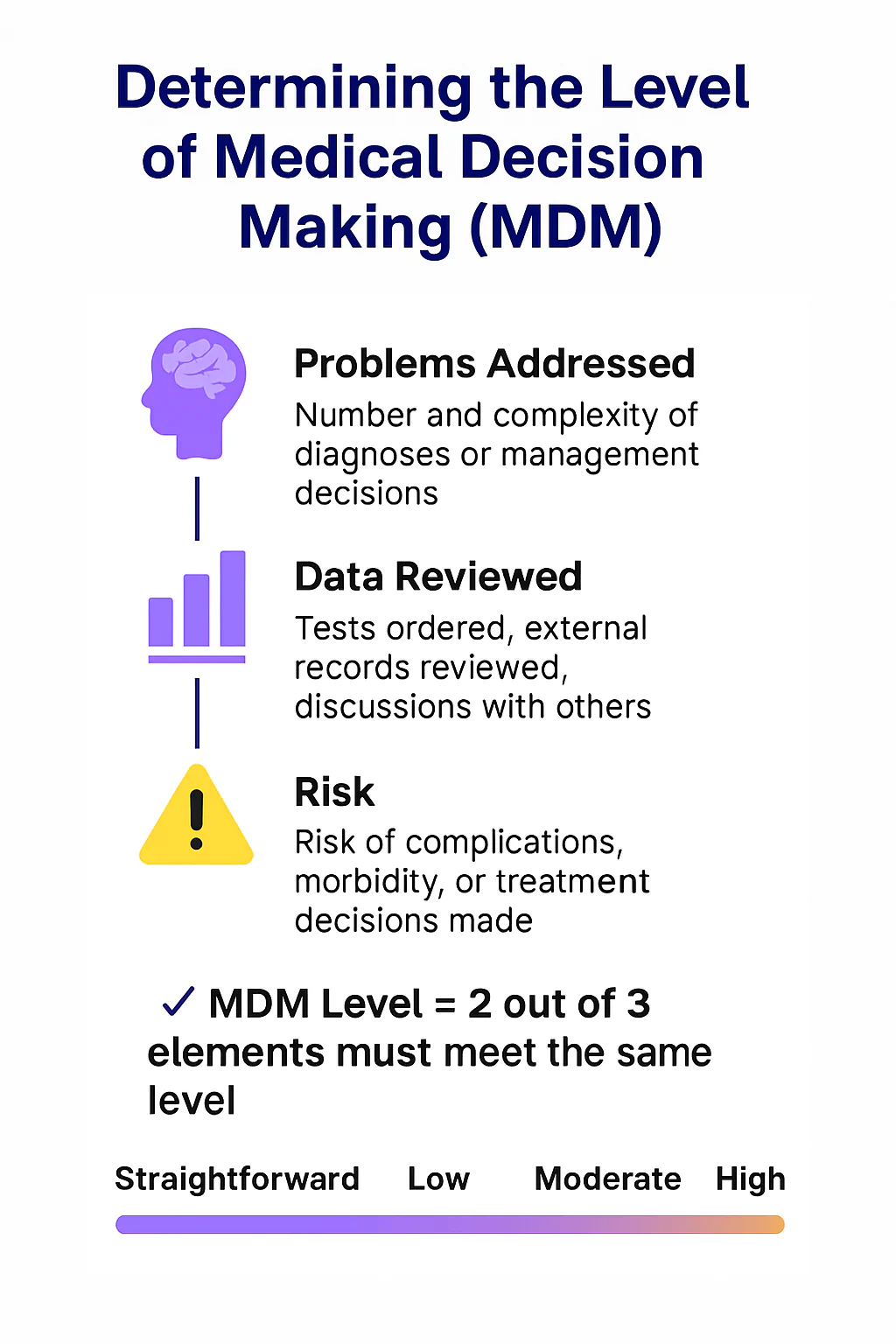
MDM levels guide how CPT codes (such as 99213 vs 99214) are chosen for evaluation and management (E/M) services. The provider doesn’t have to check every box — the two out of three rule applies: if two of the three elements (problem complexity, data reviewed, and risk) meet a level, that’s the level you report.
How Medical Decision Making Affects Billing and Reimbursement
Medical Decision Making (MDM) plays a central role in determining the level of service billed for outpatient and office-based Evaluation and Management (E/M) visits. Since the 2021 CMS and AMA guidelines update, MDM is now the primary factor used to assign CPT code levels for many E/M services, especially when time is not the controlling element.
Under this framework, the complexity of the MDM—based on diagnoses, data reviewed, and risk—directly determines which E/M CPT code is reported. For example, CPT 99484, which is used to bill for Behavioral Health Integration (BHI) services, includes MDM as a required component. Providers must document clinical decision-making tied to the patient’s mental health needs, medication management, and coordination with psychiatric consultants. This underscores how MDM serves as more than just a billing criterion—it reflects ongoing clinical reasoning in care delivery.
Correctly assigning the appropriate MDM level ensures compliant billing and optimal reimbursement. Over-documentation or under-documentation can result in either denials or lost revenue. Many payers and auditors now prioritize MDM documentation during post-payment reviews and audits.
Tip for Providers: MDM-based billing removes the need for counting physical exam or history elements. Focus your documentation on clear problem assessment, diagnostic reasoning, risk evaluation, and any relevant data interpretation to justify code selection.
Frequently Asked Questions about Medical Decision Making (MDM)
1. What is medical decision making (MDM)?
Medical Decision Making (MDM) refers to the complexity of clinical judgment used by a healthcare provider to assess, diagnose, and manage a patient’s care. It’s a key factor in determining the appropriate Evaluation and Management (E/M) service level for billing purposes.
2. What are the levels of MDM?
There are four official MDM levels:
- Straightforward
- Low
- Moderate
- High (Complex MDM)
Each level is based on three elements: the number and complexity of problems addressed, the amount and complexity of data reviewed, and the risk of complications or treatment.
3. How is MDM used in medical coding?
In MDM coding, the provider’s documentation is reviewed to determine which CPT code best fits the visit’s complexity. Since the 2021 E/M guideline updates, MDM has replaced history and physical exam requirements as the primary coding factor for many outpatient visits.
4. What is an E/M MDM table, and do I need one?
An E/M MDM table outlines the criteria used to assign MDM levels, breaking down how each of the three components contributes to the final code level. While providers don’t need to submit the table itself, understanding it helps ensure accurate coding and compliance.
5. What is complex MDM, and when does it apply?
Complex MDM (also known as high-complexity MDM) applies when the provider is managing a patient with a serious condition, multiple comorbidities, or a high risk of complications. It often involves extensive data review and coordination of care.
6. Is medical decision making used in care management codes like BHI or CCM?
Yes. While MDM is not the primary driver in all care management codes, certain services—such as CPT 99484 for Behavioral Health Integration (BHI)—require documentation of clinical decision-making and care coordination, making MDM an embedded component.
7. Does MDM determine reimbursement rates?
Indirectly, yes. Since MDM guides the selection of CPT codes for E/M services, it impacts the reimbursement rate associated with those codes. Higher MDM levels generally correspond to higher reimbursement when properly documented.
